
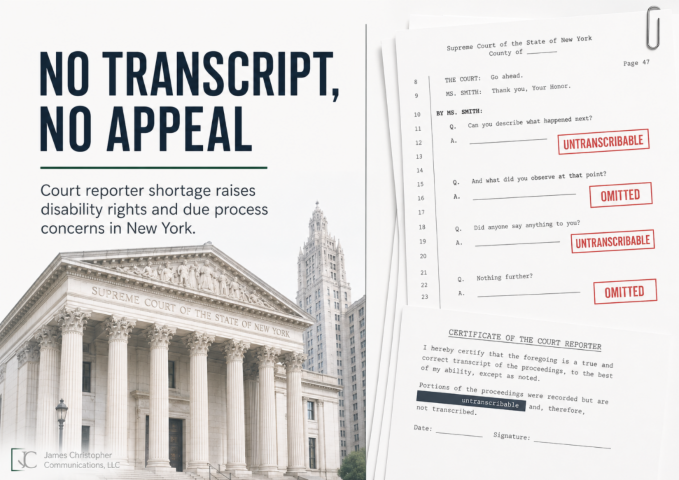
| ‘No Transcript, No Appeal’: National data shows the number of U.S. court reporters has fallen by 21 percent over the past decade |
| A national shortage of court reporters is raising urgent due process and disability-rights concerns in New York, where missing or defective transcripts are leaving litigants unable to challenge court rulings, protect appellate rights, or meaningfully access the justice system. Courts rely on certified court reporters and official transcripts to create the record used in appeals. But when that record is delayed, incomplete, or unavailable, defendants, parents, tenants, people with disabilities, and other litigants can be unable to challenge trial-court decisions, even when serious legal errors may have occurred. The issue is especially acute for disabled litigants Disabled individuals often solely rely on accurate transcripts, written records, real-time transcription, digital access, and other accommodations to understand proceedings and preserve their rights. For individuals with auditory, cognitive, neurological, or communication-related disabilities, a transcript is not simply paperwork, it’s a civil rights issue. National data shows a growing problem for accessible appeals for justice. A 2025 court reporting industry report found that the number of stenographers in the United States has declined by 21 percent over the past decade, driven by retirements, an aging workforce, and too few new entrants into the profession. The crisis has reached state high courts from the West Coast to the East Coast. In the Golden State, the California State Supreme Court is considering whether a law prohibiting electronic recording of many civil proceedings is unconstitutional when no court reporter is available and a litigant cannot afford a private reporter. New York now has its own warning sign. In People v. Meyers, decided May 26, 2026, the New York Court of Appeals reviewed a criminal conviction after a court stenographer failed to capture substantial portions of the trial record and repeatedly inserted phrases such as “blah blah blah,” “omitted,” and “untranscribable” instead of the words actually spoken. Missing portions included three full days of jury selection, opening statements, summations, jury instructions, jury notes, and the verdict. The Court called the transcript failures “utterly inexcusable,” but held that, in that case, a reconstruction hearing was sufficient to protect the defendant’s due process right to appeal. The ruling raises a broader question for appellate cases across New York: what happens when the missing record cannot be meaningfully reconstructed? Marc Fishman, a disabled Westchester father of four and disability-rights advocate, said that question is now central to his own attempted appeal. In a recent request to a retired court reporter, Fishman sought transcripts from New Rochelle City Court appearances on Dec. 17, 2018, and Jan. 8, 2019, writing that the inability to obtain them “for years has inhibited and delayed my appeal.” Fishman said the missing transcripts are not merely a technical delay, but a barrier to meaningful appellate review. He added that reconstruction may be difficult because multiple individuals connected to the proceedings — including judges, attorneys, prosecutors, and police officers — are no longer in their original roles. “New York cannot tell a disabled litigant that the remedy is an appeal while the record needed for that appeal remains unavailable,” Fishman said. “If the transcript cannot be produced, and the people needed to reconstruct the record are gone, then the state has to explain what remedy exists.” Fishman, who has publicly discussed his disabilities and medical conditions, said accurate transcripts are often essential accommodations for people with cognitive, neurological, or auditory impairments. “When courts fail to preserve the record, disabled litigants are often the first to lose access,” Fishman said. “For someone with cognitive or auditory disabilities, a transcript can be the accommodation that makes due process possible.” The transcript issue reflects a broader accountability challenge in New York courts. When records cannot be produced or reconstructed, there is often no clear public process to determine whether affected cases should receive additional review, the National Center for State Courts says. “A complete and reliable record is fundamental to appellate review and public confidence in the courts,” said a spokesperson for the National Center for State Courts in discussing nationwide court staffing challenges. “When critical court personnel are unavailable, the effects can ripple throughout the justice system.” Fishman joins a growing roster of civil rights groups, court accountability organizations, and legal experts calling for greater statewide attention to court reporter shortages. transcript preservation, digital record access, and emergency procedures to protect appellate rights. |