
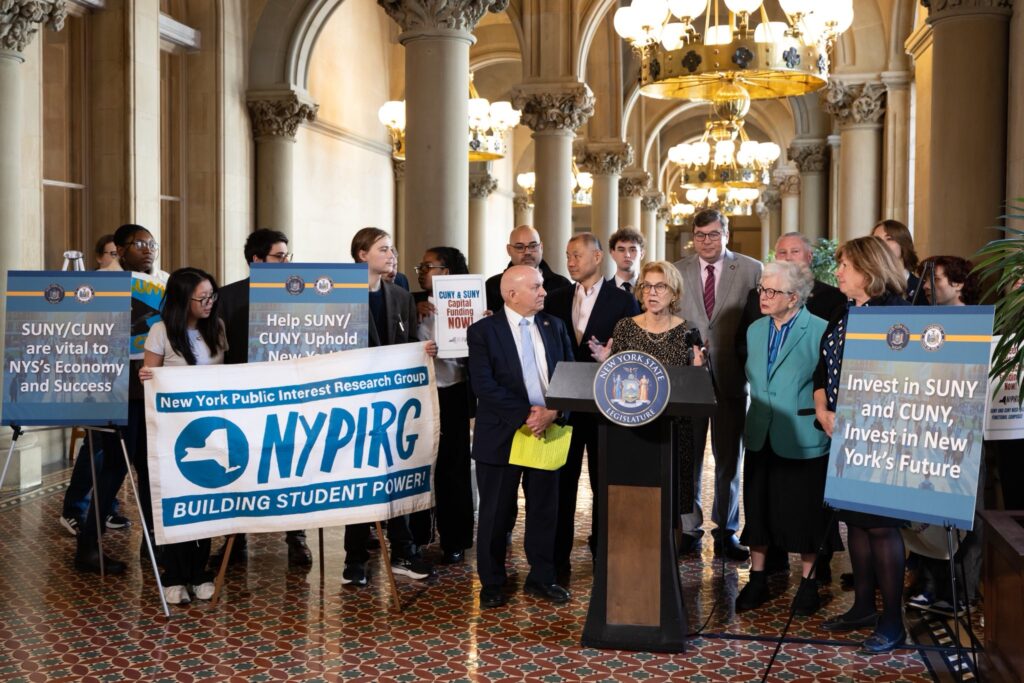
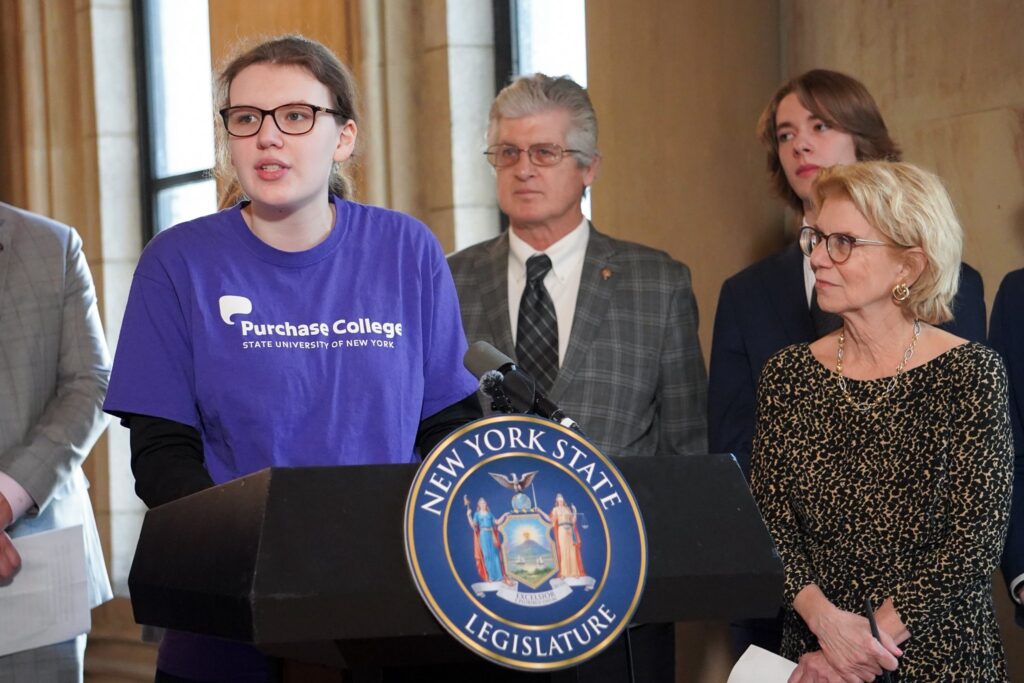
On Tuesday, March 24, Senator Shelley Mayer and Assemblymember Chris Burdick hosted a press conference with colleagues and advocates calling for critical capital funding for SUNY and CUNY in the final State Budget. They were joined by Lucas Pastwik, Student Association President at SUNY Geneseo and Caucus Chair for the SUNY Student Assembly; Santos Rodriguez, Chief of Staff for the Building and Construction Trades Council of Greater New York; and Julia Wojcik, a SUNY Purchase student, student government senator, and education intern with the New York Public Interest Research Group (NYPIRG).
Senator Mayer and Assemblymember Burdick were also joined by Chair of the Senate Higher Education Committee, Senator Toby Ann Stavisky, as well as Senators Patricia Fahy, Michelle Hinchey, John C. Liu, Lea Webb, and Jeremy Zellner, and Assemblymembers Marrianne Buttenschon, Christopher Eachus, Anna Kelles, Dana Levenberg, John McDonald, Karen McMahon, Kwani O’Pharrow, Steve Otis, Amy Paulin, Tommy John Schiavoni, Jo Anne Simon, MaryJane Shimsky, and Al Taylor.
SUNY and CUNY systems are among the country’s finest public higher education institutions and play a vital role in our state’s economy. However, the campuses are long overdue for many much-needed repairs across campuses across the state.
SUNY’s infrastructure crisis is both urgent and growing. According to a SUNY maintenance investment report, 45 percent of SUNY’s physical assets are rated poor or very poor, and 30 percent of its core infrastructure systems have exceeded their useful lives and are failing at increasing rates – causing emergencies and disruptions across campuses. Over the past five years alone, campus emergencies have surged by 200 percent in frequency and nearly 600 percent in cost, underscoring the growing strain on students and institutions alike. In just one week in January 2026, at least four SUNY campuses were forced to declare emergencies due to aging and failing equipment.
SUNY Purchase, represented by Senator Mayer and Assemblymember Burdick, is facing severe and worsening infrastructure challenges that pose real risks to student and faculty safety. Aging water mains, deteriorating pipes, and outdated drainage systems have led to ruptures on campus, underscoring the system’s fragility and the growing threat of flooding in academic and residential spaces. At the same time, failures in the campus’s aging heating infrastructure have left nearly 200 students without heat during the winter, forcing the college to secure alternative housing. Most recently, a temporary boiler failure forced a campus-wide heating outage across academic buildings, pushing classes online for several days and significantly disrupting instruction. These repeated disruptions underscore the urgent need for sustained capital investment to ensure a safe, reliable, and uninterrupted learning environment.
State Senator Shelley Mayer said, “I am proud to stand with my colleagues, advocates, and our partners in labor to fight for increased capital funding in this year’s final New York State budget for SUNY and CUNY. These institutions are so important to our state – serving students from every corner of New York and out of state students – and we have an obligation to ensure they have the resources they need to succeed. As infrastructure continues to deteriorate and extreme weather places additional strain on our systems, the need for meaningful investment has never been more urgent. SUNY Purchase, which I am proud to represent, has had to shut down in person classes and relocate students due to infrastructure. The students and faculty deserve better, and we can do better. We must act now to ensure that students, faculty, and staff can learn and work in safe, reliable environments.”
Assemblymember Chris Burdick said, “New York State has one of the finest public higher education systems in the country, and we don’t want to let that sterling reputation be tarnished due to insufficient attention to critical maintenance. The SUNY system faces a backlog of nearly $10 billion in deferred maintenance. The state of disrepair is alarming. In the Fall 2025 semester, students at Buffalo State did not have hot water for a three-week period due to a failure of aging infrastructure. Earlier this year, students at SUNY Purchase were forced to temporarily relocate after one of their dorms lost heat amid single-digit temperatures. These system breakdowns prompted me to work with the Chancellor’s office to cost out a system-wide critical maintenance increase, and we are calling on our colleagues in the Legislature to join us in advocating for this crucial funding.”
Gary LaBarbera, President of the New York State Building Trades said, “SUNY and CUNY campuses throughout the state serve as critical economic and education hubs for students, workers, and local community members in New York, and it is critical that we remain committed to maintaining and improving their infrastructure. The capital projects made possible with additional funding will not only heighten the experience of attending or teaching at these schools but also create thousands of family-sustaining union careers that will grant more hardworking tradespeople the opportunity to pursue the middle class. Institutions of higher education are a key part of the state’s economy and investing in their development benefits New Yorkers across the board.”
Julia Wojcik, SUNY Purchase student NYPIRG intern, said, “After a semester of incidents of no heat, burst pipes, and class disruptions across SUNY and CUNY, students are demanding that expanded critical maintenance funding be included in the final state budget. We are proud to stand with Senate and Assembly representatives who are fighting for this expanded funding. New York students deserve a quality learning environment, with no disruptions, which would be made possible with increased funding.”
You can watch the full press conference here. Video courtesy of New York State Senate Media Services.