By Deborah Blatt
Clothing insecurity in Westchester County continues to grow, and the combination of inflation and federal cuts to social services will exacerbate it further. At The Sharing Shelf, the nonprofit Clothing Bank that I founded to serve children and youth in need in Westchester, requests for clothing grew 25% in the first 10 months of 2025 compared to the same period last year. In more stark terms, 7,554 children and teens needed clothing from The Sharing Shelf.
As demand grows, the need for more donations grows alongside it. Each child we serve receives a Wardrobe Pack – a week’s worth of seasonally appropriate clothing matched to the child’s size. The increase in children facing clothing insecurity means that we need that much more clothing, including new socks, underwear, diapers, shoes and, in the winter, coats, boots, hats, and gloves. This makes it all the more important that Westchester residents understand both where donated clothing goes and why it matters.
The growth in clothing insecurity and our response is why The Sharing Shelf hosted in late October a luncheon and panel discussion – titled “‘Wear’ is it all going? The face of clothing insecurity in Westchester.” We brought together leaders from nonprofits and schools working with economically vulnerable families in Westchester to address the topic. Clothing insecurity and its impact on children are overlooked in Westchester, which is known for its wealth, yet 67,000 children and teens live in poverty or a low-income home in the county.
Our featured panel members included Debbie Burrell-Butler, Executive Director of the Mount Vernon Youth Bureau; Jirandy Martinez, Executive Director of the Community Resource Center in Mamaroneck; Tiffany Nagorny, School Social Worker at the Dr. Kenneth B. Clark Academy in Dobbs Ferry, and Sam Wallis, CEO of Yonkers Partners in Education. The panel was moderated by Tony Aiello, the Emmy Award-winning reporter for CBS News New York.
The panel members explained from different perspectives the importance of providing children and teens with clothing – and not just clothing itself but clothing that is clean, age- and season-appropriate, plus essentials like underwear and socks, as well as shoes that fit and allow the child or teen to participate in gym or join a team.
All panelists explained powerfully how important it is for children to have age-appropriate, season-appropriate, properly fitting clothing that is suitable to a particular activity and makes the child or youth feel comfortable. Sam Wallis spoke of the “imposter syndrome” that many clients face when they arrive for the first year of college, without the right clothing, shoes, and coat to blend in on campus. Debbie Burrell-Butler’s teens almost lost out on a job training program, because the girls lacked work-appropriate attire, until they shopped at Teen Boutique, The Sharing Shelf’s free store.
Having the wrong clothing is proven to undermine a child’s confidence, performance in school, and even attendance at school. It is also frequently the subject of bullying. We know this because our partners have told us. Just step outside yourself for a moment and imagine how you would feel showing up week after week in middle school without sneakers for gym, repeatedly ridiculed by your peers or penalized by your teacher. Think how you would feel on picture day, if your only clean shirt was missing buttons and your pants were “high waters.”
Gently used clothing, carefully screened for quality and cleanliness, can address this critical need. But it’s vital to understand where your donated clothing goes, and it’s not as obvious as one may think.
There are numerous options to donate one’s clothing: from parking lot bins to trucks that pick up donations to nationally branded thrift shops. Many well-intentioned nonprofit organizations accept donated clothing; however, it’s important to know that almost all sell that clothing to support their missions. The clothing is not directed to the children and families who need it.
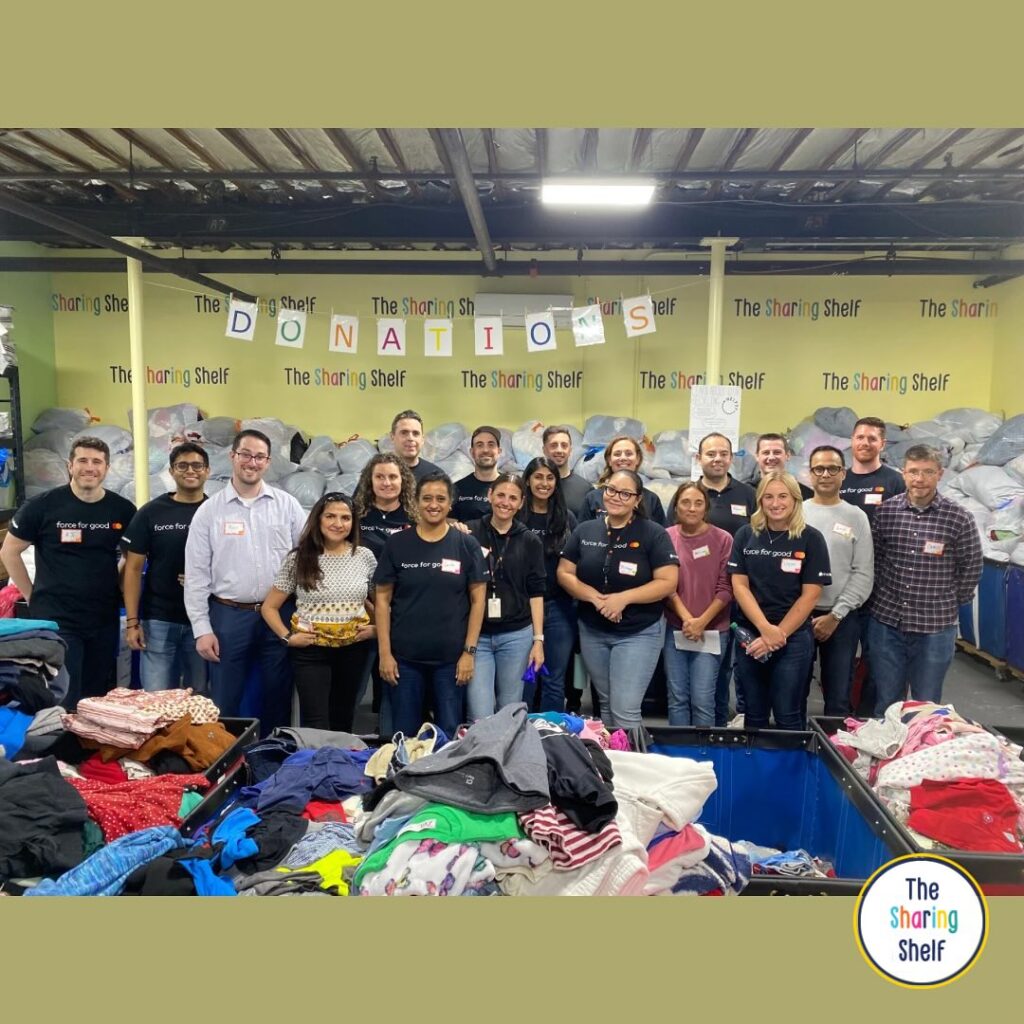
That’s why nonprofit Clothing Banks, like The Sharing Shelf, are so important. We accept new and gently used clothing for children and youth. We sort it by quality – rooting out stained and damaged items – and then by size, season, and gender. Nonprofits, schools, and government agencies place requests with us, identifying those children who face clothing insecurity. Our staff and volunteers combine donations of used clothing with strategic purchases of new items to ensure that we have everything required, at the right time, to provide clothing through our partners to the children and teens who need it most.
The Sharing Shelf’s approach not only ensures that the needed clothing reaches the designated children and teens; it also ensures that they get the needed clothing at no cost. These children, in turn, are empowered to play and feel better about themselves, reducing the chances they will be ridiculed or bullied. The impact of that is immeasurable.
Current economic pressures, however, are especially challenging. As one of our partners reports, families note that “everything is so much more expensive now.”
As the need continues to grow, donations of new and gently used clothing to nonprofit Clothing Banks are crucial. If you are donating clothing, it’s always best to donate clothes that are suitable to the season ahead rather than the one that just ended.
Financial contributions, coupled or apart from clothing donations, are equally vital. Donated clothing is one piece of the puzzle, but certain items must be new like underwear, sneakers, socks, and diapers, and financial support allows us to fill that gap. Either way you will be making a donation that has profound impact, as you provide children and youth with tools for success, which can have a life-long impact of spectacular proportions.
The author is Founder and Executive Director of The Sharing Shelf, to which donations of clothing can be made at https://sharingshelf.org/get-involved/#donate-clothing.