
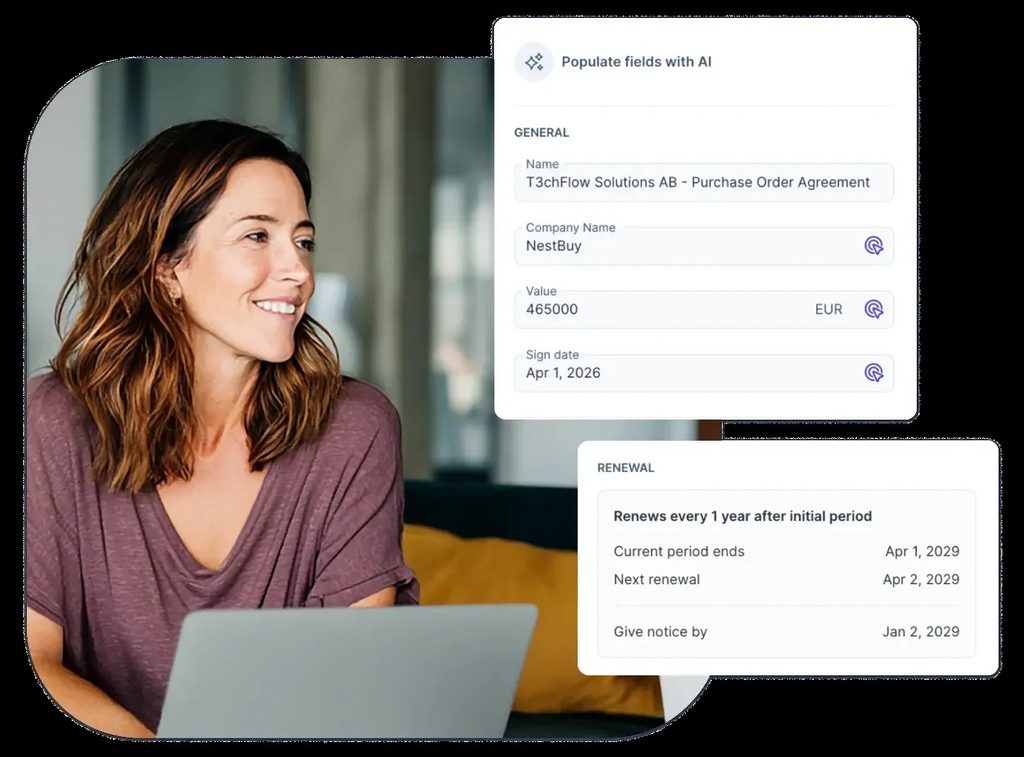
Managing agreements manually can create unnecessary delays, missed deadlines, and difficulties tracking important contract information. Contract management software gives businesses a centralized way to create, organize, negotiate, sign, store, and monitor agreements throughout their lifecycle. In 2026, modern platforms increasingly combine traditional contract management with automation, analytics, integrations, and artificial intelligence.
What Is Contract Management Software?
Contract management software is a digital platform designed to help organizations manage agreements from creation through renewal or expiration. Instead of storing contracts across email inboxes, local folders, and spreadsheets, businesses can maintain a structured repository where authorized users can find and manage documents.
Depending on the platform, functionality may include contract templates, document creation, approval workflows, collaboration tools, electronic signatures, automated notifications, reporting, renewal management, and AI-powered contract analysis.
The right solution depends on the organization’s contract volume, team size, compliance requirements, existing software ecosystem, and workflow complexity.
Why Businesses Need Contract Management Software in 2026
Contract processes often involve multiple departments, including sales, legal, procurement, finance, and operations. Without a centralized system, it can be difficult to determine who is responsible for a contract, which version is current, or when an agreement needs to be renewed.
Modern contract management platforms help address these challenges by centralizing documents and automating repetitive tasks. Automated reminders can alert teams about upcoming expiration dates and notice periods, while searchable repositories make it easier to locate agreements and relevant information.
AI is also becoming increasingly common, allowing organizations to extract important contract data and reduce manual review work.
The Role of Electronic Signatures
Contract management increasingly overlaps with electronic signature software, particularly during the final stages of negotiation and approval. Integrating signatures directly into the contract workflow can eliminate the need to download documents, print them, scan signed copies, and manually upload them again.
Modern platforms may support different types of electronic signatures, authentication methods, signing orders, audit trails, and automated reminders. For businesses operating internationally, it is also important to consider the electronic-signature regulations applicable to their markets.
A connected signing workflow can help keep the document lifecycle in one environment instead of moving contracts between multiple applications.
7 Best Contract Management Software for 2026
The following seven platforms represent different approaches to contract management. Their features, integrations, pricing models, and ideal use cases vary, so organizations should evaluate them against their own requirements.
1. GetAccept
GetAccept combines contract management with electronic signatures, proposals, digital sales rooms, and broader sales workflows. Its contract management functionality allows businesses to store and organize agreements, track key dates, and receive automated renewal reminders. The platform also offers AI Contract Management, which can extract relevant information from contracts and structure it for easier tracking.
GetAccept can also integrate contract workflows with CRM platforms, including Salesforce, HubSpot, Pipedrive, and other business systems. Its e-signature functionality supports different authentication and signature levels, including Advanced and Qualified Electronic Signatures.
2. DocuSign CLM
DocuSign is widely associated with electronic signatures, but its broader platform also includes contract lifecycle management capabilities. Businesses can use CLM functionality to manage contract creation, negotiation, approval, execution, and post-signature processes.
Its ecosystem can be particularly relevant for organizations that already use DocuSign for signing and want to extend their document workflows.
3. Ironclad
Ironclad focuses on digital contracting and contract lifecycle management. Its platform is designed to support workflows across legal, sales, procurement, and other departments.
Organizations can use it to automate contract requests, approvals, collaboration, and post-signature management while maintaining centralized visibility into agreements.
4. PandaDoc
PandaDoc combines document creation, proposals, quoting, electronic signatures, and contract-related workflows. Its interface is designed for teams that need to prepare commercial documents and send them for approval or signature.
The platform can be particularly relevant for sales teams that want document creation and signing capabilities connected to their broader sales processes.
5. Juro
Juro provides contract lifecycle management through a browser-based workspace. It focuses on creating, negotiating, approving, signing, and managing contracts in a centralized environment.
The platform can help teams reduce reliance on disconnected documents and email conversations by bringing stakeholders into a shared contract workflow.
6. ContractWorks
ContractWorks is designed to provide centralized contract storage, search, reporting, and management functionality. Its approach emphasizes visibility into existing agreements and important contractual information.
Businesses can use the platform to organize contracts, monitor dates, control access, and create reports without necessarily implementing a highly complex enterprise contract-management environment.
7. Agiloft
Agiloft provides configurable contract lifecycle management and workflow automation. Its platform can support contract creation, approvals, negotiations, repository management, compliance processes, and reporting.
Its highly customizable approach can be useful for organizations with complex contractual workflows that require specific rules, fields, and approval structures.
Key Features to Compare
When comparing contract management platforms, businesses should consider more than document storage. Important criteria include:
- Contract creation and templates
- Automated approval workflows
- Searchable contract repositories
- Version control
- Electronic signatures
- Renewal and expiration alerts
- AI-powered data extraction
- Reporting and analytics
- CRM and business-system integrations
- Access controls and audit trails
- Compliance and security features
Integration should receive particular attention. A contract platform that connects with existing CRM, ERP, procurement, or sales systems can reduce duplicate data entry and create a more consistent workflow.
How to Choose the Right Platform
The best way to select a solution is to start with the organization’s actual contract lifecycle. Map how agreements are created, reviewed, approved, signed, stored, renewed, and eventually archived.
Next, identify the most time-consuming manual activities. If the main problem is locating documents, repository and search capabilities may be the priority. If renewals are frequently overlooked, automated alerts may be more important. For organizations processing large numbers of agreements, AI-powered extraction and workflow automation may provide additional value.
Security should also be evaluated carefully. Look for encryption, authentication controls, access management, audit trails, and relevant regulatory certifications or compliance frameworks.
Conclusion
Contract management software has evolved beyond simple document storage. In 2026, businesses can choose platforms that combine contract repositories, workflow automation, electronic signatures, analytics, CRM integrations, and AI-powered capabilities.
GetAccept, DocuSign CLM, Ironclad, PandaDoc, Juro, ContractWorks, and Agiloft each take different approaches to managing contracts. The appropriate choice depends on contract volume, workflow complexity, integration requirements, security needs, and the specific processes an organization wants to automate. A structured evaluation based on these factors can help businesses build a more efficient and transparent contract lifecycle.