
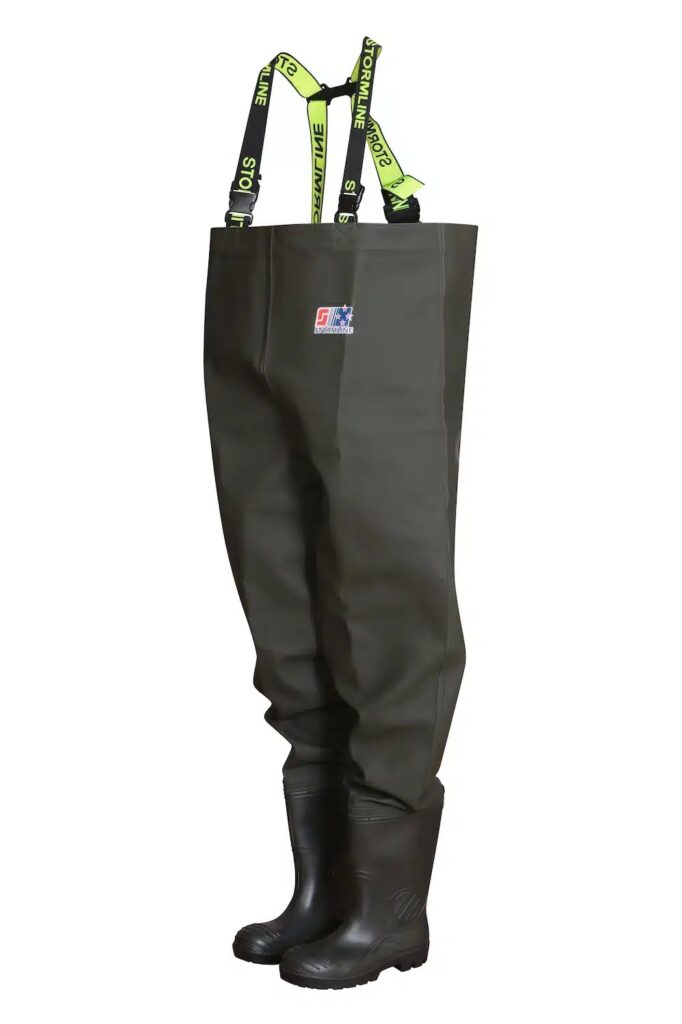
Discover why standard fishing waders fail on Yonkers drainage jobs. Learn the key differences between cheap consumer gear and heavy-duty industrial waders.
If you run a small contracting crew in Westchester, chances are you’ve done this at least once. You need waders for a culvert job or a flooded dig, so you pop into the nearest sporting goods shop and grab a pair for about $60. They look the part, they fit okay, and then three weeks later something rips or leaks and you’re back at square one. It’s a waste of money, and when gear fails mid-job, it’s a safety issue too.
The differences between fishing waders and commercial ones come down to four things: seams, shell thickness, boot construction, and chemical resistance.
Stitched Seams Are the First Thing to Go
Fishing waders are made for someone standing in a stream for a couple of hours. The seams are stitched with nylon or polyester thread, which works fine when you’re knee-deep in clean water and hanging them up to dry afterwards.
Drainage work is a different situation entirely. Those seams stay submerged for hours. The thread soaks up water, swells, and starts pulling at the needle holes. After a few shifts, you’ll notice dampness creeping up the inside of the leg, and within a fortnight the seams are letting water straight through.
Commercial-grade waders use welded seams instead. The material gets heat-bonded together, so there’s no thread and no needle holes. That one difference alone is why industrial waders can outlast fishing ones five times over.
Thin Nylon Won’t Survive a Job Site
Most fishing waders use nylon shells between 70 and 200 denier. That’s plenty for walking across a gravel riverbed, but on a construction site you’ve got rebar stubs, broken masonry, jagged concrete, old pipe fittings, and scrap metal everywhere. One catch on a bolt and the shell tears.
The material weight on industrial chest waders is measured in grams per square metre. Heavy-duty PVC options typically come in at 700gsm or even 1100gsm. Compare that to 150–200gsm on a standard fishing pair. You can tell the difference the moment you pick them both up, and you’ll really tell the difference after a week on site.
Boots That Offer No Real Protection
Fishing wader boots are soft rubber with felt or rubber soles. They’re designed for grip on river rocks, and that’s about it. There’s no steel toe cap, no reinforced sole, and nothing stopping a nail from going straight through.
On a drainage job, you’re stepping over debris, walking across broken ground, and sometimes working around heavy materials being moved nearby. A dropped fitting or one wrong step onto a nail can put someone in A&E. Industrial waders come with proper safety boots built in, usually with steel toe caps and steel midsoles.
Fuel, Solvents and Standing Water
This is the one that catches people out. Fishing waders aren’t designed for chemical exposure. The nylon and neoprene in consumer pairs will break down on contact with diesel, petrol, hydraulic fluid, solvents, and the contaminated standing water you’ll find in old storm drains.
It won’t happen overnight. The material softens, loses flexibility, and eventually cracks. PVC waders rated for industrial use are oil and chemical resistant by design, so they can actually handle what’s sitting in the water on your job site.
The Real Cost of Cheap Gear
A decent pair of fishing waders costs $50 to $80. If you’re replacing them every month or two, that’s $300 to $500 a season per crew member. A pair of heavy-duty industrial waders might run $250 to $350 upfront, but they’ll last multiple seasons if you look after them.
For a three-person crew, you’re looking at over $1,000 a year on throwaway gear versus a single purchase that actually holds up. And that doesn’t even account for the downtime and safety risks when gear fails mid-job.
Buy for the Job, Not the Hobby
Fishing waders do exactly what they’re supposed to do for anglers. But culvert repairs, storm drain work, shoreline stabilisation, and flooded excavations put gear through punishment that consumer products aren’t built for.
If you’re a small contractor or landscaper working across Westchester, spending the money once on industrial waders will save you from burning through cheap pairs all season long.