
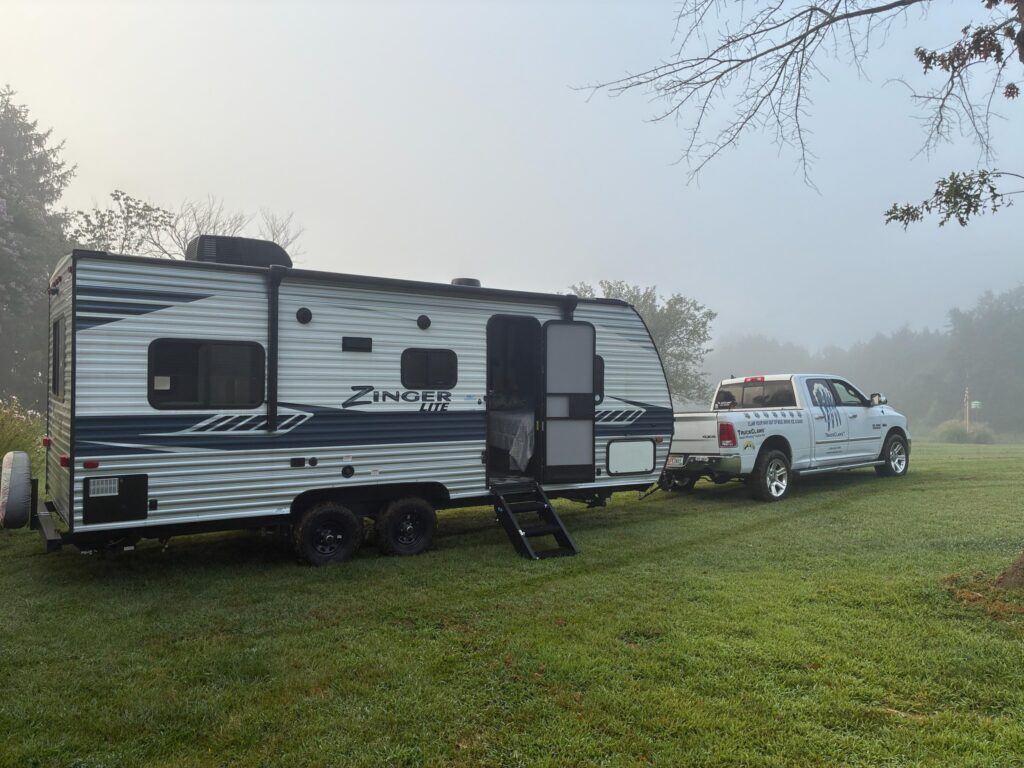
You pull into a national forest campground at 8 PM after a 400-mile day. The thunderstorm that rolled through three hours ago left the gravel pad soft. You back your 24-foot travel trailer in, drop the stabilizers, and notice the rear of your tow vehicle has sunk an inch into what used to be loose gravel. By morning, the rain that was supposed to clear has come back. Now the gravel pad is soup. You hook back up at 9 AM, ease forward, and your dual rear wheels just… dig. By 9:15 you’re three inches deeper than you started.
This is the most common RV stuck call that mobile mechanics and AAA take in summer. And it’s the one most RV owners are least prepared for, because nobody buys a Class C motorhome thinking “I’d better also get a recovery kit.”
Tow truck calls for RVs in 2025-2026 averaged $400 to $1,200 depending on weight, distance, and how far off the road you happened to be. That’s not the worst part. The worst part is that most national park and Forest Service campgrounds are not accessible to standard wreckers. The driver who shows up will tell you he can’t get to your spot, that you’ll need to be winched out to the access road first, and that’s another service call.
Why RVs sink before regular trucks:
Dual rear wheels concentrate weight on a smaller footprint than singles. Counter-intuitive but true. A dually on wet grass sinks faster than a single-rear-wheel pickup.
A loaded fifth wheel or travel trailer puts most of its tongue weight on the tow vehicle’s rear axle, which is exactly the part trying to make traction.
Most RV tires are highway-rated, not all-terrain. They’re built for fuel economy, not grip on soft surfaces.
RV owners often park “for the night” without checking the ground. By morning, the rain has done its work.
Your options when stuck:
Wait it out. Sometimes the ground dries by afternoon. Sometimes it rains again. You’re rolling dice with your check-in window at the next park.
Call a tow. Already covered the cost, the access problem, and the embarrassment of trying to explain to the kids why the trip just got delayed by a day.
Recovery boards under the wheels. Boards work, but most RV owners don’t carry them — they’re bulky and most sit unused for years. They also tend to shoot out behind the tires under heavy weight if not positioned exactly right.
A tire-mounted traction aid. A steel claw that straps to the drive wheel and physically lifts the rig forward as the tire rotates. The emergency tire traction kit for light trucks and RVs is rated for vehicles under 30,000 lbs GVW, which covers Class B, Class C, smaller Class A motorhomes, and every travel trailer rig with a half-ton or three-quarter-ton tow vehicle.
How to actually use it on an RV setup:
For a travel trailer or fifth wheel rig, install the claw on the tow vehicle’s rear drive wheel — the one that’s currently spinning. Wrap the strap around the tire, lay the steel cleat across the tread, ratchet it tight, and ease onto the throttle. The trailer will roll forward as the tow vehicle moves. Two claws (one on each rear drive wheel) gives you the most consistent extraction.
For a Class A or Class C motorhome with rear duals, the install is the same but you’ll typically want a claw on each side of the dual axle for balanced lift. The kit is sized to fit dual rear wheel applications.
For storage, the carry bag fits in the basement bay of any travel trailer or in the underbed compartment of a Class A. You’ll forget it’s there for years until the night you need it.
Three habits that prevent the campground stuck moment in the first place:
Walk the pad before you back in. Step on the gravel where your wheels will sit. If your foot leaves an impression deeper than half an inch, find another spot.
If rain is forecast, back IN with your wheels on the most-compacted part of the pad and hook up loose rather than chocked. Easier to leave at first light.
Never let a loaded RV sit on saturated ground for more than 24 hours. The longer it sits, the deeper it sinks.
The best $149 you’ll spend on RV gear isn’t a leveling system or a Wi-Fi booster. It’s the thing that gets you out of a campsite when the campground host shrugs and says “we don’t have anything for that.”