By Dan Murphy
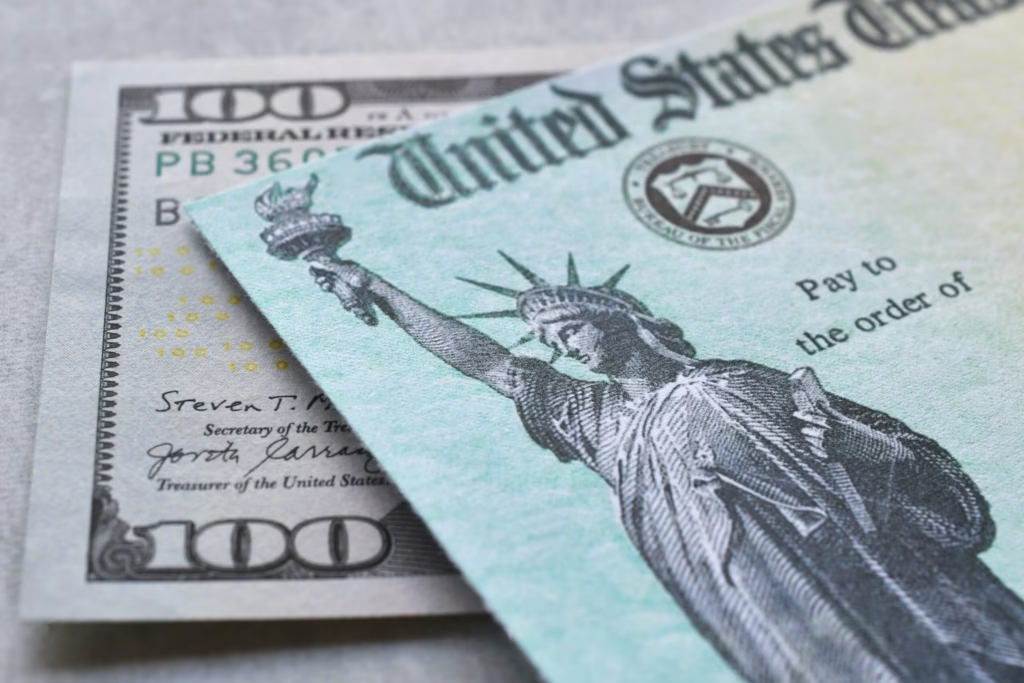
Two proposals aim to provide financial relief to Westchester families facing rising costs. The first, from Republicans in the state Assembly and Senate, calls for an Energy Rebate check of up to $400. The second, a federal plan, could provide $1,751 in tariff rebates to every New Yorker after the recent US Supreme Court decision overturning the Trump tariffs.
Congressman George Latimer has called for an alternative to tariff revenue: refunds to small businesses. In a letter to Treasury Secretary Bessent and Homeland Security Secretary Noem, Rep. Latimer and 21 other House Democrats write,
We, the undersigned, write to express concern over the preparedness of the Departments of Treasury and Homeland Security (via U.S. Customs and Border Protection) to handle the large influx of protests likely to be filed in the event the United States Supreme Court determines that tariffs imposed by President Trump under the International Emergency Economic Powers Act (IEEPA) are illegal. We urge you to immediately dedicate sufficient departmental resources and personnel ahead of the Court’s decision, with a focus on aiding America’s small businesses and sparing them irreparable financial damage resulting from the termination of this policy.
These tariffs, first invoked by Executive Order on April 2, 2025, without prior approval by Congress, imposed a universal baseline tariff of 10% on countries around the world and levies ranging from 1% to 40% on dozens of specified trading partners selected by the President.¹ Many of us previously signed onto an amicus curiae brief opposing President Trump’s imposition of these tariffs as having exceeded his authority beyond that which was lawfully delegated to him by Congress under the IEEPA.²
We are also gravely concerned about the impact of President Trump’s imposed tariffs on small businesses across the country, specifically:
According to the U.S. Chamber of Commerce, more than 97% of U.S. companies that import goods are small businesses.
Small businesses typically lack large cash cushions or the leverage to negotiate bigger discounts with suppliers, and do not have a wide range of products to spread price increases around.
Many are reluctant to raise prices because they do not want to drive customers away, leaving them with shrinking profit margins.
Even for companies that can pass the cost of tariffs on to customers immediately, many are worried that these added costs will impact their ability to remain competitive and profitable.
Those amounts are estimated by various sources to range from $120 billion to $1 trillion, and they continue to grow as the Court awaits a decision.
We, as members of Congress, offer our commitment to work collectively with you to help the American small business sector – its owners and employees – through this crisis, and to ensure that this unfortunate episode is resolved and never repeated.
A few weeks ago, New York Governor Kathy Hochul called on the Trump administration to refund the estimated $13.5 billion in tariff payments for New Yorkers. According to the Yale Budget Lab, the average New York household has faced about $1,751 in added costs since the tariffs were enacted last year.
“These senseless and illegal tariffs were just a tax on New York consumers, small businesses, and farmers — that’s why I’m demanding a full refund,” Governor Hochul said. “I will always fight for New Yorkers by staying focused on putting more money back in your pockets — not taking it away.”
At the same time, calls are now being made for Hochul herself to refund $2 billion in allocated NYSERDA funds that have not yet been spent by New York taxpayers.
New Yorkers are currently weathering some of the highest energy rates in the nation. Residential electricity rates in New York are roughly 50% higher than the national average and rose 7.6% in the past year, faster than the national average.
Since the Democratic majorities in the Legislature passed the Climate Leadership and Community Protection Act (CLCPA), electricity rates in New York have increased by 45%, leading New Yorkers to pay 30-40% more than their neighbors in Pennsylvania.
The 2025 fiscal-year budget and financial plan for NYSERDA show a surplus of approximately $2 billion. During a recent Joint Budget hearing on Energy and Environmental Conservation, NYSERDA President Doreen Harris was urged to return these unspent funds to ratepayers as bill credits, providing relief to those who contributed the surplus through their utility bills.
“Following a recent Supreme Court decision, the governor called on the Trump Administration to provide tariff refunds to New Yorkers struggling financially,” Sen. Griffo said. “She should do the same with this $2 billion NYSERDA surplus that she controls to help those hit hard by rising utility bills. Returning this unspent funding to ratepayers is one way to provide immediate relief and make life a little easier for New Yorkers who are already stretched to the limit.”
In light of these challenges, earlier this month Sen. Griffo and his colleagues unveiled a package of legislation to address New York’s outrageous energy costs and offset the effects of costly energy mandates imposed by Albany. The “Lights On With Energy Relief,” or LOWER, plan would provide
Immediate Ratepayer Relief
S8461A – Requires any surplus or unspent ratepayer funds remaining in NYSERDA’s Clean Energy Fund or any unspent funds collected by utilities to be sent back to ratepayers as a bill credit. This bill would lower New Yorkers’ utility bills by $2 billion, at a time when They are facing skyrocketing bills.
400,000 New Yorkers have had their gas or electric service shut off for nonpayment.
Estimates have a State rebate of up to $400 for all New Yorkers.
8.2 million New Yorkers recently received an Inflation Refund Check.
Hudson Valley Assemblymember Didi Barrett has proposed a different plan: pausing state taxes on utility bills; providing bill credits for all ratepayers by using previously collected, unused Clean Energy Funds held by utility companies instead of ratepayers to support the state program; and returning excess revenue beyond a utility company’s approved Return on Equity back to ratepayers in bill credits.
However, despite these proposals, Barrett’s bill does not have the support of the democratic leadership in Albany, and neither does the republican plan.