By Dennis Richmond, Jr.
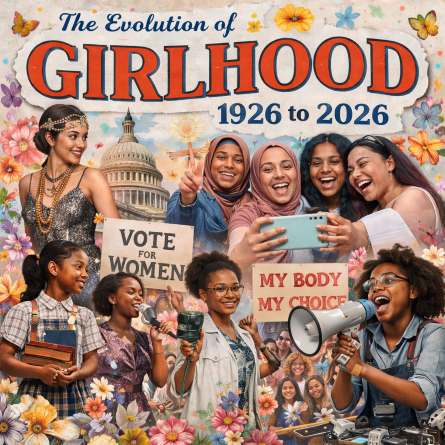
In 1926, girlhood was defined by expectation. In 2026, it is defined by negotiation.
A century ago, most girls in America were raised the same way. Education for girls was expanding, but college remained out of reach for most, especially Black girls in the South and working-class girls across the country. The right to vote had only recently been secured through the Nineteenth Amendment to the United States Constitution, and while there was progress, political power did not immediately translate into social equality. For many, being an innocent girl ended pretty quickly. Marriage, domestic labor, factory work, and caregiving made girls grow up fast.
But even in 1926, girlhood was shifting. The “flappers” were taking folks by storm. Young women cut their hair, shortened their hemlines, and claimed public space in ways that unsettled older generations. In Harlem, the cultural awakening of the Harlem Renaissance showcased writers, performers, and thinkers who challenged the nation’s racial and gender hierarchies.
Fast forward to 2026, and girlhood is different. Girls grow up online as much as they do offline. Identity is partially created in digital spaces. A teenage girl can build a life from her phone, have thousands or millions of followers on social media, and publicly articulate her gender and sexuality in ways that may have seemed unimaginable a century ago. With that, she might experience unrealistic beauty standards driven by an algorithm. She might also have to hear political debates over her body — from men.
Education isn’t a dream— it’s almost an expectation. Girls outperform boys on many academic measures and lead student governments, robotics teams, and protest movements. Young activists — from climate organizers to gun-violence advocates — have reshaped civic engagement. They are not waiting to “grow up” to claim influence. They are asserting it in real time.
Still, a lot of things are separate and not equal. Black girls are disproportionately disciplined in schools. Sometimes they are seen as disruptive. And let’s not even talk about the higher rates of poverty and systemic barriers. Globally, access to education and safety remains uneven. The promise of progress has never been evenly distributed.
The craziest change in 100 years may not be legal or technological. It might be philosophical. In 1926, girlhood was something society defined for girls. In 2026, girlhood is increasingly something girls define for themselves.
Girls, cis women, and trans women are athletes and coders, caretakers and critics, tradition-keepers and disruptors. They inherit a century of struggle — and possibility. And they carry the torch.
Dennis Richmond, Jr. (@NewYorkStakz) is a journalist, historian, and educator from Yonkers, NY. He writes to uplift unheard voices, honor history, and inspire change.