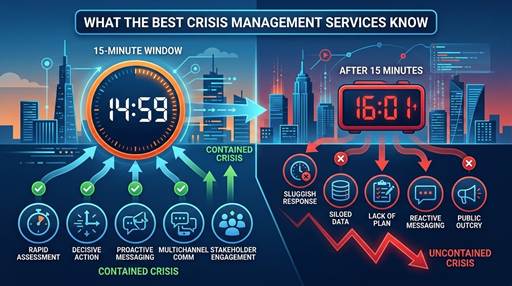
The best crisis management services have identified a 15-minute window as the decisive factor between containment and escalation. Their approach centers on real-time monitoring, pre-approved protocols, and sequenced stakeholder notifications that activate within moments of detection. Speed, message discipline, and platform-specific tactics determine outcomes. Here is what organizations must implement to stay ahead.
The 15-minute window is the span between incident detection and the first public acknowledgment or internal escalation. During this interval, teams must identify the scope and decide on immediate steps. Delays beyond this threshold allow information to spread without guidance or correction.
Data from the Ponemon Institute shows that 60% of data breach costs occur in the first 30 days, with containment decisions made in the initial 15 minutes determining 47% of total financial impact. That opening period sets the trajectory for everything that follows.
Real cases demonstrate the value of speed. Southwest Airlines addressed a 2016 equipment issue through rapid internal notification, limiting passenger exposure and media pickup. United Airlines adopted a similar approach after its 2017 passenger removal incident, issuing updates within minutes rather than hours. Both show how early response keeps narratives from developing independently.
Leading services divide this window into three phases:
- Detection (0 to 3 minutes): Monitoring systems flag unusual activity
- Assessment (3 to 8 minutes): Teams verify details and measure reach
- Decision (8 to 15 minutes): Leaders select the appropriate path forward
Threshold metrics guide activation. A sentiment drop of more than 15% or a mention velocity of more than 500 tweets per hour signals immediate protocol engagement, moving teams from monitoring to active coordination without waiting for further confirmation.
Why Response Time Determines Whether Containment Succeeds
Research from the MIT Sloan Management Review tracked 187 corporate crises and found that each 10-minute delay in the initial response increased the probability of media pickup by 34%.
Organizations that activate protocols within 5 minutes achieve containment success rates of nearly 78%. A 15-minute response drops that figure to 62%. Waiting 30 minutes reduces success to 31%. These metrics reflect how quickly information spreads through digital channels and traditional outlets.
The Domino’s Pizza incident in 2009 demonstrated the cost of delay in real time. A two-hour lag allowed damaging video content to spread widely before any official statement appeared. Companies that respond within 11 minutes in similar situations limit the loss of narrative control and reduce long-term reputational damage.
Three primary factors create decision latency during early crisis stages:
- Unclear ownership of the response process adds 8 to 12 minutes
- Missing pre-approved language templates adds 6 to 9 minutes
- Chain-of-command approval requirements add 15 to 20 minutes
Each delay compounds amplification risk. Effective crisis management services establish clear escalation protocols before incidents occur. Level 1 incidents require the CEO’s sign-off for public statements. Level 2 events need department head approval. Level 3 situations allow on-duty communications leads to release holding statements immediately.
Real-Time Monitoring Systems That Support the Best Crisis Management Services
Brandwatch and Mention provide keyword-triggered alerts within 45 to 90 seconds of first mention across 3,800+ sources. Speed in detection directly affects whether crisis containment happens before public attention builds.
Setup requires attention to detail. Teams create Boolean keyword strings that capture brand variations, executive names, and product terms. Geographic filters narrow results to key markets where issues often emerge first. Alerts route to a dedicated Slack channel while PagerDuty handles after-hours escalation to on-call staff.
Platform costs and capabilities vary significantly:
- Brandwatch: $800 to $2,000/month, 45-second latency, 95 languages
- Mention: $49 to $199/month, 90-second latency, 9 languages
- Meltwater: $5,000+/month, 30-second latency, sentiment scoring included
- Talkwalker: $1,200+/month, 60-second latency, image recognition features
Alert thresholds trigger when three mentions appear within five minutes or when high-follower accounts engage with negative content. Rate limits apply across all tools, and API access adds separate costs.
Pre-Approved Response Protocols
Edelman’s 2023 Trust Barometer found that companies with pre-approved holding statements reduced average response time from 47 minutes to 9 minutes. Templates prepared in advance eliminate hesitation and support faster decisions under pressure.
These protocols cover the most common crisis scenarios that demand immediate attention. Each includes clear language, approved facts, and designated spokespeople. Teams avoid delays caused by messages requiring multiple rounds of drafting during an active situation.
The approval chain follows strict time limits:
- Legal reviews documents within a two-hour SLA
- The Communications Director completes approval within 30 minutes
- The CEO reviews high-impact cases within the 15-minute window
Version control relies on shared documents with comment-only permissions. Dated PDF exports are stored in encrypted storage, with access limited to authorized personnel. Quarterly reviews incorporate feedback from tabletop exercises to keep templates up to date.
Sample Holding Statement Templates
Product safety recall: We are aware of reports regarding [product]. Customer safety remains our top priority. We have initiated an immediate review with the relevant authorities. Additional information will be shared once verified. Customers should [action]. Contact our support team at [number] for assistance.
Data breach notification: We detected unauthorized access to certain systems on [date]. We have engaged independent security experts and notified law enforcement. Impacted individuals will receive direct notification with guidance on protective steps. We take data protection seriously and continue strengthening safeguards. For questions, please reach out to our dedicated response line at [number].
Executive misconduct acknowledgment: We have received allegations involving [executive]. An independent investigation has begun under board oversight. [Executive] has stepped aside pending review. We remain committed to accountability and transparency throughout this process. Further updates will follow as appropriate.
Service outage update: Our team is addressing a service disruption affecting [service]. Engineers are working to restore normal operations. We apologize for the inconvenience and will provide updates every 30 minutes. Status information appears on our status page.
Misinformation correction: Reports circulating about [claim] are inaccurate. Our records show [correct fact]. We encourage verification through official channels before sharing information. Accurate details help prevent unnecessary concern among stakeholders and the public.
Third-party vendor incident: A vendor supporting our operations reported an issue on [date]. We have activated our incident response procedures and are assessing potential effects. Notifications to affected parties will occur once details are confirmed.
Employee safety event: We are responding to an incident at [location]. All personnel have been accounted for and received the necessary support. Local authorities are on site. We will share additional information as it becomes available.
Stakeholder Notification Sequences
Harvard Business Review analysis of 42 corporate crises found that the order of sequential notifications reduced information leakage by 63% compared to simultaneous communication blasts. This structured approach protects sensitive details while ensuring everyone who needs to act receives clear direction.
The process breaks into three distinct tiers:
Tier 1: Internal Leadership (Minutes 0 to 3)
A dedicated PagerDuty schedule routes alerts to the on-call Crisis Leader within 60 seconds of a monitoring system trigger. The leader activates the #crisis-war-room Slack channel, and an automated email is sent to the CEO, General Counsel, and Head of Communications with the incident ID. If no acknowledgment is received within 3 minutes, the system auto-escalates to a backup leader.
Tier 2: External Partners (Minutes 8 to 14)
Regulatory bodies receive notice first, including the SEC via EDGAR and the FTC via the Consumer Complaint Portal. Key investors among the top 10 holders receive updates via a preloaded email list. Customers in the top 500 accounts receive in-app messages via Intercom. Media contacts on a pre-approved journalist list receive a message from the team via Muck Rack at minute 14.
Note that SEC Regulation S-K requires a Form 8-K filing within 4 business days, but best practice is to notify key investors within 15 minutes of material events. HIPAA breach notification carries a 60-day legal requirement, though a 15-minute courtesy call to HHS is recommended for maintaining trust.
Tier 3: Public Statement
A public statement follows after leadership has aligned on facts and next steps.
Message Control Strategies
Sprinklr data from 12,000 crises show that initial holding statements that include specific action verbs reduce negative sentiment by 41% compared to vague apologies. Organizations that deploy clear language within the first 15 minutes gain measurable control over public perception.
Effective teams apply three distinct message frameworks during rapid intervention:
- FACT-ACKNOWLEDGE-ACTION: State a verified fact, express empathy, name one concrete next step
- TIMELINE-UPDATE: Outline what occurred, describe the current status, and commit to the next scheduled communication
- CORRECTION: Quote the inaccurate claim, supply accurate information, and name the verifying source
Each format operates within strict word-count limits. Twitter threads stay under six posts. Press releases remain at or below 400 words. LinkedIn posts respect the 1,300-character ceiling. These constraints force clarity and prevent message dilution.
Spokesperson preparation follows a concise checklist. Teams pre-load three key messages, eliminate two unacceptable phrases, and lock one scheduled update time. Real-time monitoring through Brandwatch recalculates sentiment scores every 60 seconds.
Platform-Specific Tactics for the First 15 Minutes
Buffer’s 2023 Social Media Crisis Report shows Twitter responses under 280 characters achieve 2.3x higher engagement than longer threads during breaking incidents. Short, direct messages cut through noise when every second counts.
Each platform requires a different approach:
Twitter/X: Pin an official response at the top of the profile feed. A 2 to 3-tweet thread works best when each post uses a numbered format and includes a branded visual asset.
Facebook: Post a 60-second video statement addressing core facts. Boost content in affected zip codes via geo-targeting to keep messaging localized as the situation develops.
LinkedIn: Executives should publish a personal post within 45 minutes, tagging the company page to amplify reach to professional stakeholders.
Instagram: Use Stories with a swipe-up link directing viewers to the full statement. Highlight these Stories for 24 hours to maintain visibility.
TikTok: Proceed with caution. Duet only with verified fact-check accounts when misinformation spreads. Avoid amplifying unverified claims during the response period.
YouTube: Use Community posts paired with timestamped update videos. This platform supports longer clarifications once the crisis communication team has established the basic facts.
Reputation management firms like NetReputation have documented how platform sequencing affects narrative control, noting that the order of responses across channels matters as much as the speed of any single post.
Post-Window Assessment
FEMA’s after-action report template requires documenting exact timestamps for each action taken within the first 15 minutes to identify decision bottlenecks. This documentation reveals where delays occurred and which steps need improvement for future incidents.
The seven-question assessment form captures essential data points for thorough review. Teams should complete this form within 90 minutes post-incident to maintain accuracy:
- What was the first detection time according to the monitoring tool screenshot?
- Who was notified at minutes 0, 3, 7, and 15 according to the log export?
- Which pre-approved statement was used, and what was its version number?
- What was the sentiment score at minute 0 versus minute 60 from the Brandwatch export?
- What was the media pickup count within the first hour from Meltwater?
- What was the revenue impact within 24 hours according to the internal dashboard?
The scoring rubric provides clear benchmarks. Teams scoring 90 or above followed the established protocol exactly. Scores between 70 and 89 indicate minor deviations. Scores below 70 signal the need for tabletop retraining before the next incident occurs.
Training and Simulation Programs That Sharpen Response Speed
Deloitte’s 2022 Global Crisis Simulation Survey found that companies running quarterly tabletop exercises reduced actual crisis response time by 37%. Regular drills build the muscle memory teams need when the 15-minute window opens during a real incident.
The training calendar follows a structured sequence:
- Q1: Product recall scenarios with Legal, Supply Chain, and Communications
- Q2: Data breach exercises involving IT, Legal, and Privacy groups
- Q3: Executive misconduct sessions with HR, Legal, and the CEO’s office
- Q4: Third-party vendor failures with Procurement, Legal, and Communications
Each session runs a 45-minute timed simulation followed by a 15-minute debrief. A Slackbot delivers fresh injects every five minutes, forcing quick decisions without extended discussion time.
Performance tracking focuses on three measurable areas: time-to-first-statement, accuracy of facts presented, and adherence to pre-approved language templates. External facilitators charge $3,500 per session. An internal HRBP certification program using FEMA IS-100 and IS-200 courses costs $1,200 per person for organizations building in-house capability.
Continuous Improvement After Every Incident
After each incident, the Crisis Management Committee updates the playbook within 5 business days using timestamped decision logs from the war room. This process captures every choice made during the 15-minute window and identifies patterns in response latency.
Three structured feedback systems operate after every event:
- A real-time Slack poll gathers immediate input from three designated approvers on whether the holding statement was accurate
- A 24-hour stakeholder survey through Typeform asks five targeted questions about clarity and timing
- A monthly metrics dashboard in Google Data Studio tracks average response time, sentiment recovery, and media pickup volume
Teams document every adjustment in a shared Notion page that maintains a complete version history. One Q3 simulation led to a new requirement for 60-second video statements on Facebook within the first hour. That single addition shortened average negative sentiment recovery from four hours to two and a half hours.
Both the Crisis Leader and General Counsel must sign off before any updated protocol version becomes active. That sign-off requirement is not bureaucratic friction. It is what separates organizations that learn from incidents from those that repeat them.