By Dan Murphy
At its hearing on Dec. 1, the Gaming Facility Location Board unanimously recommended the three remaining applicants, Bally’s (Bronx), Hard Rock Metropolitan Park (Queens), and Resorts World New York City (Queens), for commercial casino licenses.
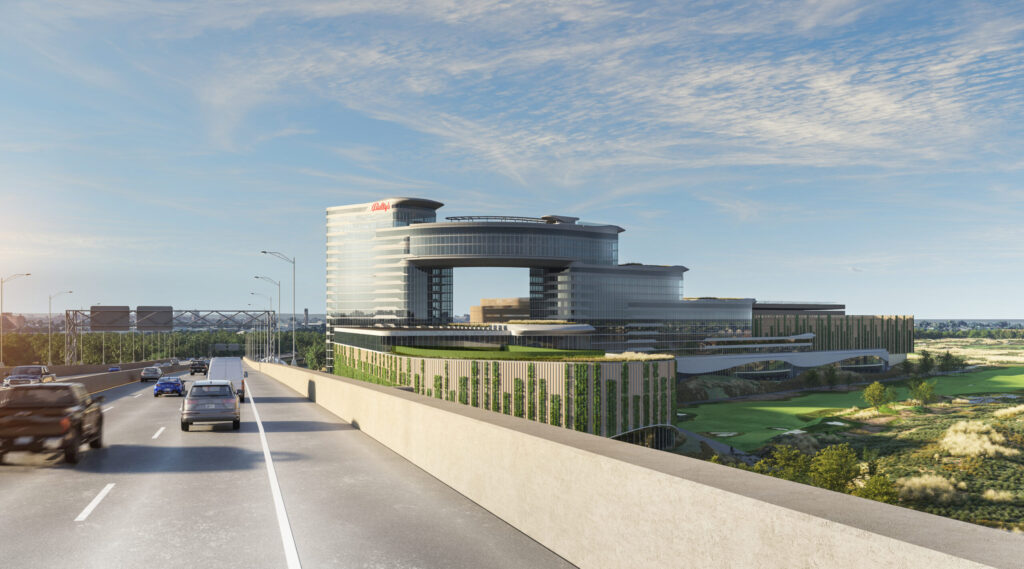
In its publicly released report, the Board praised Bally’s proposal as a “substantial investment” with a $2.3 billion capital plan, promising thousands of new jobs, a 507-room hotel, a 2,000-seat event center, a Jack-Nicklaus-designed golf course, a 4,661-space parking capacity, and extensive amenities.
It is easy, and perhaps politically expedient, to frame this as a win for New York: jobs, infrastructure, revenue, growth. But the publicly available record shows that Bally’s carries serious red flags, which the Board itself partially acknowledges but overlooks in its rush to issue all three licenses.
In its report, the Board notes that Bally’s is “a highly leveraged, non-investment-grade entity.” That language cannot be dismissed as boilerplate. It is a clear warning sign: Bally’s may lack the financial resilience to withstand economic downturns, construction delays, or underperformance of its projected revenues. Yet the Board is recommending it anyway; a questionable exercise of public trust given the scale of public stakes involved.
While Bally’s projects robust job creation with 2,876 full-time and 865 part-time workers (3,741 total, or roughly 3,503 full-time equivalents), with a median comp near $80,000 including benefits, the Board hedges. It notes that Bally’s own projections of gross gaming revenue, net revenue, and operating income may fail to materialize, especially given that the facility “will not be operational in the first three and one-half years” after licensing.
Moreover, the Board flagged serious doubts about climate resilience and stormwater management in Bally’s Bronx plan, concrete issues that could undermine the project’s viability or community impact over time.
Bally’s claims a net present value (NPV) community benefit of $765 million. But the Board itself warns that this figure may be overstated, especially given that funds for the Bronx Benefit Fund won’t flow until the facility opens, This means any benefits are decades away under the proposed 2030 timeline.
In the end, Bally’s appears to be trading long-term community promises on shaky financial ground and distant delivery, which is hardly a reliable foundation for a project impacting one of the city’s most economically and socially vulnerable boroughs.
Despite the Board’s formal posture that all three applicants “met statutory criteria,” public reporting indicates that support within the Bronx was tepid at best. According to media accounts, the Board’s selection sparked immediate protest: as one news outlet put it, “the three winning bidders hugged and clapped, but not everyone was happy… Protesters stormed out chanting ‘Shame on you!'” when the decision was announced.
Critics, including local community activists and environmental groups, flagged concerns about increased crime, addiction, traffic, environmental degradation (especially stormwater run-off into impaired waterways), and the conversion of community parkland into a casino complex.
These are not minor downsides. For a borough long underserved and often neglected in development decisions, rushing ahead with a casino, especially a large-scale resort, risks repeating patterns of top-down planning that historically have marginalized local voices. The Board’s Selection Document acknowledges some of these concerns (e.g., environmental and stormwater issues) but appears to discount them in favor of optimistic financial forecasts.
In short: the “community-centric” process envisioned by the 2022 licensing statute looks to have been largely symbolic, not substantive.
There is one fact that cannot be ignored: under its agreement, Bally’s must pay Trump Organization $115 million if it wins the license for the former Trump-linked golf course in the Bronx. That fact alone raises obvious and uncomfortable questions. As the New York Post reported, this payout would directly benefit the Trump Organization.
But even beyond optics, the more profound concern is that a public-interest decision by a state board is being channeled to enrich a private party with deep financial and political ties at a moment when state and city budgets are under pressure and public trust in institutions is fragile. It is not hyperbolic to say this smells like leveraging governmental power for private gain.
Especially given the larger context, when New York State and New York City budgets have recently been squeezed, with the President’s tenure coinciding with sharp reductions in federal funding to the state and city. Suppose the same individual stands to gain personally from a casino license, even as public coffers are being constrained. In that case, that should raise alarm bells for every resident, community leader, and policymaker.
This matter should also be viewed not simply as a questionable decision about one applicant, but as emblematic of a deeply flawed process and inequitable regulatory structure. When the Legislature authorized these downstate casino licenses in 2022, it introduced new requirements, including community advisory committee approval, environmental reviews, upfront license fees, and a minimum capital-investment threshold of $500 million.
On paper, these criteria promised a high bar. But in practice, the new rules have created a steep barrier for existing gaming operators, particularly those that have already proven their ability to deliver stable revenues, support thousands of jobs, and invest over decades in New York’s economy. Instead, the rules have favored speculative, heavily leveraged proposals that rely on optimistic projections and unproven community-benefit pledges.
Meanwhile, another sector, harness racing, continues to receive massive subsidies, despite widespread evidence that such subsidies largely benefit horse owners, breeders, trainers, and drivers, the majority of whom do not reside in New York and certainly do not live near Yonkers. With state subsidies propping up what state officials recently admitted is a sport that likely would not exist without government underwriting, it is absurd that a proven operator like MGM Resorts International would be punished by being excluded from the competition (MGM withdrew earlier this fall) while speculative casino proposals are fast-tracked.
In effect, the way the law is written and how it is being implemented have created an uneven playing field, disadvantaging operators with track records and rewarding those with debt-heavy, high-risk proposals. That’s bad policy.
Yesterday’s decision by the Gaming Facility Location Board should not be framed simply as a win for economic development. On the contrary, it feels like a gamble, with heavy financial, environmental, and political risks being placed on a highly leveraged company whose public promises may prove empty, in a process that has sidelined real community input and empowered a private interest (the Trump Organization) with a multi-million dollar payout tied directly to the licensing outcome.
Suppose the state proceeds without rigorous financial scrutiny, transparent oversight, and firm, enforceable commitments on community benefit, diversity, environmental protections, and labor standards. In that case, there is a real danger that this casino deal could exacerbate inequality, undermine public trust, and burden communities rather than uplift them.
At the very least, the Board’s glowing summary of Bally’s must be met with healthy skepticism, and lawmakers, community stakeholders, and the public should demand accountability before any final license is granted.