By Judith Niewiadomski, Yonkers
God’s covenant with His people changed over time. The Mosaic covenant was conditional; if the people fulfilled it they would be preserved and blessed, if they broke it, disaster would follow. With 631 laws to remember, human frailties, and pagan cultures surrounding them, no ordinary man could fulfill the Mosaic law perfectly. The children of Israel, despite the guardrails and instruction of the law, often fell into idolatry. Consequently, pagan enemies prevailed and they were often enslaved and dispersed into foreign countries, or suffered under evil kings of their own nation.
The law was a teaching tool to lead people to Christ: “Wherefore the law was our schoolmaster to bring us unto Christ, that we might be justified by faith.” (Galatians 3:24), not a means of salvation in itself. Logically, salvation can not be by works of the law because imperfect men cannot perfect themselves. “Therefore by the deeds of the law there shall no flesh be justified in his sight: for by the law is the knowledge [recognition, acknowledgment, discernment] of sin.” (Romans 3:20) The law pointed to the man, the Lamb of God, the Messiah He would send. “For by grace are ye saved through faith; and that not of yourselves: it is the gift of God: Not of works, lest any man should boast. (Ephesians 2:8, 9) “For what the law could not do, in that it was weak through the flesh, God sending his own Son in the likeness of sinful flesh, and for sin, condemned sin in the flesh. “ (Romans 8:3)
Two main purposes of the law were to keep the people from becoming so corrupt that they were irredeemable, and to teach them to look for the Messiah. Since no other man could obey the law perfectly, they could not work their way to God. That required the unblemished lamb of God to fulfill the law completely and thereby fufilling i, and making a new covenant which superceded it available.
Understanding how and why the Passover was superceded by the memorial of communion, requires an accurate understanding of when Jesus Christ was killed. “Your lamb shall be without blemish, a male of the first year: ye shall take it out from the sheep, or from the goats. And ye shall keep it up until the fourteenth day of the same month: and the whole assembly of the congregation of Israel shall kill it in the evening.” (Exodus 12:5, 6) Evening, in Hebrew ereb means the time from noon until sunset. Jesus Christ died at what would be 3:00 p.m. by our reckoning.
Biblical records show that Jesus Christ was killed on the 14th of Nisan, the preparation day for the Passover. The high Sabbath of the first day of the Passover feast begins at sundown, the 15th of Nisan. “Now before the feast of the passover, when Jesus knew that his hour was come that he should depart out of this world unto the Father, having loved his own which were in the world, he loved them unto the end.” (John 13:1) Jesus Christ also knew the spiritual significance of God’s timing: he would be the Passover lamb for all time, the perfect Lamb of God. One of the essential details indicating that the “Last Supper” was NOT the Passover meal was that Jesus Christ and his disciples were sitting down.
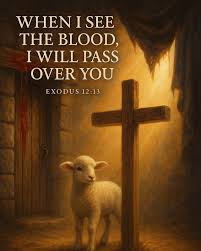
An essential protocol of the Passover meal is that it must be eaten standing up and dressed for travel. “And thus shall ye eat it; with your loins girded, your shoes on your feet, and your staff in your hand; and ye shall eat it in haste: it is the LORD’S passover.” (Exodus 12:11) Healing was part of the original Passover. Approximately two and a half million people left Egypt after the Passover. Yet, despite years of the most brutal slavery, with physical demands that were designed to cut down their numbers, “He brought them forth also with silver and gold: and there was not one feeble person among their tribes.” (Psalm 105:37) Forgiveness of sins, originally represented by the blood on the doorposts and healing, represented by the eating of the lamb, were features of the first Passover.
“But he was wounded for our transgressions, he was bruised for our iniquities: the chastisement of our peace was upon him; and with his stripes we are healed. “ (Isaiah 53:5) Because the Passover was a representation of what was to come, it was to be repeated every year, looking forward to its ultimate fulfillment. But once the Messiah had come, believers were to claim their forgiveness and healing by looking back to what Jesus Christ accomplished. “Who his own self bare our sins in his own body on the tree, that we, being dead to sins, should live unto righteousness: by whose stripes ye were healed.” (1 Peter 2:24)
Cultural differences such as when the new day started, and traditions added long after the Word of God was written down, gave rise to false assumptions about when Jesus Christ was killed. Modern Western calendars that reckon the new day from midnight have obscured the truth. At the time of Jesus Christ, the new day started at sunset, which is still the case in the Jewish calendar. Without refrigeration, the killing of the Passover lamb could not happen on one afternoon and then be cooked and eaten 24 hours or more later at the evening meal. When the new day is reckoned at sunset, killing, cleaning, and preparing and cooking the lamb occurs within a few hours.
Memorials are established by friends or family after someone has died. But Jesus Christ was the only man with the God-given authority to establish a memorial of the new covenant, a remembrance of what his death and suffering accomplished for those who believe on him. Bread and wine are metaphors for his life’s blood payment for sins and his tortured body for healing for our sin-corrupted body. The memorial reminds us that we no longer have to wait for the Messiah to come, but to bring the good news that he had come into every part of the earth; the price was paid and believers could do the works that he did and greater works. “For this is [represents] (metaphor) ] my blood of the new testament [covenant] which is shed for many for the remission of sins.” (Matthew 26:28)
God knows in His foreknowledge the technical, political, and cultural changes in life on Earth. He knew that people would move to other areas of the world, that the Temple would be destroyed, that it would not be possible for most people to sacrifice an animal. So God designed and taught Jesus Christ a memorial that could be done anywhere two or more were gathered in his name: the bread and wine of communion.
The painful work of redemption has been done, the memorial of communion is a time of thankfulness and celebration for forgiveness and healing.