By Mary Hoar, City of Yonkers Municipal Historian, recipient Key to the City of Yonkers, President Emeritus Yonkers Historical Society, received the 2004 Key to History, Yonkers Landmarks Preservation Board Member, Founder of Revolutionary Yonkers 250 and President Untermyer Performing Arts Council
Monday, May 18th
May 18, 1928: At a special meeting of the Aldermanic Committee on Zoning with the Committee of the Whole, Alderman William McGeory criticized the 75-foot height limit of apartment buildings in Yonkers as “ridiculous.” Because it “throttled the development” of the city, he proposed a new zoning ordinance to increase the maximum legal building height to 100 feet. It passed.
Tuesday, May 19th
May 19, 1919: The Yonkers members of the Republican County Committee met in their headquarters to discuss plans to include Republican women since they were enfranchised.
May 19, 1941: Fourteen Immigration Aides and fifty-seven Yonkers Police Officers began questioning one thousand people as part of the drive throughout the country rounding up undocumented aliens. Out of the one thousand men questioned in clubs, dancehalls, taverns, restaurants, pool halls, bowling alleys, and visiting every place a person might be found, just four men were arrested.
The men, from Spain, Portugal and Holland, were taken to Ellis Island after they were booked at Police Headquarters. All four had “jumped ship.” One man feared for his life; he saw and heard several ships torpedoed on his way to the US. He said, “I run away. No more Boom-Boom for me. Yonkers nice place; I want to stay.”
Wednesday, May 20th
May 20, 1927: Internationally renowned pianist Percy Grainger made his Yonkers debut at a Gorton High School concert!
May 20, 1942: Lieutenant George Barr, Leake & Watts resident from 1927 to 1935, and one of Doolittle’s airmen, was awarded the Distinguished Flying Cross for bombing Japan.
The Hawthorne JHS graduate and Yonkers High star athlete was imprisoned by the Japanese from April 1942 until the war ended. He also was awarded the Chinese Breast Order of Pao Ting.
Barr returned to Yonkers for the Leakes & Watts 1946 reunion.
Thursday, May 21st
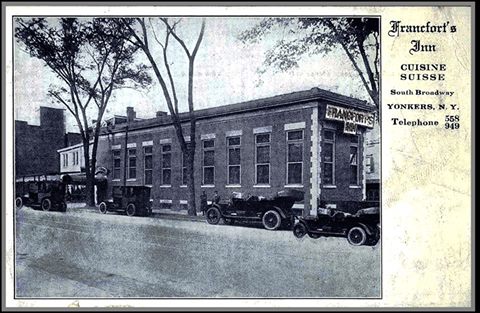
May 21, 1922: The Lions Club of Yonkers formally received its charter at a dinner and meeting at Francfort’s; its charter roster was a “Who’s’ Who” of Yonkers.
May 21, 1947: The Legal Section of General Headquarters of the Supreme Commander for the Allied Powers in Tokyo reported two Japanese war criminals were sentenced to death because of their part in the “Bataan Death March.” One thousand-three hundred prisoners of war died from starvation, illness or wounds on the long trip, including Captain Patrick Byrne and Lieutenant Colonel Cyril Marron of Yonkers.
Friday, May 22nd
May 22, 1923: Drawing on the experience and memorabilia owned by Valentine Lane’s Carl Lachmund, an outstanding musician who studied with Franz Liszt, an article in the June issue of Shadowland magazine featured Lachmund’s work while he was both a student and friend of the composer, including several anecdotes. The Yonkers man owned one of the most valuable collections of Liszt historical documents and photos of Liszt in the United States!
May 22, 1942: Egbert White of Plymouth Avenue, retired VP of the Batten, Barton, Durstine and Osborn advertising agency, proposed a magazine for soldiers written by soldiers. His proposal was accepted early 1942, and Yank Magazine was born; he collaborated with Adolph Ochs of The Chattanooga Times, Robert Fuoss of The Saturday Evening Post, and Liberty’s Alfred Strasser.
After accepting a commission as Lieutenant Colonel, he published a weekly 24-page weekly tabloid; it had no ads, cost five cents and was written by enlisted men.
Saturday, May 23rd
May 23, 1903: A large meeting was held by the Crestwood Association to decide if the name of the Yonkers Park station of the Harlem Railroad should be changed to Crestwood. The meeting purpose was to show the company the community was practically unanimous in favoring the change. Rumors were circulating that the Central Hudson Railroad authorities would refuse to change the name.
May 23, 1930: An old tree on the north side of Valentine Lane, thought to be the oldest landmark in Yonkers, was pulled to the ground by a DPW crew as a safety measure.
Yonkers legend held General Washington and his staff assembled under the big chestnut tree and developed a plan of action against a possible attack by the British Troops camped across from Yonkers at the foot of the Palisades.
Sunday, May 24th
May 24, 1945: British officials revealed thousands of feet of pipeline had been made in a secret Yonkers waterfront factory.
The Habirshaw Wire and Cable Company workforce had no idea of the importance of their work. The British Government asked our Army Engineers to provide 140 miles of HAIS pipe to protect fuel lines laid on the bottom of the English Channel.
After being approached April 1944 to make the needed pipe, Phelps Dodge President Wylie Brown realized the company did not have the facilities to make long lengths of the pipe. The company selected the Habirshaw Division, built a new factory and bought all the needed equipment. July 5th, three months after construction began, the company delivered its first length of pipeline; its final delivery was made September 16th. The longest length our Yonkers plant made was forty miles long; it weighed 3,300 tons.
May 24, 1950: Lifelong Yonkers resident and Coach of the New York Knickerbockers, Joe Lapchick signed the first African American basketball player to play in the NBA, Nat “Sweetwater” Clifton. Because they were not scheduled to play for quite a while, Clifton played his first game on November 4, four days after the debut of Washington Capitols Earl Lloyd, the first black player to appear in a NBA game.
Any questions on this column, email yonkershistory1646@gmail.com.
For information on the Yonkers Historical Society, the Sherwood House Museum on Tuckahoe Road or their upcoming events, please visit their website www.yonkershistoricalsociety.org, call 914-961-8940 or email info@yonkershistoricalsociety.org.