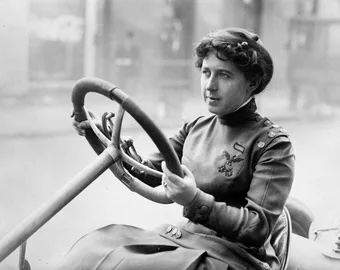
Joan Newton Cuneo
By Mary Hoar, City of Yonkers Municipal Historian, recipient of the Key to the City of Yonkers, President Emeritus Yonkers Historical Society, recipient of the 2004 Key to History, Yonkers Landmarks Preservation Board Member, Founder of Revolutionary Yonkers 250 and President Untermyer Performing Arts Council
Monday, May 4th
1927: Yonkers’ George Snowden was awarded the 1927 $8,000 American Prixe de Rome Award for sculpture; this fulfilled his dream of many years to study art abroad. He studied at Yale under Rodin expert Robert Eberhard, and was appointed an instructor of sculpture in 1926, before he graduated. Rodin bequeathed his sculpting tools to Eberhard; Eberhard passed them on to Snowden.
Tuesday, May 5th
1911: Second Precinct Motorcycle Policeman Alex Reed arrested Joan Newton Cuneo, one of “the most daring women auto drivers” in the country, for driving 43 mph on Central Avenue on her way to her home in Scarsdale.
When she whizzed past the officer on Yonkers Avenue near the racetrack, Reed assumed the car was out of control and raced to help her stop the car. She slowed as she turned on Central Avenue but picked up speed again. When she turned onto Tuckahoe Road, he finally was able to stop her and arrest her for driving 43 mph. She thought it was a joke, so drove him—and his motorcycle– to the Second Precinct.
When she realized she really was arrested, she asked to be “let go,” with a promise never to speed in Yonkers again! She was sent to the Yonkers City Court; Judge Beall accepted her plea of guilty and paroled her until the next day if she appeared during regular court hours.
Wednesday, May 6th
1911: Judge Beall accepted Johanna Cuneo’s plea of guilty over the phone and fined her $10. Court Clerk Harry Ritchie notified her of Beall’s decision, a decision characterized by many as an act of gentility.
Five days later Mrs. Cuneo hit six-year-old John Cione crossing Broadway in New York City. She took him to Roosevelt Hospital, where he was diagnosed with a severely fractured skull; hospital physicians had no hope for his recovery.
Thursday, May 7th
1920: The funeral for the late Anson Baldwin was signaled by the ringing of the St. John’s Episcopal Church bell from the bell tower rebuilt by his great-grandfather Ebenezer Baldwin116 years earlier. The original belltower built by the Philipse family had needed extensive repair; Ebenezer came from Connecticut to rebuild the steeple and belfry. The carpenter was persuaded by the small population to stay in Yonkers! When the War of 1812 broke out, Baldwin, then Major Baldwin, recruited 30 men and brought them to Long Island for training for the war some called our second War of Independence. The family lived in a two-story brick home at North Broadway and Dock Street; one daughter married Alexander Smith and another married William Waring of the hat factory family.
Friday, May 8th
1950: New York Port Authority met with New Jersey Turnpike Authority; they announced their decision to build a bridge across the Hudson either at Dobbs Ferry or Yonkers where Yonkers-Alpine ferry operated.
Governor Thomas Dewey put his foot down. The NYS Authority wanted the bridge at the widest part of the Hudson River, between Tarrytown and Nyack, a plan backed by Dewey.
1952: Yonkers residents learned about a new substance, Dextran, developed at Refined Syrups and Sugars on our Yonkers riverfront. Dextran could be used as a “volume extender” for blood plasma; the company was quick to point out it was not a substitute for blood, but would supplement a short blood supply. It could be bottled and stored indefinitely, ready to be used if ever needed.
Saturday, May 9th
1922: Yonkers Detectives John Fitzpatrick and Charles Ward and a few NYPD officers arrested four Iridio-Platinum-Gold Company executives on charges of first-degree larceny!
At the time of their arrest, the men were “working a claim” on their Yonkers “mining property,” Nepera Park’s Sidebotham Estate. The company’s description of their Yonkers’ “mother lode” claimed it had eight trillion dollars in gold, two trillion dollars in platinum and one hundred million dollars in silver.
1929: The was a major split in the Yonkers Museum of Science and Arts Board of Managers after the Museum of Natural History offered them a full-grown elephant!
The museum already had a stuffed giraffe in its collection at Trevor Mansion; staff from the New York museum visited to determine if the elephant would fit through the door. Some museum trustees thought the Yonkers facility should stick to smaller exhibits; Museum Curator Berkeley said he would “deem the presence of the elephant in the Museum’s cloistered precincts a source of embarrassment.”
Because of the topic’s contentiousness, Board President Edwin Mott and Elliot Bailey, very interested in animals, visited Mayor Fogarty. The three anti-elephant trustees were the art members of the board led by Rudolph Eickemeyer; three other board members were “pro-elephant.” The remaining trustees didn’t voice opinions.
After the meeting, Fogarty said there were considerations to weigh.
Sunday, May 10th
1904: American Real Estate Company began remodeling the old Getty homestead on South Broadway into a hotel. The building, called the Park Hill Inn, with two three-story extensions, would open in October.
1939: The Yonkers Museum of Science and Arts, still celebrating acquisition of a stuffed giraffe, learned it would receive the stuffed elephant “Tip” from the Museum of Natural History. Former circus performer Tip had a dark past; while living in the Central Park Zoo, he killed a couple of his handlers.
A few board members against accepting the pachyderm, claimed he was too big to be brought into the museum. They were correct! Tip got stuck in the doorway and workers had to take apart doorframes to bring him inside.
Any questions on this column, email yonkershistory1646@gmail.com.
For information on the Yonkers Historical Society, the Sherwood House Museum on Tuckahoe Road or their upcoming events, please visit their website www.yonkershistoricalsociety.org, call 914-961-8940 or email info@yonkershistoricalsociety.org.