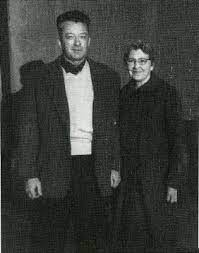
Hugh Francis Redmond with his mother during her visit to his Chinese prison in 1957
By Mary Hoar, City of Yonkers Municipal Historian, recipient of the Key to the City of Yonkers, President Emeritus Yonkers Historical Society, recipient of the 2004 Key to History, Yonkers Landmarks Preservation Board Member, Founder of Revolutionary Yonkers 250 and President Untermyer Performing Arts Council
Monday, April 20th
April 21, 1941: Dr. Jewett Frazer of Arlington Chemical Company introduced the American College of Physicians to a new food concentrate providing the nutritional equivalent of a steak and eggs meal. Marketed in a granular form in both chocolate and “neutral” flavors, it was called Aminoids; it also contained amino acids to ensure none were missing from anyone’s diet.
Arlington Chemical was founded by John Andrus.
April 20, 1942: Eighteen months earlier, German bombers had dropped a 550-pound bomb on the British Waygood-Otis factory, destroying much of the building… fortunately, the incendiary did not kill anyone!
Workers got it out of their building and sent it to their Yonkers headquarters, where it was exhibited in the Administration Building lobby.
Otis chemists analyzed the bomb nose. They found it was made from “a very poor grade of metal,” causing one Yonkers’ engineer to comment, “If we put out that kind of stuff, we’d be shot!”
Tuesday, April 21st
April 21, 1930: Pelegrina Nunez finally had her day in court. She testified Thomas Alonzo threatened to kill her if she did not leave her husband and run away with him. When she refused, Alonzo shot her in the head, then tried to kill himself.
April 21, 1937: Joining the nationwide walkout against war, Yonkers College students held a rather unique “sit-down strike” for peace. Students had to attend their regular assembly; instead, they gathered in the auditorium and listened to peace talks given by Rabbi William Margolis and English Professor Russell Craft.
April 21, 1942: Wide World Features, part of the Associated Press, featured a typical American mother with a war production job, showing how she managed both her job and “kept the home fires burning!”
Who was chosen? Mrs. Max Sell of Palisade Avenue! She manufactured cotton duck at Smith Carpet, the largest mill in the world. Her two-year old son Clemons attended a local nursery school costing 25 cents a day while she and her husband worked.
Wednesday, April 22nd
April 22, 1943: City Manager William Walsh learned Habirshaw Cable and Wire Corporation was searching for property for employee parking near its Point Street plant. Walsh had advised company attorney, former Mayor William Wallin, about the severe noise, traffic and parking congestion created by Habirshaw night workers on Woodworth and Ravine Avenues. He ordered the company to make provisions for employees’ parking.
April 22, 1953: Proponents for citywide Common Councilmanic elections and abolishment of the Yonkers ward system held a “Spot-Zone” forum at Roosevelt High School. Former Mayor Edith Welty, spearhead of proportional representation and City Manager form of government, was keynote speaker. She strongly stated the current system discriminated against the Ninth, Tenth and Eleventh Wards.
Thursday, April 23rd
April 23, 1943: Aranya Smart, Chairman of Yonkers War Savings Staff Women’s Division, announced results of Yonkers schools’ ongoing “Schools-at-War” jeep campaign. Six Yonkers schools financed 38 Army jeeps! Crestwood’s School Fifteen bond drive slogan, “The Sky’s the Limit,” facilitated 15 jeeps. School Seven financed seven and Roosevelt High purchased bonds for six. School Twenty-Six only had 100 students… yet financed five jeeps! Other schools purchased thousands of dollars of bonds and stamps.
April 23, 1953: The US State Department announced the Chinese Communist Government had taken Hugh Francis Redmond of Floral Lane prisoner. Redmond had been overseas for five years, working as an importer.
Friday, April 24th
April 24, 1937: Westchester, especially Yonkers, was hit with a food poisoning epidemic; Yonkers, with 75 people sick, had 1/3 of the county cases. Our Health Officials blamed Cushman Sons bakery, as every affected Yonkers’ resident either had eaten a Cushman cream puff or a Cushman éclair with dinner before getting ill! Yonkers’ City Laboratory staff members Dr. Frederick Weedon and Florence Knacke tested Cushman bakery’s sample pastries, including feeding a piece of a Cushman éclair to a little white mouse.
April 24, 1942: Yonkers learned machine shops at Alexander Smith and Sons Carpet Company were manufacturing “heavy parts” for the US Navy. Although no exact information was released, pictures the Navy cleared for publication showed unfinished cylindrical parts, believed to be for machine guns, heavy naval guns, and/or battleships.
Saturday, April 25th
April 25, 1932: Cardinal Hayes promoted Reverend Joseph Pernicone, Assistant Pastor of Mount Carmel Church, to pastor of Our Lady of Mount Carmel in Poughkeepsie. While pastor in Poughkeepsie, he served as Master of Ceremonies at the 1937 Requiem Mass for Guglielmo Marconi, inventor of wireless telegraphy. In 1954, Pernicone was appointed an auxiliary bishop of New York and titular bishop of Hadrianopolis in Honoriade by Pius XII.
Sunday, April 26th
April 26, 1935: The Yonkers Health Laboratory narrowed the cause of Westchester’s mass food poisoning to two possibilities: Staphyloccus and the paratyphoid group. Yonkers cases had risen to 175 cases; Westchester’s cases now totaled 703, making this the worst food poisoning epidemic in Westchester’s history.
April 26, 1942: Speaking at the American College of Physicians Convention in St. Louis, Arlington Chemical Company President Dr. Jewett Frazer reported the company had done 22 medical and nutritional studies on prefabricated food! Their food, made from meat, cereal, skim milk and yeast, was treated by enzymes.
According to Frazer, Arlington Chemical hoped their prefab food would aid wounded soldiers on the battlefield since blood and tissues quickly assimilated it without being digested.
Company preliminary testing found the prefab food was useful for postsurgical patients; potentially it could be used to treat burns, hemorrhages, wounds, and infections caused by battlefield injuries.
Any questions on this column, email yonkershistory1646@gmail.com.
For information on the Yonkers Historical Society, the Sherwood House Museum on Tuckahoe Road or their upcoming events, please visit their website www.yonkershistoricalsociety.org, call 914-961-8940 or email info@yonkershistoricalsociety.org.