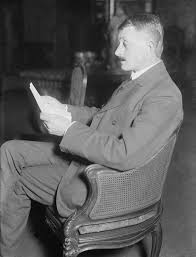
British Poet Laureate John Masefield wrote some of his works while in Yonkers
By Mary Hoar, City of Yonkers Municipal Historian, recipient of the Key to the City of Yonkers, President Emeritus Yonkers Historical Society, recipient of the 2004 Key to History, Yonkers Landmarks Preservation Board Member, Founder of Revolutionary Yonkers 250 and President Untermyer Performing Arts Council
Monday, March 2nd
March 2, 1918: Leslie Sutherland was elected Chair of the Catholic War Fund Campaign, slated to start on March 17th, St. Patrick’s Day. The fifteen Yonkers Roman Catholic churches and the Knights of Columbus had committed to raise $82,800 with the assistance of patriotic non-Catholic Yonkers citizens… like Mr. Sutherland.
March 2, 1923: Assemblyman Russell Livermore of the Fourth Westchester district stopped by the Yonkers City Clerk’s office to pick up copies of bills approved by the Common Council. He was the son of Arthur and Henrietta Wells Livermore, founder and first president of the Women’s National Republican Club.
March 2, 1947: Douglas Crier was elected President of the Yonkers Branch of the NAACP.
Tuesday, March 3rd
March 3, 1934: The Rotary club launched their campaign against obscene literature, focusing on the type banned from being mailed, but still on sale at the newsstands.
March 3, 1945: Habirshaw Cable Company announced expansion of its local facilities to include a fourth plant at the foot of Main Street where National Sugar Refinery once stood. Habirshaw spent $757,000 for the facility and was to employ several hundred men to make the needed wire. As soon as installation started, machinery started producing much needed strand wire for the US Signal Corp.
This most likely was the waterfront location where top secret Operation Overlord cable was constructed, the operation— and cable– many later credited with being responsible for D-Day’s success.
Wednesday, March 4th
March 4, 1945: Four eleven-year-old South Yonkers boys held a puppet show to raise money for the Red Cross! Starting off as a rainy-day activity, it soon became a benefit performance for the Yonkers branch. Dave Wies, Paul Knepfer, Dale Grand and Arnold Knepfer joined their efforts, making scenery and props, and writing a script for the three puppets the boys would use. They performed their show at the Wies Valentine Avenue apartment; at the end of the show, one of the marionettes made a touching speech asking for donations. The boys were able to donate $5.75 to the Red Cross Drive and had very proud parents!
Thursday, March 5th
March 5, 1916: An unpublished poem written by John Masefield was found in Philadelphia; Masefield wrote the poem while working in the Smith Carpet Shop in 1898.
March 5, 1928: Protests against the scheduled appearance of Roscoe “Fatty” Arbuckle at Loew’s Theater were filed with Public Safety Commissioner Frank Devlin by Florence Macbean, an official of the Charity Organization Society. Miss Macbean stated “Arbuckle’s appearance here would have a bad influence on the morals of our City.”
Many believed the 1921 death of actress resulted from an encounter with Arbuckle, an encounter he denied.
Friday, March 6th
March 6, 1942: New York Daily News columnist Ed Sullivan mentioned Yonkers native Brigadier General Frank Brady in his column; hero aviator Brady, the son of late Yonkers Police Captain Hugh Brady, won many awards for his courage fighting in the skies over Java.
March 6, 1948: After reading correspondence from Refined Syrups and Sugars about the “inadequacy of service and lack of punctuality” on the NY Central’s Hudson Line, the special committee of Yonkers citizens and officials appointed by Mayor Curtiss Frank discussed the issue. They developed a list of suggestions to improve the line’s service.
Saturday, March 7th
March 7, 1906: Former Fire Commissioner and well known builder George T. Kelly gave the Yonkers Fire Department a personal check for more than $2,500; the check was to pay salaries of the men who had not received their money due to the Yonkers fiscal crisis.
March 7, 1928: After Public Safety Commissioner Frank Devlin requested an opinion, Corporation Counsel Leonard McAneny ruled an appearance of Roscoe “Fatty” Arbuckle at Loew’s Theater, would not constitute “an offense against public decency.” Yonkers had no legal right to block his appearance. Arbuckle had been tried three times over the incident. Twice the jury couldn’t reach a verdict; the third trial found him innocent.
Sunday, March 8th
March 8, 1930: The Nathan family announced Fairlawnm their late mother’s North Broadway estate, would be auctioned to close her estate. The property on Yonkers’ northern border included a twenty-five room home with a baronial hall, an open staircase, large fireplaces, a picture gallery, music room, library, servants’ quarters and complete kitchen equipment. The outbuildings on the estate were greenhouses, a gardener’s cottage and a large garage with chauffeur’s quarters. Bluestone drives, broad lawns, mature trees and shrubbery completed the package.
May 8, 1944: Seaman First Class Andrew Reed sang the praises of Yonkers. Reed arrived in Yonkers on a ship needing repairs at Blair Shipyard. When the work started, the men were given a furlough. Every Yonkers resident he met was welcoming. One night, he and a shipmate returned from Manhattan and waited for a trolley to take them back to their ship. Vincent Borelli of Van Cortlandt Park Avenue, passing by in his car, saw them and gave them a ride back to the ship. The next morning Borelli found Reed’s wallet with $51. He tried to reach the sailor with no luck, so Borelli asked YPD to help. YPD found Reed’s ship had sailed but continued efforts to locate him. Reed was found at the Brooklyn Navy Yard; he was told to report to police headquarters. The sailor was delighted to get his wallet, papers and money back!
Borelli refused a reward, stating he was “glad to do something for someone in our armed services.”
To quote the sailor, Borelli and the officer were “just about tops!”
If you have questions, please email yonkershistory1646@gmail.com.
For information on Yonkers Historical Society, Sherwood House and upcoming events, please visit their website www.yonkershistoricalsociety.org, call 914-961-8940 or email info@yonkershistoricalsociety.org