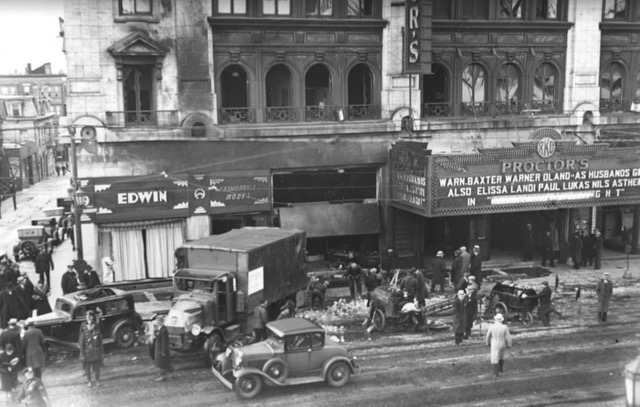
Photos of the RKO explosion in 1934. Proctor’s theater, located on South Broadway, is still behind what is now an office building.
By Mary Hoar, City of Yonkers Municipal Historian, recipient of the Key to the City of Yonkers, President Emeritus Yonkers Historical Society, recipient of the 2004 Key to History, Yonkers Landmarks Preservation Board Member, Founder of Revolutionary Yonkers 250 and President Untermyer Performing Arts Council
Monday, February 23rd
February 23, 1934: An electrical explosion in front of RKO Proctor’s Theatre on South Broadway killed three people. Motorcycle Officer Patrick Whalen and passerby Michael Gruber leaped into the cellar to save a young girl they saw the explosion throw into the pit of flames. The men managed to push 10-year old Gloria D’Addio to safety before they died. James Frazier, who had been working on a transformer in the basement, later passed away from severe burns.
February 23, 1937: Showing extraordinary courage, bravery and quick-wittedness, 33-year old Oak Street’s Warren Williams prevented 8-year old Emilio Prestano from being carried into the flume leading to the Hudson and certain death in the swirling waters of the Nepperhan Creek. Emilio had attempted to walk across the old sewer pipe near Fire Headquarters and fell into the creek five feet below.
Seeing the young unconscious youngster in the river, Williams ran to the School Street Bridge and plunged into the Creek to save him.
Williams, father of two children, received the highest praise and commendation from the Yonkers Common Council.
Tuesday, February 24th
February 24, 1918: Saunders Trades School received a letter from “somewhere in France,” thanking students for the hospital supplies they made for French hospitals to treat people injured during the war.
February 24, 1943: C. Van Ness Wood of the Greystone Holding Corporation made an offer for a large parcel of the Yonkers owned property, the former Brandt Farm on Saw Mill River Road. They offered $1200 for the property; a war firm wanted to build a garage and other structures on the land. Wood informed the Council they had all needed priorities for building materials. The Council was concerned the purchase would block the right of way to city holdings behind the property. Wood indicated they would purchase nearby land to leave the right-of-way, but also specified the deal needed to be made quickly, or his client would move planned operations to New Jersey.
Wednesday, February 25th
February 25, 1918: Yonkers Bakers began making “Victory Bread.” According to the National Food Administration regulations, twenty percent of flour substitutes had to be mixed with wheat flour.
February 25, 1928: Dr. Frederick Dieterich, Director of the Bureau of Laboratories, announced he would establish a blood donors’ registry in Yonkers!
Thursday, February 26th
February 26, 1910: Vassar graduate Elsie LeGrand Cole told a Woman’s Day rally in Teutonia Hall her part in the shirtwaist makers’ strike in NYC opened her eyes to the needed social and economic reforms in industry. She added, if women were allowed to elect lawmakers, many social and industrial hardships would be eliminated.
February 26, 1914: George T. Kelly, builder of Yonkers “new” City Hall, purchased William Allen Butler’s home at the southeast corner of North Broadway and High Street. Kelly planned making interior and exterior alterations.
Thursday, February 27th
February 27, 1925: The Woman’s Clubs of Yonkers entertained the Westchester County Federation of Woman’s Club. The main topic of discussion at the morning and afternoon sessions was “Good Government.” Mrs. Lawrence Tanzer lead an open forum on the Woman’s Jury Bill, Marriage Law and the Child Labor Amendment. Lunch was served at the Central Methodist Church, and the Chaminade Club provided musical entertainment for the visitors.
February 27, 1941: While speaking to “Wake Up Yonkers,” a group she founded, Edith Welty reported a group of “Lone Wolves” were organizing to “back Mrs. Welty.” She continued, “a prominent citizen” told her he was forming an organization of people who were not Republicans, not Democrats, just “Lone Wolves.”
Saturday, February 28th
February 28, 1936: After carefully reviewing a plan suggested by the Yonkers Chamber of Commerce, Westchester Director for the National Youth Administration (NYA), Adah Hopkins Aime submitted the plan to State NYA Director Karl Hesley.
Hesley and Yonkers Public Safety Commissioner Denis Morrissey enthusiastically tentatively accepted the plan to have guards at street crossings! Fifty men would be hired; their special training would include Red Cross First Aid. Their equipment would include whistles and special caps; they would be on duty morning, noon and school closing hours. Adah Hopkins Aime was the sister of Federal Relief Administrator Harry Hopkins, both former Yonkers Residents.
February 28, 1952: Sansone brothers Daniel and Anthony pled guilty to gambling charges, running a policy slip operation out of their School Street produce business. Assistant District Attorney Morton Edminston moved to dismiss two other charges against the brothers. They received maximum potential penalties; Daniel received six years and Anthony four.
Sunday, March 1st
March 1, 1895: John Copcutt’s will was filed for probate. The petition said the estate was not worth more than $150,000. He left property at 127 Buena Vista Avenue to his sister-in-law Ann Maria Phelp and daughter Ann Elizabeth Hyde was left the Nepperhan Avenue brick house where she lived. Daughter Rebecca Medwin Leale, wife of Dr. Charles Leale, the doctor who treated President Lincoln immediately after he was shot, received a house on Hudson Street. Copcutt’s wife Rebecca received the remainder of the estate. Son William owed the father more than $310,000 and was asked to sign a general release of all claims against the estate; if he did so, all his debts would be forgiven. Son John and the three daughters were executors of the will.
March 1, 1930: To fill the need for a high powered car, a sedan capable of driving 90 miles an hour was given to the Police Department Detective Division to be used for emergency calls.
Questions or comments on this column? Email YonkersHistory1646@gmail.com.
For information on the Yonkers Historical Society, Sherwood House and upcoming events, please visit their website www.yonkershistoricalsociety.org, call 914-961-8940 or email info@yonkershistoricalsociety.org.