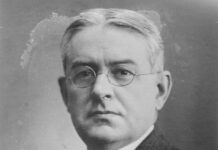
Admiral Husband Kimmel, from Yonkers
By Mary Hoar, City of Yonkers Historian, President Emeritus Yonkers Historical Society, recipient of the 2004 Key to History and the Key to the City of Yonkers, Yonkers Landmarks Preservation Board Member, Founder of Revolutionary Yonkers 250 and President Untermyer Performing Arts Council
Monday, January 12th
January 12, 1944: The Tarrytown Division of Eastern Aircraft announced they would not hire new women trainees from our School of Aeronautical Manufacturing for at least two months. Many students had completed more than 400 hours of training; they were given the opportunity to apply for jobs at other area war plants. Representatives from Otis Elevator, Habirshaw Cable and Wire, Anaconda Wire and Cable, and North American Phillips Companies interviewed students interested in working at their plants. Yonkers War industries Training Director Dr. Lawrence Ashley announced Otis would hire multiple people immediately. He later revealed students who wanted jobs in aviation would have to work away from our immediate area.
He revealed the school had trained more than 2,000 men and women in 1943; these former students now worked at companies in Yonkers, Manhattan, Brooklyn, Long Island, New Jersey, Connecticut, California, Pennsylvania, and Rome, NY.
Tuesday, January 13th
January 13, 1943: Brigadier General James Doolittle, commander of the North Africa US Air Forces, announced Lieutenant George Eward Jr. of Purser Place received an award for service against the enemy in North Africa. After graduating from the Air Force Advanced Flying course the previous summer, he received commendation for “meritorious conduct and outstanding progress in military training as an aviation cadet!”
January 13, 1945: Captain John Crocker, son of Dr. and Mrs. William Crocker of Argyle Terrace, was reported missing in action in Belgium. Crocker attended Gorton High School and then Phillips Exeter Academy. He was a 1935 Cornell University graduate; at Cornell, he won the Barton Medal for being the “outstanding soldier” in his class. At the time he was called to serve, Crocker was a Pennsylvania businessman. His father John was Director of the Boyce Thompson Institute for Plant Research and a Trustee of the Yonkers Board of Education. His mother Persis was the Civilian Mobilization Chair of Yonkers.
Wednesday, January 14th
January 14, 1864: President Abraham Lincoln and his cabinet sent a letter to the Yonkers’ Sanitary Fair Committee to raise money for wounded Civil War servicemen. After being raffled, the winner donated the letter to the people of Yonkers; it now is on display at Philipse Manor Hall, previously Yonkers City Hall.
January 14, 1928: At the annual YMCA meeting, members voted to allow Catholics, Unitarians and members of a few other churches to become voting members and to serve on the board of directors of the organization.
Thursday, January 15th
January 15, 1934: Modern dance pioneer Hemsley Winfield of 24 Wolfe Street passed away from pneumonia; he was 26 years old. The first African American under contract to the Metropolitan Opera, he danced the role of the Congo Witch Doctor in the premiere of The Emperor Jones opera in 1933, he founded the New Negro Art Theater. He was the first African American to appear on the concert dance stage.
Winfield graduated from School Thirteen and Yonkers High School; he studied at Columbia University before entering the world of dance and drama.
January 15, 1943: Brigadier General James Doolittle, commander of the US Air Forces in North Africa, presented twenty-year-old Yonkers resident George Ewald Jr. of Purser Place an award for meritorious service against the enemy in North Africa.
A graduate of Yonkers High School, after completing the Air Force Advance Flying School at Mather Field, California, Ewald received commendation for his “meritorious conduct and outstanding progress in military training as an aviation cadet.”
Friday, January 16th
January 16, 1947: Admiral Husband Kimmel of Bronxville Road, Yonkers, revealed to a joint Senate-House Committee he received death threats when he returned to the U.S. after the Pearl Harbor attack; he told the committee he had asked the Navy to do nothing more to inflame the public against him.
Kimmel was the Admiral in charge of Pearl Harbor December 7th, 1941; three weeks later, Admiral Chester Nimitz was appointed commander of the Pacific Fleet. A month later, a five-man commission headed by Associate Supreme Court Judge Owen Roberts claimed Kimmel’s and (Army Commander of the Hawaiian Department) General Walter Short’s errors of judgment “were the effective causes for the success of the attack.”
Kimmel, made no public statements at the time, later said at his Court Martial he had received no intelligence reports on impending danger. The two men also were accused of not cooperating and communicating, a premise both strongly denied.
Kimmel later was cleared of the charges.
Saturday, January 17th
January 17, 1942: Yonkers Police Office Peter Dankowitz and Saunders Trade School electronics instructor Edward Madden were designated to conduct a remote-control test on one of the air raid warning sirens; the hope was this would determine if all Yonkers sirens could be operated by short wave radio signals.
January 17, 1945: Yonkers Civilian Protection Director George Bell announced a special elongated two-to-three minute “blue air raid siren” would warn people if Yonkers was being hit by a robot bomb attack. Hearing the blast, all civilian protection volunteers were to report immediately to their stations to await orders.
Sunday, January 18th
January 18, 1924: Dr. Leo Baekeland, creator of Bakelite in his Nepera Park plant, was named an officer of the French Legion of Honor.
January 18, 1944: John Doherty, First Aid Director for Yonkers Red Cross, spoke proudly of all the teenage girls who volunteered to donate blood. He had to refuse their generous contributions as they were too young to donate blood; the age limit was eighteen… and eighteen-year-olds had to have their parents’ consent to donate.
Questions or comments on this column? Email
YonkersHistory1646@gmail.com.
For information on the Yonkers Historical Society, Sherwood House and upcoming events, please visit our website www.yonkershistoricalsociety.org, call 914-961-8940 or email info@yonkershistoricalsociety.org.