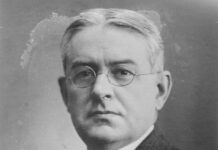
Yonkers native and Yonkers High School graduate Dr. John Winthrop, winner of the 1946 Nobel Prize in Chemistry
By Mary Hoar, City of Yonkers Historian, President Emeritus Yonkers Historical Society, recipient of the 2004 Key to History, Key to the City of Yonkers, Yonkers Landmarks Preservation Board Member, Founder of Revolutionary Yonkers 250 and President of the Untermyer Performing Arts Council
Monday, November 17th
November 17, 1944: “Salute the Navy” and a Navy Band stopped in Yonkers, to promote our Sixth Bond Drive. Accompanied by WAVES, Coast Guardsmen, and Army equipment, they marched from Larkin Plaza to the World War Memorial on South Broadway where they held a program to inspire Yonkers to buy bonds; our Yonkers’ subscription quota was $12,600,000.
Sergeant Robert Friedman, Buena Vista Avenue, was the featured speaker; he held three Presidential Citations, a Purple Heart, a Silver Star and the Infantryman’s Combat Badge with laurels, received because of his heroic actions in three invasions.
The first buyer was Travers Avenue’s discharged veteran David Rifkin who had served in North Africa.
Tuesday, November 18th:
November 18, 1777: British General Tryon sent Hessian troops to pillage and burn homes in Philipse Manor. The Hessians allegedly stripped women and children of clothing, then turned them out into the cold. Old men and boys were led to enemy lines wearing little but a halter the Hessians put around their necks to lead them.
Patriot newspapers severely condemned Tryon for making war on women, children and the elderly.
November 18, 1926: Michael Landy, Superintendent of Yonkers’ Department of Combustibles, ordered contractors building a theater at South Broadway and Herriot Street to stop blasting with so much force and noise. Officials at St. Joseph’s Hospital reported doctors could not perform surgery because the explosions were so intense, its building shook with each blast.
November 18, 1932: Yonkers joined the Keskeskick Chapter, DAR, to observe the reopening of Philipse Manor Hall, Manor House Square’s renovated historic landmark, and celebrate Yonkers Days!
A torchlight parade with music, banners and streamers kicked off the celebration; theater screens, milk bottles and laundry bundles advertised it. One hundred seventy-five merchants celebrated Yonkers Days, all selling quality merchandise at record low prices.
Trolley cars and buses not only announced the event with posters, they provided free transportation during Yonkers Days’ morning shopping hours!
Wednesday, November 19th:
November 19, 1919: Jockey Club Chairman August Belmont sold Fair Play, considered by many the best horse he ever raced and the top stallion of his Nursery Stud, to Yonkers’ Gifford Cochran for a record breaking $100,000, topping William Whitney’s purchase of Hamburg. Fair Play had sired Man o’ War and Mad Hatter.
Yonkers believed Cochran wanted to breed his own winning racing stable.
November 19, 1946: Nobel prizes were awarded to two former Yonkers residents! Dr. John Mott, internationally known religious leader and long-term head of the YMCA, received the Nobel Peace Prize; Dr. John Northrop received the Nobel Prize in Chemistry for his work preparing enzymes and virus proteins in a pure form. Northrup graduated from Yonkers High School. Dr. Mott lived in Yonkers for many years; he received his award for creating a peace-promoting brotherhood across national boundaries.
Thursday, November 20th:
November 20, 1934: Investigation by Assistant Corporation Counsel Hannon unearthed a forgotten Court of Appeals’ decision invalidating the New York City bill to annex Yonkers. His research started after Bryn Mawr Park resident Clem Roeder criticized City Clerk William McCabe for “jumping the gun.” After the Common Council voted against annexation, McCabe notified the State Assembly leadership Yonkers was against the plan. Roeder claimed Yonkers residents favored annexation, so the City Clerk asked our Legal Department for an opinion.
McCabe was able to remind Roeder New York voters approved a 1927 constitutional amendment prohibiting annexation without a referendum in the affected municipality. More important, the Court of Appeals ruled “no home rule bill of political subdivision in the state is effective,” meaning the state legislature could not override wishes of the locality, canceling NYC’s attempt to grab Yonkers!
Friday, November 21st:
November 21, 1926: Public Works Commissioner William Goldsmith rejected the proposed city dump on Saw Mill River Road by Sprain Ridge Hospital. He believed drainage from the site into the Nepperhan River would contaminate our water supply.
November 21, 1944: Fire broke out on the Swedish liner Gripsholm, anchored off Yonkers. By the time our firefighters reached the ship, its crew had extinguished the blaze.
Between 1942 and 1946, the US chartered Gripsholm transported exchanges of POWS and US citizens caught behind enemy lines a dozen times.
Saturday, November 22nd:
November 22, 1919: The Prince of Wales, later King Edward VIII and the Duke of Windsor, decorated three Yonkers men with British Military Medals; the ceremony took place on the HMS Renown, lying in the Hudson River off Manhattan.
Angus Robertson of Van Cortlandt Park Avenue was a former Sergeant and recipient of the Distinguished Service Cross awarded for heroism in action before the Hindenburg Line.
Besides receiving the Distinguished Service Medal from General Pershing and the Croix de Guerre from France, Thomas Dean of Elinor Place received the British Military Medal from the Prince.
The third, Sergeant William Spencer of Cliff Street was awarded a decoration from the Prince of Wales for his “conspicuous services” during the war, showing extraordinary bravery under fire by silencing a machine gun nest and killing four Germans. He also was honored with the US Distinguished Service Medal and the French Croix de Guerre.
Sunday, November 23rd:
November 23, 1943: Otis Elevator was notified its Yonkers plant won the Army-Navy production award for “high achievement in the production of war material,” for the third time; included was a tribute from Under Secretary of War Robert Patterson. He commended the Yonkers men and women employees for setting “an inspiring example for your fellow Americans on the production front.” The Yonkers Otis plant was entitled to fly an “Army-Navy E flag” with two white stars.
Questions or comments on this column? Email YonkersHistory1646@gmail.com.
For information on the Yonkers Historical Society, Sherwood House and upcoming events, please visit our website www.yonkershistoricalsociety.org, call 914-961-8940 or email info@yonkershistoricalsociety.org.