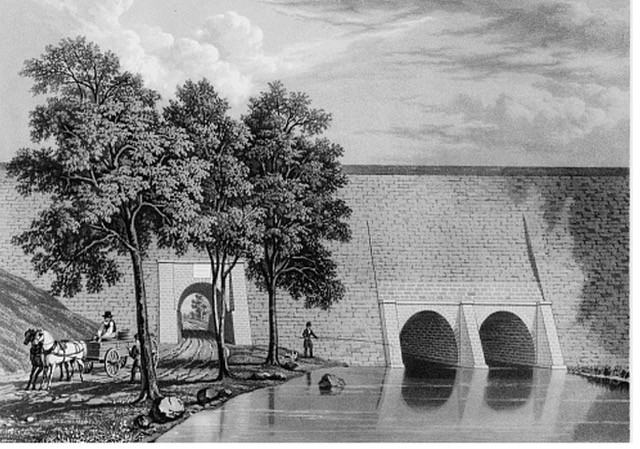
The Old Croton Aqueduct Bridge over Nepperhan Avenue, Yonkers.
By Mary Hoar, City of Yonkers Historian, President Emeritus Yonkers Historical Society, recipient of the 2004 Key to History, Yonkers Landmarks Preservation Board Member, Revolutionary Yonkers 250 Chair and President Untermyer Performing Arts Council
Monday, June 23rd
June 23, 1780: Grenadier and British regiments pitched camp at the Philipse Manor House.
June 23, 1917: To kick off the Red Cross seven-day drive to raise $100,000 for war work, Alexander Smith Cochran donated $25,000.
June 23, 1928: The first full-length film feature with words presented in Westchester County opened at the Strand Theater.
“Tenderloin,” a swift moving crime drama, starred Conrad Nagle and Dolores Costello. Produced and released by Warner Brothers and directed by Michael Curtiz, it was considered Curtiz’s most daring film.
It was a sound part-talkie crime film; in addition to sequences with clear conversation sequences, the film featured intertitles, i.e., text displayed on the screen.
Tuesday, June 24th
June 24, 1929: Sir Mortimer Singer, High Sheriff of the County of Berkshire and Yonkers native, died in London. Son of Isaac Merritt Singer, inventor of the Singer sewing machine, he was born in Yonkers July 25th, 1863. His parents later moved to France, then England at the start of the 1870 Franco-Prussian War. After studying at Cambridge, he became a naturalized British citizen about 1900. Sir Mortimer was named a Knight of the British Empire in 1920.
June 24, 1943: Nodine Hill men, mostly war workers, lost sleep because of a “peeping tom!” Children in the neighborhood were afraid of him and refused to play outside after dinner. War workers returning home at midnight were afraid to go to sleep until daylight; they wanted to keep watch over their families.
Neighborhood air raid wardens searched the area every night; if they spotted someone suspicious, they blew whistles, and area residents ran out to join the search.
YPD detectives answered an early morning call to find more than 40 people armed with rocks, clubs, pipers, bricks and other makeshift weapons. Why? Someone had attempted to sneak into 110 Webster Avenue.
June 24, 1943: After meeting with a representative of a large American tobacco company, Mayor Benjamin Barnes suggested the Common Council create a “City Hall Cigaret Fund,” to buy discounted cigarettes for overseas soldiers.
The War Department stopped sending overseas packages from civilians and asked tobacco companies to come up with their own schemes to send cigarettes to American servicemen. Each pack of cigarettes cost five cents and was labeled as a gift from the people of Yonkers. They then were shipped by convoy to the men overseas.
Wednesday, June 25th
June 25, 1941: The three biggest companies in Yonkers— Smith Carpet, Otis and Habirshaw— announced they would restrict production for a week to allow employees to take annual vacations. Otis and Habirshaw gave workers the option to accept additional pay if they chose to work instead of taking a vacation.
Thursday,June 26th
June 26, 1942: Ralph Mulligan, Chairman of the Yonkers War Bond and Stamp Committee, announced bettors at Empire City Racetrack would be able to buy War Bonds and Stamps!
The Empire City Racing Association approved the Committee’s application for Red Cross volunteers to sell war bonds and stamps at the track. Local banks sponsored the sale, and booths in the clubhouse and grandstand were built with the cooperation of Track Superintendent Michael McDermott.
One booth would be in the clubhouse and two in the grandstand. Track announcements encouraged winners to take their winnings in War Bonds and Stamps!
June 26, 1943: The USO Junior Hostess Association asked the Common Council to immediately hire policewomen to deal with teenage girls loitering on Yonkers streets at night to pick up servicemen in uniform! The hostesses also asked curfews for minors be rigidly enforced.
Friday, June 27th
June 27, 1841: The Croton Aqueduct began supplying water by gravity to reservoirs in Manhattan, supplanting the polluted NYC water supply; it remained in service until 1955.
June 27, 1891: The cornerstone for the Soldiers and Sailors monument was laid with a copper box made by Thomas McVicar.
June 27, 1944: Yonkers Marine and Quartermaster Sergeant Hubert Lloyd of Caryl Avenue received cigarettes supplied by the “Yonkers Cigaret Fund” while stationed in the South Pacific! He promptly wrote a letter to his Caryl Avenue neighbor, Chairman of the Fund and City Clerk Francis Heafy. He stated, “It might interest you to know that the fine record shown by labor and industry there (Yonkers), a record which tops the entire Country, is greatly appreciated out here… it is, indeed, heartening to know your hometown is in there, pitching.”
Saturday, June 28th
June 28, 1927: The Yonkers All Stars, a newly formed semi-pro club under the management of Walter Donohue, played their premier game at Pelton Oval against the Brooklyn Royal Giants. Team members were Tex Greening, Frank Debroske, Boss Landy, Bill Ungvarsky, Lou Becker, Lefty Brooks and Cy Barker. Pitcher Harry Beamish and catcher Pete Ormond completed the lineup. Umpire was Bill Grieve.
June 28, 1937: John Dickson, Sr., who pioneered wholesale distribution of newspapers in the United States, retired at the age of seventy-three. Dickson began with eight boys and went from street sales to house-to-house delivery in 1898, delivering the Yonkers Daily News… the first evening paper delivered in Yonkers. When the paper discontinued, he handled delivery of both The Yonkers Statesman and The Yonkers Herald until the two papers merged. After his death, The Herald Statesman management switched the delivery contract to George Goldstein, Buena Vista Avenue.
Sunday, June 29th
June 29, 1923: After witnessing the “tapping of the old Croton Aqueduct,” Water Bureau Superintendent Harry Foley announced this removed all danger of a Yonkers “water famine,” as the tapping sent 2,000,000 gallons into the Saw Mill River daily.
June 29, 1943: With the closing of the Getty Square Branch of the Putnam Division of the NY Central Railroad, the Office of Defense Transportation gave Club Transportation Company permission to operate an extra bus during morning and evening rush hours to bring the “Old Put” passengers to the Central’s Ludlow Station.
Questions or comments on this column? Email YonkersHistory1646@gmail.com.
For information on the Yonkers Historical Society, Sherwood House and upcoming events, please visit our website www.yonkershistoricalsociety.org, call 914-961-8940 or email info@yonkershistoricalsociety.org.