
A new climate assessment for the state of New York shows extremely hot days are fewer than in the early 1900s, drought is less severe, and Great Lakes water levels are stable
Sea level rise at The Battery in Manhattan is less than 3 millimeters per year with no acceleration
New York’s dairy, apple, and maple syrup production are all up
A new climate assessment for New York shows that there is no “climate crisis” in the Empire State.
New York has warmed by nearly 2.5°F since 1900, but the number of very hot days has declined and is lower than in the first half of the twentieth century, according to a new state-by-state climate assessment from The Heartland Institute.
The New York State Climate Summary, part of Heartland’s ClimateAtAGlance.com project, compiles data going back more than a century, including records from NOAA and the USDA. The study serves as an easy-to-verify counterpoint to the climate-crisis coverage New York regularly receives.
Some of the findings of the report are below.
- Fewer very hot days, not more. Days with highs of 95°F or above are less common in New York today than they were in the early 1900s. The warming is not coming from hotter summer days.
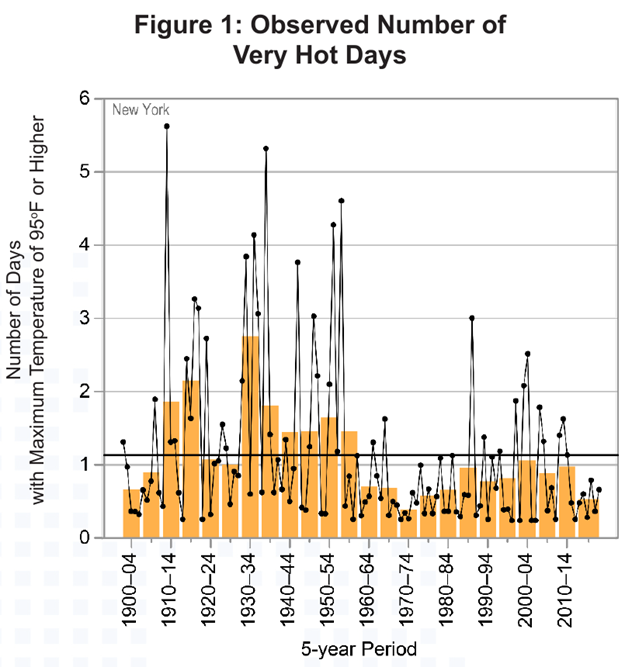
Figure 1: Observed number of very hot days in New York since 1900. Dots are annual values. Orange bars show averages over a 5-year period; the last bar is a 6-year average. The horizontal black line shows the average of the entire period. Chart source: Frankson, R., et al. New York State Climate Summary 2022.
- Milder winters, and a possible Urban Heat Island effect. Most of the warming comes from fewer very cold nights, with lows of 0°F or below, along with warmer nights in other seasons. Cold kills far more people than heat, so milder winters are a health benefit. Because the warming shows up at night without rising summer highs, the report points to the Urban Heat Island effect as a significant factor, as concrete, asphalt, and metal absorb heat during the day and release it at night.
- Sea level at the Battery is rising slowly, with no acceleration. The Battery at the southern tip of Manhattan has one of the longest sea-level records in the country, going back to 1856. It shows a steady rise of about 2.95 millimeters per year, less than a foot per century, and no acceleration.
- Drought is less frequent and less severe. Annual precipitation has gradually increased, especially since the 1970s. The severe, prolonged drought of 1965 has had no comparable successor, and the driest month on record was August 1965, while the wettest was September 2011.
- Lakes Erie and Ontario are stable. Lake Erie has been near or above average since the drought of the 1960s ended and is generally higher than in the early 1900s, and Lake Ontario’s levels are more stable than in the past.
Figure 2: Lake Erie Water Levels
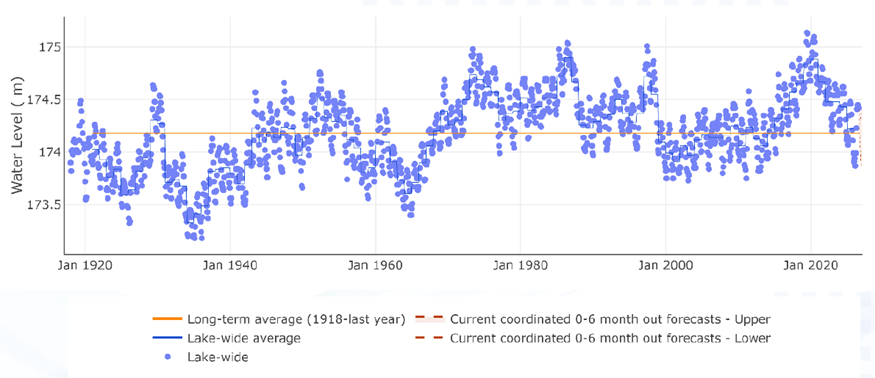
Figure 2: Lake Erie water levels since 1918. Chart from NOAA Great Lakes Environmental Research Laboratory “Great Lakes Water Level Dashboard.” Accessed August 14, 2026.
- Severe hail isn’t increasing. Severe hail of one inch or larger has not become more common in New York.
- Agriculture is growing. New York is among the top five dairy-producing states, and its milk production is up 49 percent since 1990. Apple production rose about 35 percent from 1980 to 2025, with yields up 82 percent. Maple syrup production has been up 121 percent since 1992, with yield per tap up 104 percent since 2001.
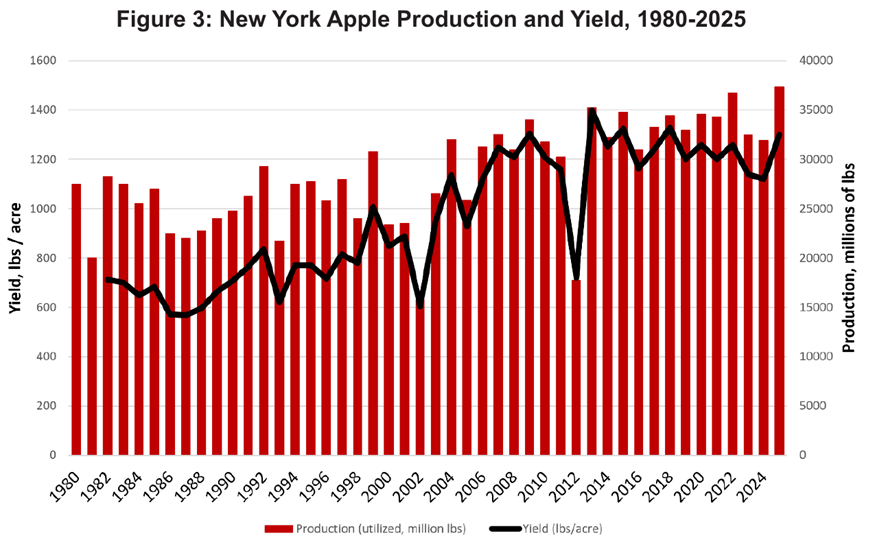
Figure 3: New York state apple production and yield, 1980-2025. Data from USDA Economic Research Service for 1980-2010, and National Agricultural Statistics Service for 2011-2025.
“Despite a lot of the doom and gloom in the media about the weather, where every heatwave or lack thereof in New York is hyped as part of a long-term march towards the apocalypse—this is not the case in the Empire State. Average temperatures have risen over the past century, but it’s not driven by extreme heat, but rather milder winters. There are fewer extreme heat days per year in New York today than there were in the early decades of the 20th century. Agriculture is doing well and there is no sign of any looming End Times disaster.”