
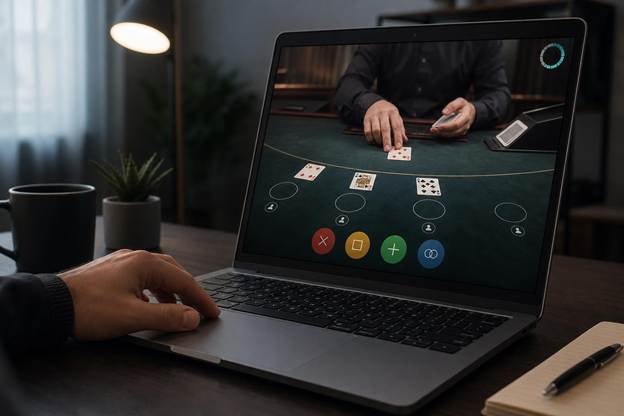
The dealer lays two cards on the felt. A total appears beside the player’s hand, a row of buttons offers the next move, and a countdown begins. Anyone used to navigating a video game will recognize the arrangement.
Live blackjack brings those familiar screen controls to a physical card table. Behind the dealer’s video feed, software collects decisions, tracks wagers and keeps each player’s view in step with the round.
The Table Extends Onto the Screen
At the studio table, the dealer shuffles and deals real cards. Players take part through a browser or mobile device, choosing a seat and selecting digital chips during the betting window.
For readers looking at live blackjack canada, the controls around the dealer’s image help explain how participation works. The balance shows the funds available, the wager display tracks money committed to the round, and the hand total appears beside the cards.
Gamers know this arrangement as a heads-up display: information placed around the main action so it remains easy to follow. Here, the camera supplies the view of the table while the surrounding controls give each remote player a way to act.
Buttons Follow the Hand
As the cards change, so do the choices on screen. Hit, Stand, Double Down and Split have separate buttons, with available actions enabled for the current hand. A plus sign can represent another card; opposing arrows can indicate a split.
The betting window has its own signals. Some layouts use green while bets are open, yellow as the deadline approaches and red once betting closes. When a player’s decision is due, a timer shows the remaining response time. The rules can specify Stand as the default action when that time runs out.
Players can sometimes submit their first decision before the dealer reaches their seat. The system holds the instruction until that hand’s turn arrives.
There are keyboard controls, too. Published game instructions include number keys for selecting chips, an undo command and Escape for closing windows, alongside mouse and touch controls.
The Video and Controls Must Keep Pace
A button press has to reach the game at the right point in the round. Card-reading equipment turns the physical cards into information the software can process, while control servers record activity and results.
The Michigan Gaming Control Board’s live game framework requires demonstrations of barcoded card-reading equipment and acceptable latency between the audiovisual feed and the interface. Latency is the delay between something happening and its appearance or response on screen.
The framework also requires results to be recorded before they are sent to the gaming platform. Controls must prevent late wagers.Together, these checks address the timing of the game as well as the accuracy of the information moving through it. Rules differ by jurisdiction: in Canada outside Ontario, operators such as ToonieBet are licensed by the Tobique Gaming Commission.
A Seat Can Mean Different Things
That coordination allows one table to support several forms of participation. In a conventional seven-seat layout, each seated player makes decisions for a hand. The screen identifies the player responsible for it.
Bet Behind introduces a different role. A participant wagers on a hand controlled by someone else, with settings covering certain additional choices. The seated player’s decisions determine how that hand is played.
Shared-hand formats take another approach. Participants receive the same initial two-card hand, then choose their actions individually. Their final hands can differ, and the software presents each person’s cards and result.
The layout therefore needs to make control clear. Following another player’s hand and making independent decisions call for different information, even when everyone is watching the same dealer.
Costs and Results Need Their Place
Extra features add more information to that screen. Some live variants display randomly assigned multipliers with associated fees and conditions. Players need to see how the feature applies, what it costs and which rules govern its use.
Once the round ends, history panels provide a record. Game numbers, wagers and results help identify a particular hand. During an error, chat messages or pop-ups can tell participants that play has paused while staff investigate.
Settings offer further control over the presentation, including video quality, sound levels and chat visibility. Some systems save those preferences to the player’s profile across devices.
Live blackjack is age-restricted gambling involving real money, and losses are possible. Adults who choose to participate should set firm spending and time limits, avoid chasing losses and use self-exclusion or local support services if gambling becomes difficult to control.
The familiar buttons are only part of the design. A useful interface also keeps costs visible, explains interruptions and leaves a record after the dealer clears the cards.