
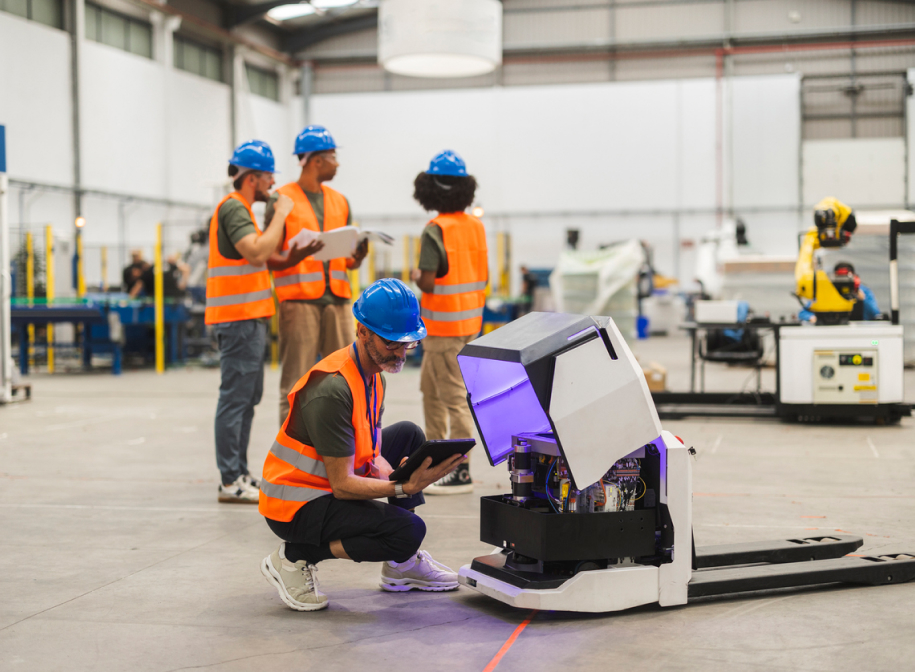
Manufacturers have come to rely on industrial automation to achieve increased productivity and reliable operation. In many industries, robots are now employed to perform repetitive assembly tasks, transport materials, package, weld, and make precision parts. As manufacturing demands grow, companies are looking for reliable power options that can keep their robots running smoothly without the need for downtime.
Battery technology will be an important part in meeting these goals. Today’s robotic systems demand energy storage that is compact, offers consistent performance, and has the ability to fit into the challenging environment of industry. Lithium-ion technology has proved to be an efficient solution given its high energy density and ability to deliver reliable power outputs. These qualities enable manufacturers to increase their manufacturing efficiency and stay more in control of their automated workflows.
Lithium-Ion Technology Is Revolutionizing Industrial Robotics
In many cases, traditional battery technologies can add to operational challenges when the industrial robots need to be charged often and are maintained/replaced long or frequently. Improved energy efficiency and faster charging times are some of the limitations that lithium-ion technology can overcome. The lightweight construction also contributes to the lightweight operation of autonomous mobile robots without an excessive load of batteries. This is especially significant in the manufacturing environment where robotics are used to move parts from one place to another in the manufacturing facility.
Lightweight equipment can facilitate improved mobility and energy use. Also, lithium-ion batteries have relatively constant voltage during most of their discharge. Thus, the robotic equipment can be supplied reliable power during harsh operations. The resulting more consistent performance and reduced interruptions from falling battery output help manufacturers.
Faster charging allows for continuous production operations.
When manufacturing equipment is not available during charging times, production delays can impact manufacturing efficiency if the equipment is not in use. To some degree, lithium-ion technology can help solve this problem by providing the ability to charge quickly and with intermediate charging during operational breaks. Unlike fully discharged, AMRs and AGVs can recharge during the run or between tasks.
The strategy encourages the flow of goods through warehouses and production lines. The smart battery management systems also check the charging conditions to ensure that the battery is not charged improperly, which would harm its performance. If set up correctly, charging schedules can be used to match production needs and workload. The benefits make lithium-ion batteries for industrial robots especially attractive for sites with more shifts or who need to be automated. Overall, faster charging contributes to businesses optimizing the use of their equipment and minimizing downtime in production.
Enhanced battery management system
Consistent power supply is essential for reliable automation, as is the ability to monitor important battery parameters. Modern lithium-ion battery systems utilize battery management systems that monitor and control the battery’s temperature, voltage, and charging habits. These systems enable greater protection from potentially harmful operating conditions and enable safer battery use. They can also give info on battery health and battery remaining life. With such insight, maintenance teams can pinpoint potential issues early on, even before they become production-related. Industrial robots are then able to have easier operation predictability and better maintenance planning. In addition, built-in monitoring functions provide an insight into energy use in various production processes. Robots that are required to operate continuously during long manufacturing runs, such as precision tasks, need reliable battery performance.
A partner to flexible automation in various sectors
Robots are used in manufacturing, automotive, distribution, pharmaceutical, and food processing environments. Different application demands such as working hours, movement pattern, and energy consumption are imposed with each application. Lithuanian battery systems are flexible and can fit in the various applications of robots and equipment specifications. They are small and can fit into a robot that is designed for mobile applications in limited environments. In the meantime, bigger batteries can power more machines for extended periods of time or with greater output.
Reliable energy storage is a key factor.
As factories become smarter, the demand for efficient automation systems, which work with minimum human involvement, rises. More and more complex factory environments are emerging thanks to robotics, artificial intelligence, and connected manufacturing technologies.
Choosing the right batteries, however, involves a number of considerations such as battery capacity, charging specifications, temperature limits, and battery safety ratings. Businesses need to choose the right solutions for their equipment, and an experienced battery supplier can assist them with making the right choice. In the end, reliable lithium-ion power systems lead to increased production speed, stable automation, and sustainable manufacturing expansion.