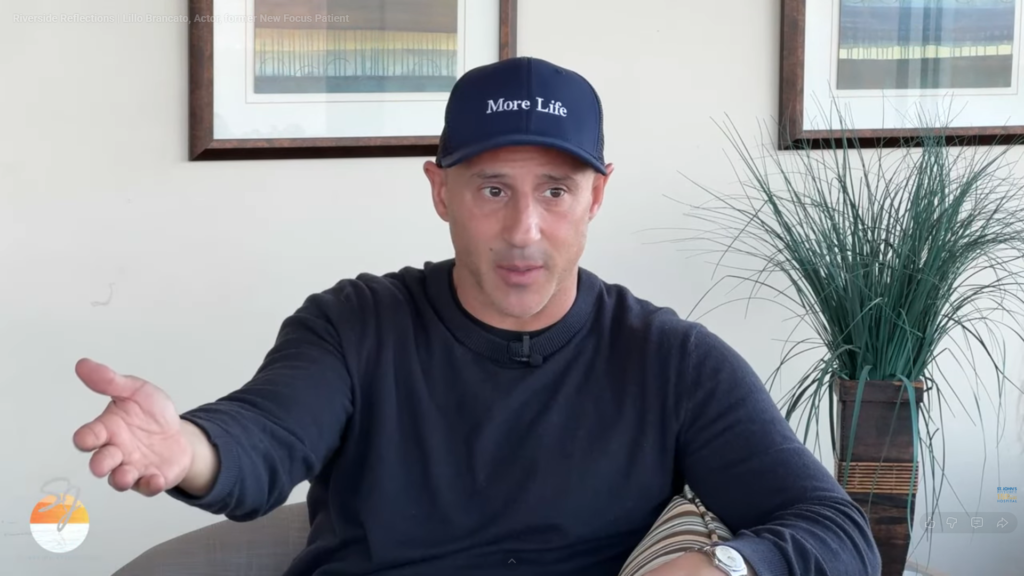
Lilo Brancato
By Dan Murphy
Many readers remember Lilo Brancato as Calogero in Robert De Niro’s 1993 film, A Bronx Tale, and as Matthew Bevilaqua, a young mobster, in The Sopranos.
Raised in Yonkers, Lilo has experienced many ups and downs since his breakout role over 30 years ago, including struggles with addiction, arrest, and jail time.
Lilo has been sober for years and now shares his story to help others battling addiction.
He recently spoke to SJRH about his journey from Hollywood stardom, through addiction, to sobriety—and how sharing his story supports others in recovery.
Lilo recently sat down with Denise Mananas, Associate Vice President for External Affairs from St. John’s Riverside Hospital, for an episode of Riverside Reflections.
Q-Thanks for being here
A-Well, you know, I’m from Yonkers. I wasn’t born here, but I was raised here. I was born in Bogota, Colombia, and I was adopted when I was four months old by Italians. My parents met in South Yonkers. It was like an Italian enclave.
My whole life, I went to school in Yonkers. I started at Sacred Heart, but just after I finished the 10th grade, I got thrown out. And then I got thrown out of Westlake High School up in Thornwood for using a fake address. So, my mother said, just go to Roosevelt; my paisan is over there. So, between all the throw-outs and the days looking for a new school, I went to school for 30 days that whole year.
So it was like May, and I’m in Roosevelt. And I remember I was walking down the hallway with a teacher. And I wanted to get out of going to school for the rest of the year. So, I told him, “Hey, you know, like, maybe I missed so many days.” Is this year even going to count? Shouldn’t I just come back in September, and we’ll start all over? You know what he told me? I’ll never forget this in my life. He said, you know why Mussolini made the buses run? And I said, no. Why? He goes because he was the boss. Like I’m the boss here. He said, You come to school, and you’ll pass. And I passed 11th grade.
So now, over that summer vacation, I started drinking. I was sleeping in my friend’s car.
I was a bad kid, a very bad guy in school. And then I remember it was the day after the 4th of July 1992. I heard about the Bronx Tale, and I heard a lot of kids were reading for it. But you think it’s, like, such a long shot. This is not going to happen to you to be in this movie. It’s not like it’s a little part where it’s like, oh, we got two scenes in a movie, but then this is the movie. You are the movie; you narrate it.
Q-So, what was that experience like once you got it?
A-Well, they found me on the beach. We went to the beach on July 5th. My brother called me out of the water because the guy was handing out flyers. My brother said, wait till you see my brother. He looks just like DeNiro. Then I went to audition, and then I got called down to Manhattan. And then I kept getting calls, callbacks. Once I met De Niro, it started to feel more real.
Q-But it had never really occurred to you to be an actor before?
A-I saw a psychiatrist when I was a kid because I was bad, and the school recommended it. I used to ride my bike to this Doctor. He was on Mile Square Road, literally right up the street. He did say you would be good in the dramatic arts. And when I got the part, he said I told you you’d be a good actor.
Q-So, you grew up in Yonkers, and you got into that movie? It was after the movie that you kind of got yourself into a little trouble.
A-Yeah, well, then I started smoking weed, and then it went from that to the next thing.
Q-What was the next thing?
A-I was a crack addict, then a heroin addict. I was spending almost $1,000 a day at this point.
I did a scene in The Sopranos with Furio. When he comes in, I’m in my underwear. I was high on dope from the night before. That was around the time I lost my cousin. Her name was Dina. She was 21 years old. She died of brain cancer. She suffered for many years.
I was taking pills at the time, and the pills were becoming so big that the government started cracking down on them, and it made it harder for you to get on the street. So, what does that leave you then? It leaves you heroin. Then you go to that, and then, you know, you’re snorting 15, 20 bags a day. Then you realize I’m spending $2,200 a day, and somebody says, “Hey, well, if you put it in your arm, it will only be $40.” But I never went that way because I had money. But that wasn’t my rock bottom.
Q-You’ve given us quite a story. What was that turning point for you? What happened that made that click in your brain?
A-I got in trouble on December 10th, 2005. So, all of 2006, I was in Rikers Island. I was in NIC, which is North Infirmary Command, because I got shot three times.
Q-And that was not your low point.
A-No, it wasn’t.
Q-Interesting.
A-Because if anything, I was in pain. So, I wanted more pain medication because I was an addict, a junkie, and because I was in real pain, I was craving those. After the North Infirmary Command, which is a hospital, they moved me over to the main building.
But I was still getting drugs there. I was getting morphine and OxyContin. I was getting, you know, everything at jail. And my mom would send money orders. But she didn’t know it was for drugs. She thought it was for cigarettes. I had another kid in the next cell block. He was a blood, and he was getting heroin straight from New York, you know, bundles. The mailman was letting it in. He got arrested right out in the parking lot. We saw the whole thing. It was on Eyewitness News.
So, November 12th, 2006. I took 4 bags of heroin, and I’m smoking a cigarette in the TV room, and next thing you know, I felt like I wanted to swallow my tongue. I was overdosing, I overdosed, I had to literally hold my tongue and run to my cell and lie down.
Q: Was that the low point?
A-No, because I still liked how powerful these drugs are. They taped my cell off with yellow tape. It was a crime scene. New York City detectives came and interrogated me because they wanted to know… Where are you getting this? You’re a high-profile guy. How does this come in here?
After I overdosed, they gave me a urinalysis. They found out, and then I went to the box. But before I went to the box, I was still getting high because the kid had it, and we were still doing it. Just to show you the strength of the addiction, how powerful it is. That’s my point.
Q-Yeah. That’s very interesting. So, let’s go to the low point.
A-Well, the low point is after I overdose, I’m doing it, doing it, doing it, doing it, doing it, doing it. And then I go to the box. And then my cousin Pat, who became a lawyer, came to see me. He knew that I was in there for overdosing, and he was very disappointed. Like, you know, you got all this. All of us here. We love you. We want to see you beat this.
And for some reason, that day it just clicked, and after that, I never had the desire to get high again. It was like a modern-day miracle. I wanted to show the world I can do this. It’s just about your mindset; that’s everything.
Q-All right, so now you’re in jail, and you had that moment, and you kind of got clarity. How did you follow that up? Because I know you accessed care through one of our programs, our New Focus Center. Tell me about that process.
A-Well, when I first came home on parole, I had to attend a drug program. I think it was a 90-day program. It was definitely necessary for me for the transition, right? And it kept me in check for a few months, and I just learned how to, you know, walk around outside without doing anything stupid.
But I could see it was like a symbiosis, a mutually beneficial relationship that we had altogether because it’s like, this is the city that I grew up in, and I lived in. Right. And a lot of these people there went to jail with me. They sold me drugs. We did drugs together.
So now everything is full circle. And I see a lot of people that I know from the street. But now you’re in a position to actually help them because now you came home from jail, like people know what you went through, but now they see you’re sober and stuff like that, and just me helping other people and seeing all the people that did need help and how helpful I could be to them just based on me being in movies and stuff like that. I don’t think I’m better than anyone because of it, but some people, because you were in those situations, maybe will tend to listen to you a little bit more.
Q-You’ve had great success.
A-Right? This is a pretty cool thing I can actually help people with, because by doing that, I’m helping myself. I’m telling you to do the right thing. You don’t need this. Come on, man, you know what I mean? So now you told that person that. So that person’s hanging on your every word and listening to you for guidance, for courage. You can’t go do that and be bad now, because he’s going to say he was just telling me, and then they’re going to fall off the deep end.
Q-So, when you were in treatment for 90 days, what was it about the conversation and the daily habit of that, that that really worked for you? Did it set your life on a different kind of trajectory that you were able to then sort of navigate going out into the real world?
A-When you’re in prison, you are going to have structure in your life, which is something that so many addicts desperately need and they don’t have. They have all this free time and no structure, and then they go do drugs because there’s nothing else to do. But prison incorporates structure in your life, right?
But then, when you come home, a lot of that structure is gone. But what New Focus did for me was that I had to go five days a week, and they had structure. So, it was like a part of your day. And I live by structure-you have to have that.
And you just figure everything out for yourself. But this helps you figure it out, you know, like, alright, now it’s time. And it’s just, it’s very necessary if you’re in recovery, you have to have structure in your life.
Q-I have to believe that sharing your story does aid your recovery. It does keep you on track, right?
A-Because it’s almost like you’re out here preaching about your recovery and the right things to do. Then it’s almost like an embarrassment to relapse. I’m building myself up so much that it makes it so much harder to go back, because what a fool I’m gonna look like. And that helps me. Whatever works. You know what I mean?
Q-So, let’s talk about some of the things you’re doing. You have a podcast, The Culture Project. Right. Tell me about that.
A-We give you more choices so you can live more. It’s a treatment center in New Jersey. And it’s just basically, you know, helping people be the best version of themselves, you know what I mean?
Q-Who are they inviting to be guests on that?
A-Well, we’ve had a few rappers just to show, like the kind of rags-to-riches stories we got: the girl from A Bronx Tale, and Domenick Lombardozzi, who was in A Bronx Tale. He’s in a lot of stuff now. I’m the director of public relations, but I’m also boots on the ground. I run groups and similar activities. That’s the stuff I really like.
Q-So, are you acting now? Are you back in that?
A-I like to do my own things. I co-wrote a film called Sleepyhead, and then I wrote one called Never Meet Your Heroes. It’s about addiction with the girl Taral Hicks from A Bronx Tale. We have a daughter. Her character is a nurse, and she’s going to work in this hospital.
Q-You talked earlier about growing up in Yonkers. Why come back to Yonkers? What is it about Yonkers?
A-Well, I’ve got all my family here. The familiarity. It’s not a bad place to live. New York City is right here. You got access to trains, and upstate’s right there. So Yonkers is nice.
Q-I wanted to know what message you would have for young people, adolescents today, who are faced with making decisions about what they’re going to do and what they’re not going to do.
A-I mean, obviously, they are at a crossroad in their lives, to, you know, either go right or left, and there’s a lot of decision-making at that point. But the decision to use or not do drugs is a no-brainer. Look at the mistakes that others have made and how drugs and alcohol have impacted their lives. Because you’re going to be no different if you go down that road. So, learn from others’ mistakes. That’s what I would say.
Watch the episode at link— https://www.youtube.com/watch?v=Jgguw4AN6eM&t=32s