Industrial wire baskets do more than hold parts or inventory. Discover 6 real facility challenges they solve, from parts washing to WIP staging and beyond.
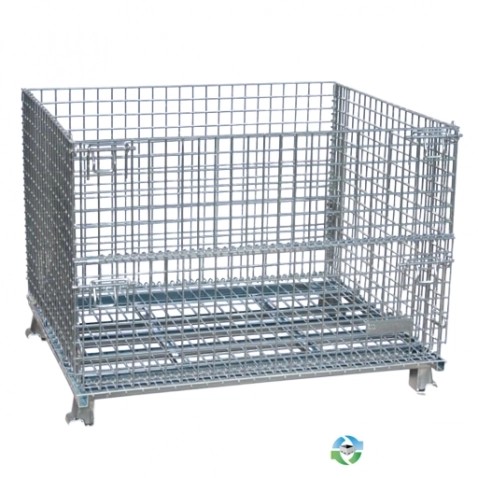
Most facilities buy their first industrial wire basket for a specific job, only to find six months later they’re using it in four different departments, wondering why they waited so long. It’s one of those products that looks simple on the surface but turns out to be surprisingly versatile once you start putting it to work. If your operation is still relying entirely on solid bins for everything, you might be making a few jobs harder than they need to be.
Problem 1: Parts Washing and Surface Treatment
Wire baskets were practically invented for this application. The open construction allows cleaning fluid, rinse water, and air to reach every surface of the part without repositioning or manual turning. Solid containers trap fluid and prevent contact, leading to inconsistent results and longer cycle times.
In finishing lines, anodizing operations, and industrial parts washing, wire baskets are the default choice for good reason. If your current process involves hand-placing parts in a solid bin and hoping the wash reaches everything, switching to wire will show results immediately.
Problem 2: Work-In-Process Staging on the Production Floor
Work-In-Process (WIP) staging is one of those areas where visibility quietly kills productivity. When parts are in a solid bin, someone has to physically open or tip it to know what’s inside and how many pieces are left. With wire baskets, a quick glance from across the aisle tells you everything.
Faster picks, easier counts, and no wasted trips to check inventory levels. For high-mix production environments where multiple part numbers move through staging at the same time, the visibility advantage compounds quickly.
Problem 3: Autoclave and Heat Treatment Applications
Solid bins block airflow and heat penetration, which is a real problem when uniform temperature exposure is the whole point of the process. Industrial wire baskets allow heat, steam, and airflow to circulate freely around the entire load.
This matters in medical device sterilization, food processing, and industrial heat treating. If your current containers are slowing down cycle times or creating hot and cold spots in the load, the container construction is likely part of the problem.
Problem 4: Inventory Counting and Audit Prep
Cycle counts are faster when you don’t have to touch every container. With a solid bin, counting means opening, digging, and often moving product around to get an accurate number. With wire baskets, a counter can walk the aisle and get a reliable visual count without stopping to open anything.
When you need to find an industrial wire basket option or shop industrial wire basket sizes for an audit-friendly storage system, this is the use case that often tips the decision.
Problem 5: Scrap and Waste Collection
Wire baskets handle scrap collection better than almost any other container type. They’re easy to tip into a larger collection bin, easy to weigh without unloading the contents, and easy to inspect visually without digging through material.
Metal recycling operations, stamping facilities, and machining shops use them heavily for this reason. The open construction also means that fluids and fine particles fall through rather than pooling at the bottom, keeping things cleaner and reducing container weight between pickups.
Problem 6: Storage That Needs Airflow
Some products simply cannot be stored in sealed or solid containers without creating a spoilage or safety risk. Fresh produce, damp materials, and certain industrial components that off-gas during storage all benefit from containers that allow air to circulate freely.
A solid bin traps moisture and accelerates spoilage or corrosion. Wire construction solves that problem without requiring any special equipment or modifications.
The Right Wire Basket Makes the Job Easier Across the Board
Wire gauge, finish, load capacity, and stackability are the four specs worth nailing down before purchasing. Galvanized finishes handle most general industrial environments well. Stainless steel is worth the extra cost for food contact, medical, or corrosive chemical exposure.
Container Exchanger carries new and used industrial wire baskets across a wide range of sizes and configurations. If your facility has applications where solid bins are creating friction, it is worth taking a look at what is available.