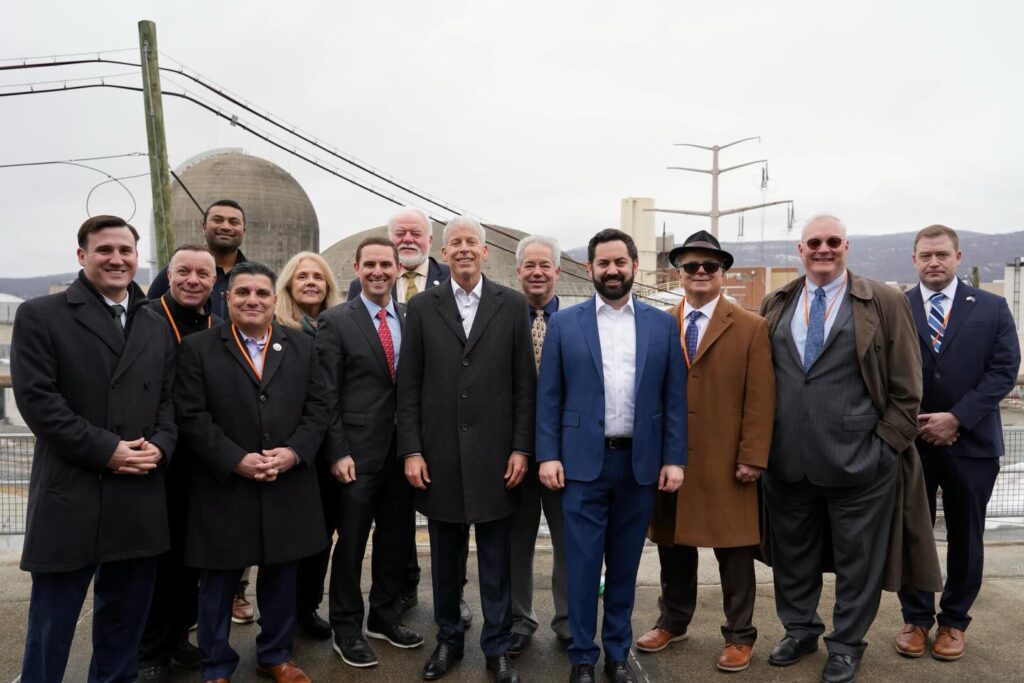
Last week, US Department of Energy Secretary Chris Wright visited the closed Indian Point Power Plant in Buchanan, Westchester. Joining Wright were local republicans, including Congressman Mike Lawler, Assemblyman Matt Slater, Yorktown Supervisor Ed Lachterman, and State Senate candidate Sergio Esposito.
Congressman Lawler correctly pointed out that the decision made by former Governor Andrew Cuomo to close Indian Point was a “disastrous energy policy decision to close Indian Point Power Plant down before reliable replacements were in place.”
But there is NO CHANCE that Indian Point will ever be opened again, and the Republicans’ decision to call for its re-opening only fueled local democrats and their opportunity to criticize any plans to do so.
Westchester County Executive Ken Jenkins said, “Absolutely not. Let me be clear – because apparently, I was not clear enough for Congressman Lawler and the Trump Administration: restarting the Indian Point nuclear power plant is not welcome in Westchester County.
“New York State already has access to a range of low-cost, environmentally responsible energy alternatives, including solar, wind, geothermal, and hydropower. We do not need – and we do not want – Indian Point back online. The health and safety of millions of residents in the Hudson Valley will always matter more than reopening a nuclear facility.
“That is why I support Governor Kathy Hochul’s plan to expand nuclear energy capacity in New York State in appropriate locations, while excluding New York City, Long Island, and the Hudson Valley from consideration. Indian Point operated for nearly six decades before closing in 2021, following years of public concern about environmental and safety risks. We have already been through this once. Our communities fought long and hard to close this facility, and we are not going to reopen that debate now, nor ever.”
Assemblymember Dana Levenberg said, “Apparently, Congressman Mike Lawler brought President Trump’s Energy Secretary to Indian Point today to unveil Republicans’ latest plan to make life more expensive and dangerous. Nuclear is the most expensive form of energy per kilowatt-hour; reopening Indian Point at this time would not bring utility costs down. Furthermore, we simply can’t trust the Trump administration to keep us safe. A former NRC Chairman recently called Trump’s executive orders on nuclear energy ‘a guillotine to the nation’s nuclear safety system.’ And this was before the president began brazenly defying international law, raising terrorism risks to horrifying new heights. This proposal makes zero sense for the communities surrounding Indian Point, which includes New York City, just 21 miles to the south. I remain adamantly opposed to it. Westchester County does not support reactivating a plant that sits in the heart of one of the most densely populated regions in the country and continues to raise serious concerns for our environment and our communities.”
Lawler did point out that “According to the Empire Center for Public Policy, New York’s average residential electricity price has increased to 27.39 cents per kilowatt-hour, about 59% above the national average. Over the past year, prices in New York rose by 12%, twice the national average, and four times inflation, hitting Hudson Valley families hard.
“Albany’s decisions to close Indian Point, block new natural gas pipelines and power plants, and impose costly mandates under the Climate Leadership and Community Protection Act leave working families with higher bills and less reliable energy.
“Nuclear power, alongside natural gas and renewables, is essential for clean, reliable, and affordable energy. Approving pipelines like the Northeast Supply Enhancement is critical to keeping costs down and the grid stable.”
County Legislator Colin Smith wrote a reasonable column on Substack, which acknowledges both sides of the argument.
“Reopening Indian Point is the wrong answer to New York’s utility-bill crisis.
Yes, closing Indian Point had real costs. It affected host communities, complicated New York’s energy transition, and removed a major source of power from the downstate mix. But reopening a decommissioning nuclear plant is still not a serious near-term solution to the crushing bills families and businesses are facing right now.
The deeper problems are structural: delivery charges, rate-setting, infrastructure costs, and broader grid-planning failures. If we are serious about helping ratepayers, the focus needs to be there.
New Yorkers are angry, and they have every right to be. Utility bills have become crushing for families, seniors on fixed incomes, and small businesses already stretched by the broader cost of living. That anger is not imagined, and it is not partisan. It is rooted in a genuine affordability crisis.
I say that as someone who argued publicly in 2016 that Indian Point should be closed. At the time, my position was site-specific, not ideological. I was not making a universal case against nuclear power. I was making a case against this plant, in this location, with this history.
Indian Point sat in one of the most densely populated corridors in America. It had a long record of controversy involving leaks, contamination, emergency planning, and the broader question whether a nuclear facility ever made sense in that location at all.
I still believe those concerns were serious and legitimate. But intellectual honesty requires a second admission: some of us who supported closure assumed the transition away from Indian Point would be smoother, cleaner, and less costly than it has turned out to be.
On that point, reality has been humbling. Replacing a major source of firm generation is not simple. Downstate reliability remains under pressure. New Yorkers are now living with the cumulative cost of supply constraints, transmission delays, infrastructure investments, and utility rate decisions that keep pushing bills higher.
NYSEG’s current electric request is especially jarring. According to DPS materials, the company is seeking approximately $464.4 million in additional annual electric revenues, which it says would translate into a 23.7 percent increase to the total bill for a typical residential customer using 600 kilowatt-hours per month.
This is not a shuttered facility sitting intact, waiting for someone to turn the key. Indian Point is in decommissioning. Power operations at Unit 3 ceased in 2021. The site was transferred for prompt decommissioning, and federal and state materials make clear that the plant is well into that process.
All spent nuclear fuel has been moved into dry cask storage.
Those examples do not show that Indian Point is a ready-made solution. They show the opposite: that restart, where it happens at all, is complicated, costly, and slow.
One can believe New York should have a serious nuclear future and still believe that Indian Point is the wrong site, the wrong project, and the wrong answer to today’s affordability crisis,” wrote Legislator Smith.