
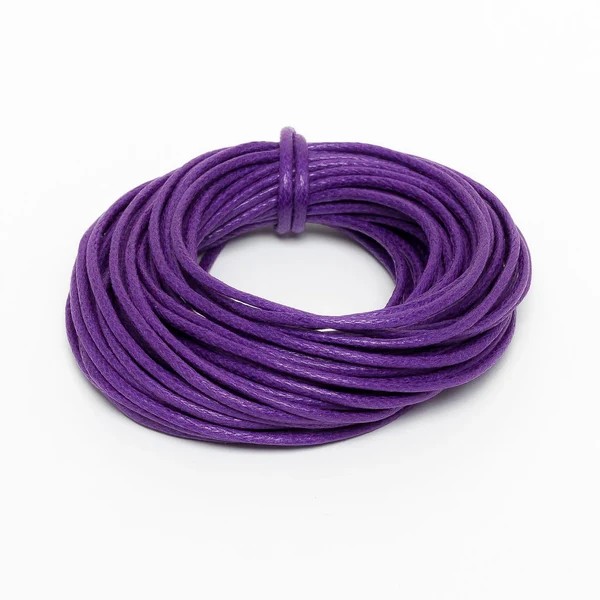
A macrame bracelet takes an evening to knot and, with a careless ending, about a fortnight to come apart. The body of the piece rarely gives way. The tails do: a melted tip that has cracked, a sliding knot that has crept open, a Tube End glued around a bundle too thick to seat. This guide covers the endings that hold up under daily wear, using GRIFFIN Braided Nylon Cord and Waxed Cotton Cord as the working examples, and explains how to test each finish before the bracelet leaves your bench.
Where a macrame bracelet usually fails
Daily wear attacks a bracelet in three places. The closure is opened and shut several times a day. The cord ends rub against sleeves and catch on knitwear. And wherever soft cord meets hard metal, the cord flexes with every movement of the wrist while the metal does not.
Most failures come from choosing a finish for how it looks on the bench rather than for what it does on a wrist. A tidy overhand knot tail unravels in the wash. A glued end that looked invisible lets go because the glue went onto a damp cord. The pattern matters less than the ending: macrame bracelet patterns of every kind, and Shamballa bracelets with their beads, fail in the same three places. Once you know which of them your design stresses most, the choice of ending becomes straightforward.
Four finishes and what each one is good for
A sliding closure suits adjustable bracelets, gifts, and anything sized by guesswork, and it needs no hardware. A fixed loop-and-knot closure suits narrow cord and light beads, and it stays exactly as tied. A Tube End with a clasp suits cord that will be worn hard, because the metal takes the strain the knots would otherwise carry. A sealed, tucked end suits designs where a tail must disappear under a bead or inside a knot.
How to end a macrame bracelet therefore depends on the strain it will carry, and on the cord. The sections below take each finish in turn, with the diameters and findings it accepts.
The sliding closure and how to size it
A sliding closure is two overlapping tails, each tied around the other with a short run of square knots. Pull the tails apart and the loop widens; push the knots together and it tightens.
Size it from the hand, not only the wrist. The closed loop should match the wrist, and the open loop has to clear the widest part of the hand, usually across the knuckles, with a little room to spare. Standard bracelet lengths run from 17.5 cm to 19 cm for women and from 20.5 cm to 28 cm for men, so measure the wrist first, then confirm the open size by passing the hand through the loop before the knots are sealed.
Keep the knots on the sliding section snug enough to grip but loose enough to move; a section packed with knots binds and will not adjust. Finish each tail with an overhand knot so the closure cannot pull apart completely.
Sealing a nylon end by melting, without a lump
Braided Nylon Cord ends can be melted to stop them fraying, which makes nylon the simplest cord to finish. The lump comes from holding the cord in the flame.
Cut the end cleanly with sharp scissors. Bring it to the side of a small flame, not into it, and pull away the moment the fibres shrink and take on a gloss. The tip should finish no wider than the cord itself. If it balloons, trim it off and try again with a shorter exposure. Let the tip cool without touching it, because molten nylon sticks to the skin. Work in a ventilated space and keep the flame away from beads and knotted sections, which discolour quickly.
A melted end is a seal, not a fixing. It stops fraying but does not hold a knot in place, so a tail that matters structurally still needs a knot or a Tube End behind it.
Waxed cotton ends and why they behave differently
Waxed Cotton Cord is cotton with a wax coating, and it should stay away from a flame. Cotton chars instead of fusing, which leaves a brittle black tip. The finishing methods are mechanical instead.
Tie an overhand knot at the end of each tail, trim close, and place a small drop of GRIFFIN Superglue on the knot. Test the glue on an offcut first, since wax can slow a bond. Where the tails go into a Tube End, bind them together with fine wire, trim the bundle square, and glue it in. An adjustable waxed cotton bracelet can also close with two slip knots, one tied from each end, which avoids glue and metal altogether.
Adding a clasp to a knotted band
Soft cord and hard metal need a go-between, and the usual one is a Tube End. Bind the cord ends together with fine wire, trim the bundle so it seats cleanly, and glue it inside the Tube End with GRIFFIN Superglue. Then attach a Spring Ring or Lobster Clasp to the Tube End loop with an Open Jump Ring. Close the ring by moving one end sideways past the other and back again; pulling it open outwards weakens the round.
A route that avoids glue is to thread the cords through a Double Eye Tag on a Spring Ring before braiding, folding them so the fold sits in the eyelet. GRIFFIN clasps and findings are made of 925 sterling silver, nickel-free, with 7-micron 24K gold plating (where applicable).
Cord diameter and the finish it will accept
Braided Nylon Cord comes in six diameters: 0.30 mm, 0.50 mm, 1.00 mm, 1.20 mm, 1.50 mm, and 2.00 mm. Waxed Cotton Cord comes in five: 0.8 mm, 1.0 mm, 1.5 mm, 2.0 mm, and 2.5 mm. The diameter decides which finish is practical.
The finest nylon, at 0.30 mm and 0.50 mm, is too slight for a bare overhand knot to carry a clasp loop and works best as the binding cord of a sliding closure. Mid-range diameters of 1.00 mm, 1.20 mm, and 1.50 mm knot cleanly and accept every finish above. At 2.00 mm, and at 2.5 mm in waxed cotton, a sliding closure turns bulky, and a Tube End or a tucked end is the tidier answer.
Whatever the cord, a bundle of tails has to fit the Tube End. Closed-eye Tube Ends have inside diameters of 2.0 mm, 2.5 mm, 3.0 mm, and 5.0 mm. Diameters are guidelines for textile cord and can shift slightly between batches, so dry-fit the bundle before any glue goes in.
Testing the finish before you give the piece away
Three tests take a few minutes. For the pull test, hold the closure in one hand and the far end of the band in the other, and pull firmly; nothing should slip. For the wet test, wear the bracelet for a day, rinse it in lukewarm water, and let it dry flat; knots that have crept or glue that has whitened need redoing. For the flex test, bend the bracelet sharply at the closure and at each Tube End thirty times, then check for loosened knots or a cracked seal. Give glued joints time to cure fully before running any of them.
Matching the ending to the strain
Adjustable fit calls for a sliding closure, hard wear for a Tube End and clasp, and tidy tails for a melted nylon tip or a glued cotton knot. Choose the finish when you choose the cord diameter, not after the last knot, and run the pull, wet, and flex tests on every piece.
Frequently asked questions
How do you finish a macrame bracelet?
Match the ending to the strain: a sliding closure for adjustable fit, or a Tube End with a Spring Ring or Lobster Clasp for hard wear. Nylon tails can be melted; cotton tails take a knot and a drop of Superglue.
How do I make a sliding knot closure?
Overlap the two tails by about 3 cm, tie a short run of square knots around both with a separate length of cord, then stop each tail with an overhand knot.
Can you melt the ends of a braided nylon cord?
Yes, Braided Nylon Cord ends can be melted. Waxed Cotton Cord ends cannot, because cotton chars rather than fuses.
What cord diameter for a macrame bracelet?
Diameters from 1.00 mm to 1.50 mm knot cleanly and accept every finish in this guide. At 2.00 mm, a Tube End suits better than a sliding closure.