
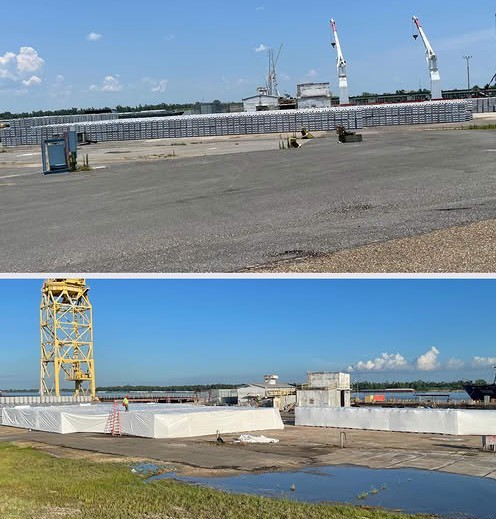
A single Gulf Coast thunderstorm can erase three days of work. Anyone who has managed an industrial build between Houston and Beaumont already knows that — they’ve watched exposed pipe insulation turn to mush overnight, or seen freshly coated structural steel go orange with flash rust before the crew even clocked out. Weather is not a scheduling inconvenience on the Gulf Coast. It is an adversary with a consistent track record.
The stakes are high enough that protecting your assets before weather hits isn’t optional anymore; it’s a line item that serious project managers treat like any other specification. This article breaks down the methods Texas industrial sites are using, when each one makes sense, and the reasoning behind a layered approach that most experienced site managers won’t skip.
The Scale of What’s At Risk in Texas Right Now
Texas industrial construction isn’t slowing down. Nationally, total real investment in manufacturing structures reached a record high of $231.9 billion in 2024 , according to the Federal Reserve Bank of Dallas (2025) — and Texas carried a disproportionate share of that activity, driven by petrochemical plant expansions, LNG terminal buildouts, and new chemical processing capacity along the I-10 corridor.
More construction in progress means more exposed assets sitting on open sites for months at a time. That equation gets painful fast when Gulf Coast weather enters the picture. High humidity alone accelerates corrosion on unprotected steel. Add a tropical system or even a routine convective storm, and the damage can move from cosmetic to structural in hours.
Project managers who treat asset protection as an afterthought tend to find out its value at the worst possible moment — usually during a rain delay that wasn’t on anyone’s schedule.
Why Gulf Coast Weather Is a Different Problem
Construction, both private and public, was valued at $2.2 trillion in 2024 — all of it impacted by weather and climate, with extreme weather events such as flooding, high wind, and extreme temperatures capable of degrading building materials and threatening critical infrastructure , per NOAA’s National Centers for Environmental Information (2024).
On the Gulf Coast, that threat isn’t theoretical. You’re dealing with a combination of factors that few other U.S. regions share: ambient humidity that rarely drops below 60%, hurricane season running from June through November, afternoon thunderstorm patterns that develop faster than most radar apps can track, and intense UV radiation that degrades uncovered materials year-round. A plastic membrane that lasts six months in Montana might need replacement after three on a Houston job site.
The core challenge is timing. You can’t always schedule around weather, and large industrial builds rarely have the luxury of shutting down and pulling materials indoors. The equipment stays put. The structure stays put. Your protection strategy has to be in place before conditions deteriorate.
“Exposure to extreme weather and climate hazards in the Gulf of Mexico state region is increasing as a result of population growth and increased construction of public and private development in hazard-prone areas.” — National Academies of Sciences, Engineering, and Medicine, as cited in NOAA Climate.gov analysis (2024)
The Gulf Coast Weather Window Framework
The most effective protection decisions on Texas industrial sites follow what experienced site managers call the Gulf Coast Weather Window — a four-factor check that happens before any significant asset goes unprotected for more than 48 hours.
- Duration of exposure. How long will this asset sit outside before it reaches a covered or enclosed state? Anything beyond 72 hours in summer months on the Texas coast warrants active protection.
- Asset sensitivity. Raw structural steel tolerates more short-term exposure than coated pipe sections, electrical components, or insulated vessels. Rank your assets accordingly.
- Season and storm probability. A mid-January install window carries different risk than an August one. Know your local storm climatology, not just the generic “hurricane season” window.
- Recovery cost vs. protection cost. Price the replacement or remediation of the asset against the cost of wrapping or enclosing it. On any petrochemical job, the math almost never favors skipping protection.
Running this check before mobilization — not after weather shows up — is what separates sites that hit schedule from those filing damage claims.
Protection Methods: Choosing the Right Fit
Not every protection method suits every application. Here’s a straightforward comparison of what’s typically deployed on Texas Gulf Coast industrial sites:
| Method | Best For | Gulf Coast Limitation | Typical Use Case |
| Heavy-duty tarps | Short-term, small equipment | Wind lift in tropical conditions; trapping moisture underneath | Generators, small tool staging areas |
| Temporary rigid enclosures | Long-duration, large structures | High setup cost; slow to mobilize | Extended turnaround work on process units |
| Industrial shrink wrap | Custom-contour coverage of large or irregular assets | Requires trained installers; not reusable | Vessels, pipe racks, structural components, full construction site containment |
| Scaffold wrap systems | Perimeter containment during active work | Debris containment only; minimal weather barrier | Blast and paint operations |
Shrink wrap earns its place on large industrial builds because it conforms to whatever shape you need covered. A stainless steel storage vessel doesn’t fit under a standard tarp without gaps. A prefabricated pipe skid that’s waiting three weeks for installation can be sealed tight with a custom-fit wrap that sheds water, blocks UV, and won’t let wind work it loose at 2 a.m. during a squall.
A Scenario Worth Running Through
Picture a $300 million LNG facility expansion in Southeast Texas. The contractor has 40 prefabricated skid assemblies staged outdoors waiting on foundation completion — each carrying instrumentation, coated piping, and insulated vessels. The window between delivery and installation is six weeks in late summer.
Tarp coverage won’t work: wind gusts from Gulf thunderstorms regularly hit 50 mph, and moisture trapped under an improperly sealed tarp accelerates the very corrosion it’s meant to stop. A temporary rigid enclosure can’t cover 40 scattered skids economically. Shrink wrap is the call — and the right site team brings in a professional crew with heat guns and UV-stabilized film to custom-seal each assembly before the first storm system rolls through. That’s not a heroic decision. It’s just the correct application of the Gulf Coast Weather Window check.
Crews running a industrial construction wrap service in Texas like this work in conditions that make improper installation obvious fast — which is exactly why trained, on-site professionals rather than general laborers handle the application on any project where the asset value justifies the coverage.
After the Wrap Goes On
Installation is the beginning, not the end. Gulf Coast heat cycles — cool mornings, 95-degree afternoons — create expansion stress on wrapped materials. The U.S. cost for weather disasters in 2024 was $182.7 billion , according to NOAA’s Office for Coastal Management (2025), a figure that reflects how quickly unchecked weather exposure turns into financial loss across every industry, including construction.
Inspect wrap seams after any significant storm event. Check vent points to confirm condensation isn’t building inside. If your asset is going to sit longer than originally planned — a common reality on large industrial builds — budget a mid-project inspection into the schedule before problems develop rather than after.
The sites that finish on time in Texas aren’t the ones with better luck. They’re the ones that treat weather as a fixed planning variable and put the right protection in place at the right moment. Gulf Coast weather isn’t going to negotiate with your project schedule. Your asset protection strategy should be the thing that doesn’t give ground.