
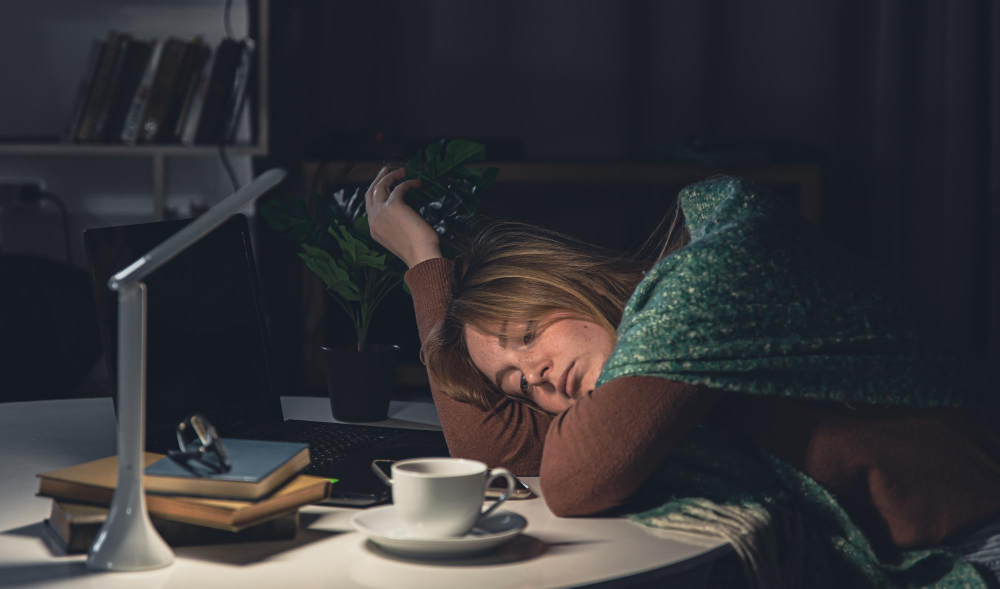
Sleep deprivation quietly sabotages your willpower and habit formation. Here’s the science-backed reason why your routines stick when you’re well rested.
You’ve tried quitting the afternoon soda for three years. You’ve deleted the app, told your partner to hold you accountable, even put a sticky note on your monitor. And every day by 2:30 PM, you’re walking to the vending machine anyway. Here’s the uncomfortable truth nobody put in front of you: your willpower was never the real problem.
Your sleep was. When you’re running on six hours or less, your brain physically cannot mount the same resistance to temptation that it can after a solid night’s rest. And until you fix that foundation, every habit you’re trying to break is fighting an uphill battle against your own biology.
What Sleep Deprivation Does to Your Decision-Making Brain
Your prefrontal cortex is the part of your brain that says no. It’s the rational voice that reminds you the cookie isn’t worth the 4 PM crash, that the late-night scroll isn’t worth the groggy morning. That region is also, unfortunately, the first casualty of poor sleep. When you’re tired, your prefrontal cortex goes offline in stages, and a deeper, more impulsive region called the amygdala takes over the steering wheel.
The result shows up in real numbers. The Centers for Disease Control and Prevention reports that one in three U.S. adults fails to get the recommended seven hours of sleep per night, a pattern the agency links to chronic conditions including depression and type 2 diabetes. What that stat doesn’t capture is the daily micro-battles you lose because your brain is tired: the impulse buys, the snapped responses, the “just this once” moments that pile up into habits you can’t shake.
Think about a time you made a genuinely great decision after a terrible night’s sleep. I bet you can’t recall one. That’s not a coincidence, it’s neurology.
The Science of Why Tired Brains Crave More
Sleep deprivation doesn’t just weaken your defenses. It actively amplifies your cravings. Research published over the last decade consistently shows that sleep-restricted individuals show heightened activity in the brain’s reward centers when shown images of desired foods, and reduced activity in the regions responsible for evaluating long-term consequences. Your brain literally recalibrates toward immediate gratification when it’s exhausted, because it interprets fatigue as an energy crisis that needs solving right now.
This hits hardest in the late afternoon and evening hours. That’s when your sleep debt has compounded all day, your blood sugar is dipping, and your brain is screaming for a quick fuel source. Your soda habit, your chip habit, your “one glass of wine that becomes three” habit, they all feed on this exact vulnerability.
The 2 AM Question: What Counts as “Enough” Sleep Anyway
Before you can fix your habits, you need an honest baseline. The CDC’s recommendation cited above is seven hours minimum for adults, but that’s a population average. Some people genuinely need eight or nine hours to function at full capacity, and a small percentage of the population carries a gene variant that lets them thrive on six. You know which group you fall into by one simple test: do you wake up without an alarm, and do you feel alert within 15 minutes of waking? If the answer to either is no, you’re accumulating sleep debt, regardless of what the clock says.
Here’s where most people make their mistake. They treat sleep like a passive activity, something that just happens after they finish their to-do list. But the National Sleep Foundation, drawing on a consensus of experts from multiple disciplines, has published age-specific sleep duration recommendations that most adults are missing by an hour or more. The Foundation’s panel found that adults aged 18 to 64 need seven to nine hours, yet the average falls closer to six and a half on work nights. You’re probably not as fine as you think you are.
So before you read another habit book or download another productivity app, do yourself a favor. Track your sleep for two weeks. Not your intention to sleep, your actual sleep. You might be surprised by what shows up.
Building a Habit-Breaking Plan That Respects Your Sleep Debt
Once you accept that sleep is the load-bearing wall of your habit change, the strategy shifts. You don’t attack the habit head-on while exhausted. You build a sequence that works with your biology instead of against it. Here’s a framework I’ve used with clients and friends that actually holds up:
- Week one: Stabilize sleep only. Don’t touch the habit. Pick a consistent wake time and stick to it for seven straight days, even on weekends. Expose yourself to bright light within 30 minutes of waking. This is the single highest-leverage move you can make.
- Week two: Add a morning decision. Move your highest-temptation choices to the first two hours after waking, when your willpower reserves are at their peak after a stable sleep week. Schedule the hard phone call, the workout, the meal prep for mornings.
- Week three: Target the 2 PM danger zone. This is when your sleep debt hits hardest. Plan a 10-minute walk outside, a protein-rich snack, or a short nap if you can manage it. Replace the trigger before the craving arrives.
- Week four: Audit and adjust. Look at which days you slipped. I guarantee you’ll see a correlation with nights where you slept poorly the day before. That pattern is your roadmap for what needs to change next.
I’d rather see you make one habit change stick over eight weeks than cycle through four failed attempts in the same period. The slow version actually ends up faster.
Habit Formation Isn’t About Grit, It’s About Recovery
Here’s the part that the self-improvement industry doesn’t want to admit: habit change is an energy management problem dressed up as a discipline problem. When you look at people who successfully quit smoking, or who maintain regular exercise routines, or who stopped doomscrolling at midnight, they share one trait more than any other. They protect their sleep. They treat it as non-negotiable, not as the thing that gets sacrificed when life gets busy.
The flip side shows up in every relapse pattern I’ve ever witnessed. Someone decides to quit drinking or cut back on sugar or start running, they white-knuckle it for two weeks, then they hit a stretch of late nights at work, sleep drops to five hours a night, and on day three of that stretch they cave. They blame their lack of discipline. They beat themselves up for being weak. But their prefrontal cortex was never given the fuel it needed to fight in the first place.
For people dealing with heavier substance use patterns, this connection matters even more. Recovery programs that ignore sleep quality often see higher relapse rates, which is why structured support options that include sleep hygiene as a core component, like the approach outlined at boldstepsbh.com, tend to emphasize rest alongside therapy and group work. The brain heals during sleep. Depriving it of that healing during recovery is like trying to mend a broken bone while walking on it.
Five Signs Your Sleep Is Sabotaging Your Willpower
Not every tired day is a sleep debt crisis. But there’s a specific cluster of symptoms that tells you sleep, not discipline, is the culprit behind your stuck habits:
- Your cravings spike predictably between 2 PM and 6 PM, regardless of what you ate for lunch
- You make impulsive purchases online after 9 PM that you regret by morning
- You need caffeine to start your day and more caffeine to finish it
- You fall asleep on the couch most nights but struggle to sleep in bed
- Your “treat yourself” moments happen on days following poor sleep, not randomly
If you nodded along to three or more of these, your habit loop is running on exhausted hardware. Fix the sleep first, and you’ll find the habit change effort drops by half.
One Week to a Better Baseline: What to Do Tonight
You don’t need a dramatic overhaul to see movement. Start tonight with three things. Set your alarm for the same time tomorrow as you would on a workday, even if tomorrow is your day off. Put your phone in another room before you get into bed, not on the nightstand, another room, because the gravitational pull of a lit screen at 11 PM is stronger than any intention you set at 8 AM. And make your room genuinely cold, somewhere in the low 60s, because your core temperature needs to drop to trigger deep sleep.
That’s it. That’s the whole first assignment. Do that for a week and notice what happens to your 2 PM cravings, your after-dinner snacking, your patience with your family. The changes show up fast when you’re not fighting your own biology anymore.
Change the Foundation, Then Change the Habit
Every habit you’re trying to break has a root system, and sleep is the soil it grows in. Keep the soil depleted and you’ll keep pulling up the same weeds no matter how hard you tug at the leaves. Restore the soil, and the weeds start losing their grip on their own. The question isn’t whether you have enough willpower. The question is whether you’ve ever given yourself the biological conditions where willpower can actually work. Most people haven’t. You can be the exception starting tonight.