
Guest contribution. The author writes about peptide and hormone pharmacology. This article is editorial commentary, not medical advice.
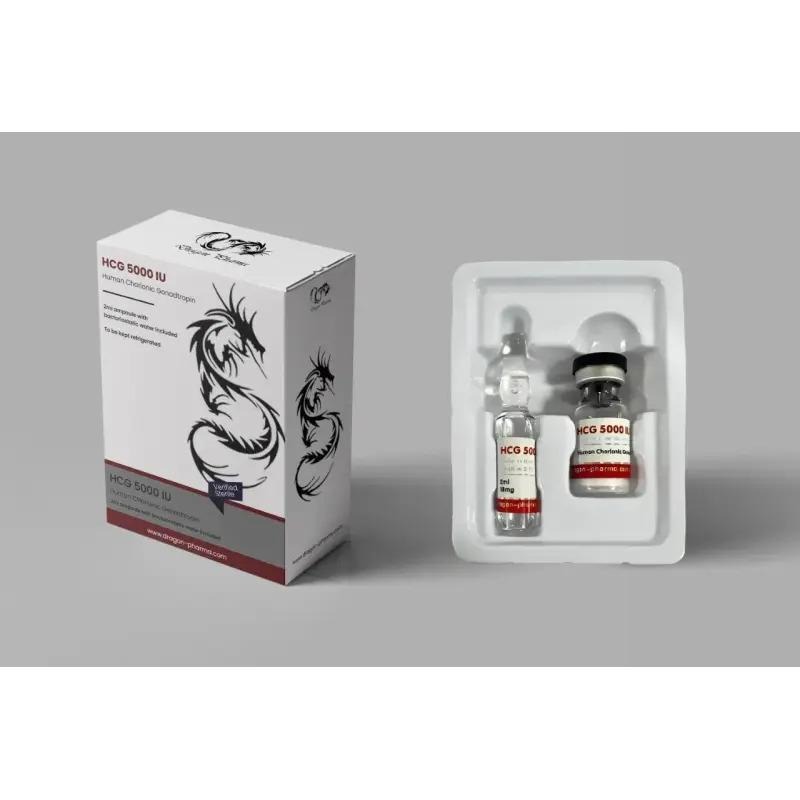
Most product numbers in this market describe a mass. A vial labelled 250 contains 250 milligrams of something. Human chorionic gonadotropin does not work that way, and the difference is not pedantic — it is the single most commonly misunderstood figure on any listing in this category.
This piece is about what the number on an hCG vial actually measures, why the presentation is what it is, and what that means for everything from labelling to reconstitution.
What hCG is
Human chorionic gonadotropin is a glycoprotein hormone, composed of two subunits. The alpha subunit is one it shares with luteinising hormone, follicle-stimulating hormone and thyroid-stimulating hormone — a common structural element across several hormones. The beta subunit is unique to hCG, and it is what makes the molecule specific.
That structure determines what it does. Because the alpha subunit is shared, hCG binds the same receptor that luteinising hormone binds — the LH/CG receptor — and acts as a substitute for LH at the target tissue. In the testes, that means it stimulates the cells that LH would normally stimulate.
The clinical history is genuine and long. hCG is used in fertility treatment, in the management of certain endocrine conditions, and diagnostically. It is an approved medicine with defined uses, and it reaches this market as an unapproved research material like everything else here.
Why the number is not a mass
This is the part worth reading carefully.
hCG is measured in International Units, not milligrams, and the reason is biological rather than bureaucratic. International Units express biological activity — how much effect a preparation produces in a defined assay — rather than how much of the substance is present by weight. For a glycoprotein hormone, those two things are not proportional, because the molecule’s activity depends on its glycosylation pattern, and different preparations of the same protein can differ substantially in potency at the same mass.
So a 5,000 IU vial does not contain 5,000 of anything by weight. It contains a quantity of hCG standardised to produce 5,000 IU of activity against the reference preparation. Two vials both labelled 5,000 IU contain preparations calibrated to the same activity, which is not the same claim as containing the same mass.
This has a practical consequence that catches people out. When comparing an hCG listing against a listing for a peptide measured in milligrams, the numbers are not on the same scale and cannot be compared arithmetically. They measure different things. A buyer who treats “5,000” on an hCG vial and “5,000” on a peptide vial as equivalent quantities is comparing a biological unit to a mass unit, and the comparison is meaningless.
Why 5,000 IU is the standard presentation
The presentation follows the clinical product rather than the market’s preferences, and the history explains it.
hCG is supplied as a lyophilised powder with a separate diluent, because the reconstituted solution is unstable and short-lived — the powder is what makes shipping and storage practical. The 5,000 IU vial is a long-established presentation from the pharmaceutical product, alongside 2,500 IU and others, and the research market has largely inherited those formats rather than inventing its own.
A 2,500 IU presentation is the same compound at half the activity standard, supplied with proportionally less or the same diluent depending on the manufacturer. Which of the two makes sense depends on how much is needed and how quickly a reconstituted vial will be used — because once in solution, the clock is running.
What it does, and what it does not
The mechanism is specific enough to state precisely, and the distinction matters.
hCG substitutes for luteinising hormone at the receptor. It stimulates the target tissue directly. What it does not do is restore the upstream signalling — the hypothalamus and pituitary side — because it acts downstream of where that signalling originates. During use, the testes are being driven by an external signal, exactly as they were during a period of suppression.
That is the mechanism, and it produces two consequences worth knowing. The first is that hCG maintains responsiveness in tissue that would otherwise go unstimulated; it does not address the axis itself. The second is that hCG is itself suppressive at the pituitary at higher levels over extended periods, which means the tool used to maintain the target tissue can prolong the upstream problem. That tension is genuine and unresolved in the community literature.
A related compound frequently discussed alongside it — growth-hormone secretagogues such as sermorelin, which act at the pituitary rather than the gonad — illustrates the same principle from the other direction: a compound’s position in a signalling chain determines what it can and cannot do. Upstream and downstream are not interchangeable.
Reconstitution and storage
hCG arrives as a powder with a diluent, and the handling rules are strict because the reconstituted product is fragile.
The diluent supplied with the product should be used, not substituted — it is formulated for the compound, and replacing it changes the solution’s characteristics. Once reconstituted, refrigeration is the minimum, and the material should be treated as time-limited rather than indefinitely stable. The usual caution about temperature cycling applies with more force here than for a lyophilised peptide, because the product is already in its least stable form.
For a powder still sealed, storage is more forgiving: cool, dark and sealed, at the conditions the supplier states. The transition from powder to solution is the moment the handling requirements tighten.
Reading a listing
An buy hcg 5000 iu listing should state four things: the activity in IU, whether a diluent is included and what it is, the batch number, and the analysis behind it. A hcg 2500 iu for sale listing should state the same at the smaller presentation.
Two specific things are worth checking. The first is whether the listing distinguishes IU from mass, because a seller who describes 5,000 IU as “5,000 mg” has misunderstood the product they are selling. The second is whether the diluent is included — hCG supplied without it cannot be reconstituted without sourcing a substitute, and the substitute may not be appropriate.
The wider buy hcg online category shows the ancillary products this compound is usually discussed alongside, which is useful context: hCG sits with the recovery-related products rather than with the anabolic compounds, reflecting where it acts rather than what it is.
For anyone wanting the full picture on the product itself, dragonpharmastore.to sets out the presentations with their documentation, which is at least the place to compare them on the numbers rather than on the marketing.
Questions people ask
What does 5,000 IU mean? Five thousand International Units of biological activity, standardised against a reference preparation. It is not a mass and cannot be compared arithmetically with a milligram figure.
Is 5,000 IU twice as much as 2,500 IU? Twice the activity standard, yes. Whether that matters depends on what the preparation is being used for, which is a clinical question.
Why is it measured in IU rather than mg? Because its potency depends on its glycosylation, so mass is a poor measure of activity. International Units capture what the preparation does rather than how much it weighs.
Does hCG restore natural production? No. It substitutes for luteinising hormone at the target tissue. The upstream signalling is a separate matter, which is why it is discussed alongside SERMs rather than as a replacement for them.
Why does it ship as a powder with a separate diluent? Because the reconstituted solution is unstable. The powder is the stable form and the diluent is added at the point of use.
The bottom line
hCG is a glycoprotein hormone that substitutes for luteinising hormone at its receptor, supplied as a powder with a diluent, and measured in International Units because its activity depends on its structure rather than its mass. The number on the vial describes biological activity; it is not a weight, and comparing it with a milligram figure elsewhere in this market is a category error.
That distinction is the whole of what the headline figure means, and it is the one most listings never explain. Everything else — the presentation, the reconstitution, the storage window — follows from the product being a fragile glycoprotein supplied in its stable form and used in its unstable one.