
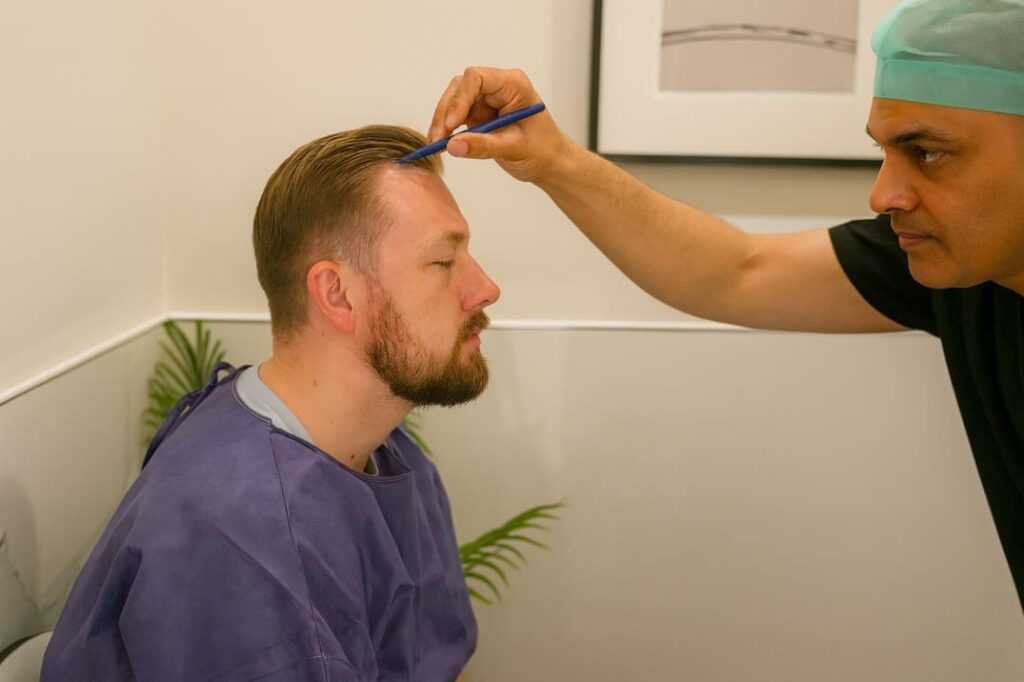
Most people researching a hair transplant spend their energy comparing graft numbers and prices, and far fewer ask what the year afterwards actually feels like. That is where expectations tend to come unstuck. Surgeons at a hair restoration clinic in Dublin will describe the same arc as their counterparts in London or Leeds: the operation takes a single day, the result takes twelve to eighteen months, and the middle stretch is unsettling for reasons nobody mentions in the consultation room. What follows is the usual course, month by month. Individual recovery varies, and none of it replaces an in-person assessment by a qualified practitioner.
Days One to Seven
The first night is the strangest. The scalp is still partly numb from local anaesthetic, the donor area at the back of the head feels tight, and the recipient area is dotted with thousands of pinpoints where grafts have been placed. Sleeping position matters more than most patients expect. The standard instruction is to sleep propped at roughly 45 degrees for the first three to five nights, on two or three pillows or in a reclining chair. Gravity carries post-operative fluid downwards, and lying flat encourages it to settle around the forehead and eyes. Swelling usually appears on day two or three, peaks around day four, and can be pronounced enough that people book the week off work simply to avoid explaining it. It resolves on its own.
Washing begins earlier than expected, often on day two or three depending on the surgeon’s protocol. The method is deliberate: soak the recipient area with saline spray or a diluted, unscented shampoo lather, leave it several minutes to soften the crusts, then rinse with a cup rather than a shower head. No rubbing, no fingernails, no direct jet of water. Small scabs form around each graft within 48 hours, and the point of the washing programme is to loosen them gradually rather than lift them off. A graft dislodged in the first 72 hours does not grow back.
Week Two
Between roughly day eight and day fourteen the crusts start to shed. Some clinics permit gentle fingertip massage during washing at this stage to help them along, others prefer patience. Either way, the recipient area gradually clears, and underneath it the short transplanted hairs are still visible, giving a misleading impression that the job is done.
What remains is redness. Pale skin holds it longest, and it can persist for four to eight weeks, sometimes longer, looking a little like sunburn or a rash. The donor area heals faster and is usually inconspicuous within a fortnight, though numbness or odd tingling in the back of the scalp can linger for a couple of months. Most surgeons clear patients for light exercise around two weeks and heavy lifting at three to four. Hats are generally allowed once the crusts are gone, provided they are loose.
Weeks Three to Eight
This is where the transplanted hairs fall out. Almost all of them. The follicle has been moved, its blood supply interrupted and re-established, and the shock pushes it into a resting phase called telogen. The visible hair shaft detaches and sheds, while the follicle itself stays in place beneath the skin. This is shock loss, and it happens to the large majority of patients.
Existing native hair around the recipient area can shed at the same time, particularly miniaturised hair that was already weakening. That variety usually returns with the transplanted hair, though not always in patients whose loss was advancing quickly to begin with.
Months Three to Five
The follicles now sit dormant while the scalp looks worse than it did before surgery. Patients often describe month three as the low point, and it is when clinics field most of the worried phone calls. The reasoning behind the panic is understandable: money has been spent, weeks of careful washing have passed, and the head looks emptier than it did in the pre-operative photographs.
The explanation is simply biology running to schedule. A follicle emerging from telogen takes around three to four months to produce a new shaft and push it through the skin. Nothing visible happens during that wait. When regrowth does begin, it arrives unevenly. Some areas sprout at twelve weeks, others at twenty, and the hairs that appear first are fine, wispy and pale, sometimes described as vellus. The scalp looks patchy and mismatched. The phrase used across forums and clinics is the ugly duckling phase, and it is a normal stage rather than a sign of failure.
Months Six to Nine
Around month six most patients see the change they have been waiting for. Roughly half to two thirds of the eventual result is typically visible by this point. The new hairs thicken, gain pigment and start to behave like the surrounding hair rather than baby fluff. Coverage improves week on week, and the patchiness of the earlier months evens out as the slower follicles catch up.
Texture is often odd at this stage. Newly grown hair can be curlier, wirier or more unruly than the hair it came from, which surprises people who transplanted straight donor hair and find it growing in with a kink. This usually settles over subsequent growth cycles.
Months Ten to Twelve and Beyond
By the twelve-month mark most of the density has arrived, and this is the point at which many patients consider the process finished. It generally is not. Hairs continue to thicken in calibre through months twelve to eighteen, and the crown, which is slower than the hairline in almost every case, may need the full eighteen months or a little more. Surgeons who assess results honestly compare standardised photographs at twelve to eighteen months rather than judging earlier.
Final results vary considerably. Donor quality, hair calibre, contrast between hair and skin colour, the extent of the original loss and the surgeon’s plan all affect what a given number of grafts can achieve, and no outcome is guaranteed.
One point deserves emphasis because it is routinely underplayed. A transplant redistributes hair; it does not switch off androgenetic alopecia. Native hair around and behind the transplanted area can keep thinning on its own timetable, which is why some patients look excellent at eighteen months and noticeably thinner again at five years without a maintenance plan. Anyone considering surgery should discuss ongoing medical treatment, and the realistic prospect of a second procedure later, before the first one is booked.