
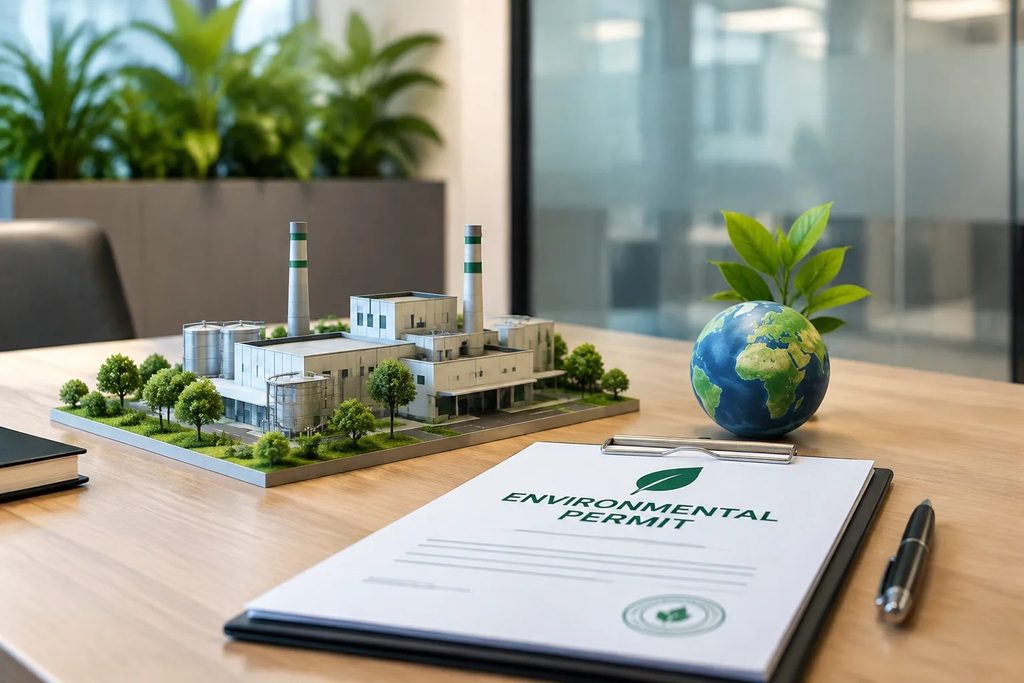
Opening a factory in Dubai takes more than a trade license and a lease. Any plant that releases emissions, discharges wastewater, stores chemicals or generates noise also needs environmental approval before it starts production. Treating it as an afterthought can mean late redesigns, delayed openings or an order to stop operating.
This guide explains what the approval is, who needs it and how the application works.
What the Approval Covers and Who Issues It
An environmental permit confirms that an industrial facility meets Dubai’s rules on air emissions, effluent, waste handling and noise. Consultants and suppliers may call it a permit, an environmental clearance or a no-objection certificate. These usually describe stages of the same approval pathway.
For years, Dubai Municipality issued these clearances, and many guides still name it as the issuer. That changed in August 2026, when the municipality announced that environmental permits for industrial projects, and for development and infrastructure projects, had moved to the Dubai Environment and Climate Change Authority. Anyone planning to get a clearance certificate from Dubai Municipality should now confirm the current channel with the new authority.
For a broader look at the same topic, this overview of environmental permits for Dubai factories is a useful companion reference.
Which Facilities Need Environmental Approval
Most activities that create emissions, effluent, hazardous waste or significant noise fall within scope. Chemical production, coatings, metal finishing, plastics, food processing and construction materials are typical examples. Sites running boilers, furnaces or large generators, or storing hazardous substances, generally receive closer review.
Lighter operations such as assembly, packaging or small batch production may face a simpler review, but they are rarely exempt altogether. Larger or more sensitive projects can be asked for an environmental impact assessment or a technical study, prepared by an environmental consultant approved by the authority.
How the Clearance Process Usually Works
The first step is matching the activity on your trade license to what the plant will actually do. List every chemical, emission source and wastewater stream, then confirm the risk category with the regulator.
Next comes the document pack. Applicants are commonly asked for the following, although the authority sets the exact checklist:
- Trade license, tenancy contract and site location details
- Site layout, process flow description and safety data sheets
- A list of chemicals with storage quantities, plus waste and wastewater management plans
The application is then submitted through the authority’s official online channel. Inspectors may raise queries or visit to check chemical storage, ventilation, spill control and signage. Flagged issues are fixed and re-inspected. Once approved, record the validity date and set a renewal reminder well in advance.
Aligning Your License With the Permit
The trade license, whether issued by the Department of Economy and Tourism or a free zone authority, defines what a company may do. The environmental approval shows it can do so safely. When the two do not match, the application stalls.
A common case is a business licensed for trading that later starts light manufacturing. It must amend its activities before its plant can be assessed. Checking zoning, drainage and ventilation before signing a lease avoids renting a unit that cannot meet the required controls.
Costs, Timelines and Common Mistakes
There is no single fee. Costs vary with activity type, facility size and risk category, and studies, consultant support and equipment upgrades add to the total. Keep separate budget lines for each and request the current fee schedule from the authority before committing.
Processing time also varies. Low-risk files move faster, while complex plants may need several rounds of review. Delays usually come from incomplete files, vague process descriptions, failed inspections and missing contracts with authorised waste collectors. Signing the waste contract before inspection and keeping disposal records helps avoid that.
Planning Ahead
Environmental approval is a core part of launching any factory in Dubai, not a formality to handle after fit-out. Confirm your category early, prepare a complete file, align it with your license and verify fees and timelines with the current authority.
The same groundwork applies whether a manufacturer is licensed on the mainland or in a free zone such as Meydan Free Zone, since the environmental approval itself is issued by the emirate’s environmental regulator.