
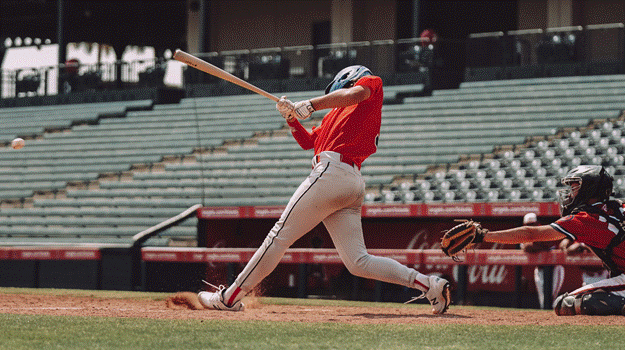
A few weeks into the 2026 MLB season, the home run leaderboard is already telling a compelling story. Familiar sluggers are doing what they’ve always done, driving the ball out of the park with authority, while a new wave of hitters is forcing its way into the spotlight.
April doesn’t decide the home run crown, but it often reveals who’s trending in the right direction based on early production trends. For those tracking power across the league, these early performances offer a valuable snapshot of how the season might begin to unfold.
Jordan Walker, St. Louis Cardinals
Jordan Walker’s start has been impossible to ignore. With eight home runs to lead the league, he’s finally resembling the breakout force many expected. The key difference is consistency; his swing is creating more lift, and the contact quality is there to match.
Statcast indicators back it up. A barrel rate well above league average and steady hard-hit contact suggest this isn’t just a streak through the first few weeks. Walker is getting the ball in the air with intent, turning raw power into tangible results.
Momentum matters early in the season. A strong April can quickly shift how a player is viewed across the league, and Walker’s surge has firmly placed him among the names to watch. This kind of start often draws broader attention to his power profile.
Aaron Judge, New York Yankees
Aaron Judge doesn’t need a hot start to command attention, but he has one anyway. Six home runs in the opening weeks, paired with exit velocities north of 115 mph, reinforce his status as the gold standard for power hitting.
Consistency defines Judge’s profile. Multiple 50-home run seasons have set expectations at a level few players can match. Even when others surge, he remains the benchmark. That track record keeps him central to early-season power discussions each year.
That steady presence is reflected across the league. For those comparing top sluggers, tracking home run betting odds offers a useful way to see how players like Judge continue to anchor the race for the league’s home run leader while newer names rise alongside him.
Kyle Schwarber, Philadelphia Phillies
Kyle Schwarber’s power comes with a familiar rhythm, streaky, explosive, and ultimately reliable over time. After launching 56 home runs in 2025, he has carried that approach into the new season with six early long balls.
His profile hasn’t changed much. Schwarber thrives on elevating the ball and pulling it with authority. That combination naturally leads to stretches where the home runs come in bunches over the course of a season.
Short-term fluctuations are part of the package. A quiet week rarely changes the bigger picture with Schwarber. Over the course of a season, his approach tends to produce. That consistency keeps him relevant in power discussions year after year.
Yordan Alvarez, Houston Astros
Yordan Alvarez continues to make power look effortless. Six home runs and an OPS of 1.175 highlight how efficient his production has been through mid-April. His ability to generate consistent hard contact keeps his power output steady.
Plate discipline sets Alvarez apart. He rarely expands the zone, forcing pitchers into difficult decisions. When he gets a pitch to hit, the result is often loud contact. That selective approach often leads to more favorable hitting counts.
Durability questions linger in the background, but his offensive floor remains among the highest in baseball. Alvarez doesn’t rely on volume alone; his impact comes from quality. That efficiency allows him to produce without needing constant at-bats.
Gunnar Henderson, Baltimore Orioles
Gunnar Henderson’s early performance feels like a return to form. Six home runs and steady offensive output point to a hitter regaining confidence in his power stroke. His early consistency suggests a more stable approach at the plate.
Development rarely follows a straight line. Henderson showed flashes of elite power in previous seasons, but consistency proved elusive at times. This year, the swings look more controlled, and the results are following through the first few weeks of 2026.
Younger hitters often reach a point where tools begin to translate into production. Henderson appears to be approaching that phase, making him one of the more intriguing names in the current group as the season continues to take shape.
Emerging Power Threats Gaining Attention
Not every April storyline belongs to the league leaders. A handful of players are generating buzz through strong metrics, improved approaches, or eye-catching performances.
Shohei Ohtani, Los Angeles Dodgers
Shohei Ohtani may not lead the league in home runs, but his presence still looms large despite a slow start. Strong lineup protection helps him see more pitches in the zone, and that combination of opportunity and elite ceiling keeps him central to the home run race.
Oneil Cruz, Pittsburgh Pirates
Oneil Cruz has always had elite raw power, but this season, the difference is more consistent contact. Improved discipline and pitch selection are helping that strength show up more reliably. When tools and approach align, production can rise quickly, and Cruz fits that profile.
James Wood, Washington Nationals
James Wood’s rise has been one of the more notable early developments. Five home runs and a .971 OPS reflect a promising start and growing confidence, while his size and bat speed generate impressive power. Early momentum can build quickly for players like this, and the upside is clear.
Why Early Power Numbers Don’t Tell the Full Story
Early home run totals only capture part of what’s happening at the plate. Underlying metrics like barrel rate, exit velocity, and launch angle often provide a clearer indication of whether a hitter’s power is sustainable or simply a short-term spike.
Some players make strong contact without immediate results, while others benefit from timing or conditions despite similar quality of contact. That gap can shape early perceptions, making the latest MLB player stats and trends useful for added context.
External factors also play a role. Cooler April weather can limit carry, while ballparks and lineup protection influence power opportunities. As these variables stabilize, early numbers become more reliable indicators of long-term performance.
A Season Still Finding Its Shape
April offers a glimpse, not a conclusion. Early leaders can cool off, while others heat up as conditions change and rhythms settle. Established stars like Judge and Ohtani continue to provide stability, while emerging names inject unpredictability into the race.
The home run landscape evolves over months, not weeks, as the season progresses. Early trends highlight potential, but they rarely define the outcome. For now, the mix of proven power and rising talent keeps the race wide open and worth watching closely.