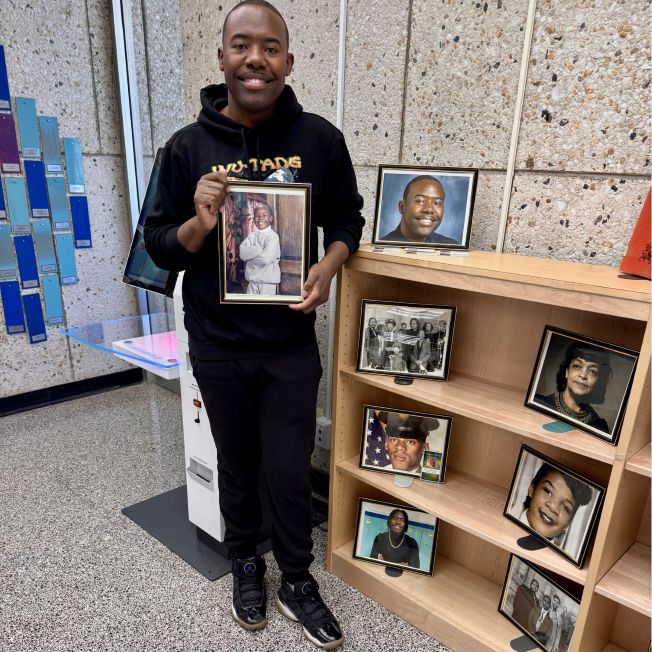
Dennis Richmond Jr. with personal photos. Photo by Hortena Richmond
By Dennis Richmond, Jr.
This month, my family’s history is officially on display at the Grinton I. Will Branch of the Yonkers Public Library, and it feels magical. To walk into a public institution and see my own family represented—our pictures, names, and stories—is a powerful reminder that Black American families are history too.
For so long, history has been something we’ve been taught to search for in textbooks, museums, or distant archives. But this display challenges that idea. It shows that history lives in our living rooms, in our grandparents’ memories, in church records, census documents, family Bibles, photographs tucked into drawers, and stories passed down at dinner tables. My family’s story—rooted in South Carolina, Connecticut, and New York, stretching back generations—is not exceptional because it is famous, but because it is real.
The goal of this display is simple: to make history feel accessible. I want people in Yonkers and across Westchester County to see themselves reflected in the past and to realize that their own families are worthy of preservation, documentation, and celebration. Too often, especially for Black folx, our histories are fragmented by migration, enslavement, segregation, name changes, and lost records. This small display is my way of showing that even with gaps, we can still reconstruct meaningful narratives about where we come from.
In partnership with the Grinton I. Will Branch, I am also hosting two community events this month that build directly on that mission: a Genealogy 101 workshop and a Black LGBTQ+ history program.
On Wednesday, February 18th, I will lead Genealogy 101: How to Trace Your Roots, a workshop for teens and adults focused on practical tools for beginning family research. Participants will learn how to use census records, birth, marriage, and death certificates, military files, church archives, and online databases to start building their own family trees. More importantly, the program emphasizes that genealogy is not about perfection—it is about curiosity, patience, and learning how to ask the right questions.
Later in the month, on Saturday, February 28th, I will present Black LGBTQ+ History: From 1926 to 2026, a community discussion tracing a century of Black LGBTQ+ life, culture, and preservation. As the LGBTQ+ community continues to make social and political strides, it is imperative that our history is not only told, but actively protected. Too often, Black LGBTQ+ people exist in the margins of both Black history and LGBTQ+ history, leaving our stories erased, hidden, or treated as footnotes.
This program centers Black LGBTQ+ voices—with a twist. It weaves together ballroom culture, personal family histories, and community memory, with a focus on how Black LGBTQ+ folx document their lives. History is not just about the past—it is about memory, survival, and legacy.
Together, these programs reflect what this library display represents for me: that history is communal. It is something we build together, share together, and pass down together. Libraries are not just places for books; they are living archives of people’s lives.
If my family’s story can inspire even one person to ask their grandmother a question, search their last name, or feel seen in a historical space, then this display has already done exactly what it was meant to do.
Happy Black History Month.
Dennis Richmond, Jr. (@NewYorkStakz) is a journalist, historian, and educator from Yonkers, NY. He writes to uplift unheard voices, honor history, and inspire change.