
Explore the advantages of aluminum alloy CNC turning, precision machining steps, and anodizing surface treatments to help buyers optimize supply chains, control manufacturing costs for precision aluminum parts, and enhance product quality.
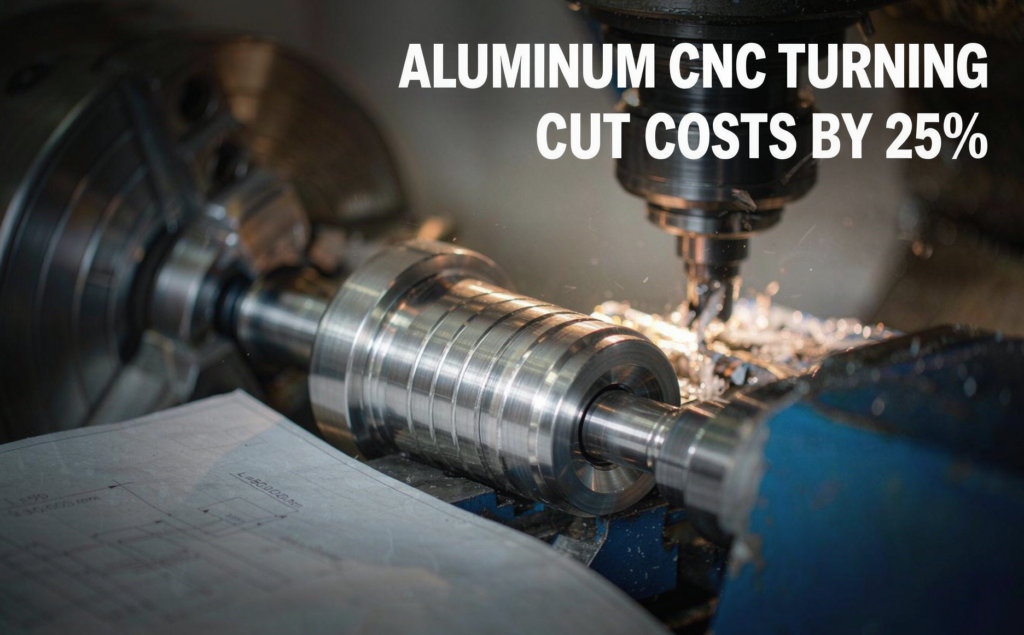
Advanced aluminum CNC turning processes can reduce manufacturing costs by 25% while maintaining high precision.
Introduction
In modern precision engineering, it is through finding the most appropriate aluminium CNC turning process, optimizing design for manufacturing (DFM), and using standardized anodizing treatments that a company can shorten production cycles and simultaneously reduce scrap rates and procurement costs by 20% to 30%, all while still meeting tight tolerances.
Why Is Aluminum the Preferred Material for Precision CNC Machining in Modern Manufacturing?
Lightweight and strong aluminum alloys like 6061-T6 and 7075-T6 are very machinable materials. They also have very good conducting properties thermally which makes them ideal for both aerospace brackets and consumer electronics enclosures.
Mechanical and Thermal Advantages
Aluminum CNC machining makes use of one of the strongest specific strengths materials to create lightweight but sturdy parts. Repeatable accuracy down to ±0.005 mm by advantages of CNC machining enable the creation of complex shapes without needing to go through further processing. Since aluminum conducts heat so effectively, it’s used to allow the heat generated in high power setups to be dissipated.
Quality Foundation Through Certification
Manufacturing precision aluminum parts of high quality starts with controlling raw materials. ISO 9001 certified producers perform spectrometer testing to check the alloy composition and so guarantee homogeneous workability among different material batches
Key benefits:
- Lightweight: as much as steel but 60% less weight.
- Corrosion Proof: Natural oxide layer protects against corrosion.
- Cost effective: Rapid cutting speeds lead to reduced cycle time.
How Does the CNC Turning Process Work to Achieve Tight Tolerances for Cylindrical Components?
The CNC turning process works as the workpiece rotates, while cutting tool remains fixed for producing cylindrical objects. Getting familiar with various cutting parameters will help achieve precision in your results down to the micrometer level.
Core Mechanics and Parameter Control
In aluminium CNC turning, crucial parameters are spindle speed (3,000-6,000 RPM), feed rate (0.05-0.15 mm/rev), and depth of cut (0.1-0.5 mm). Right choice of these will decrease cutting forces and thermal accumulation, which in turn will improve dimensional accuracy.
Evaluating Professional Service Providers
When evaluating a CNC aluminium alloy turning service, the engineers should look at machine calibration, in-process probing, and DFM support. A factory with multi-axis turning and CMM verification of course can keep critical diameters within 0.005 mm consistently.
Evaluation criteria:
- Machine features: Live tooling, Y-axis, sub-spindle.
- Control: First-piece inspection and SPC data.
- Material know-how: Experience with various types of aluminum.
How Do Anodizing Aluminum Parts Enhance Corrosion Resistance and Aesthetic Appeal?
Anodizing is a process that naturally increases the oxide layer of aluminum, resulting in a strong, corrosion-proof surface. Anodizing aluminum parts makes the surface harder, increasing it to HV 300-500 (Type II) and HV 500-700 (Type III), making it more wear resistant. This process also enables the dyeing of the surface for visual customization.
Anodizing gives a coating of 0.005-0.025 mm per side, pre-machining engineers must know about it to adjust the tolerances before machining. Premier manufacturers like LS Manufacturing not only use anodizing but also implement it with environmental regulations of ISO 14001. This helps them get a stable oxide layer thickness. Additional post-processing methods for instance electroless nickel plating allow them to control the nature of the surface per their needs.
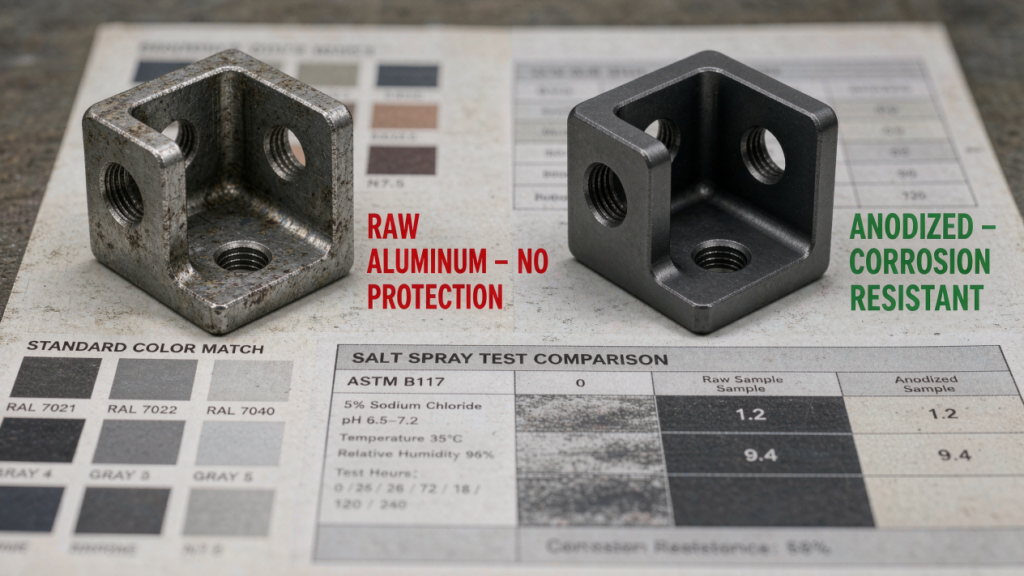
Anodizing significantly enhances the corrosion resistance and surface durability of aluminum parts compared to raw metal.
What Critical Factors Should Buyers Consider When Choosing Professional CNC Turning Services?
Choosing a good CNC turning services provider needs checking if they have proper manufacturing capability, measurement equipment, can deliver on time, and provide engineering DFM support.
A quality CNC turning service must be experienced in multi-axis turning machines, live tools, and automated bar loaders. The measuring instruments which include the CMM and roughness tester have to be calibrated. IATF 16949 and AS9100D certified suppliers do the implementation of defect prevention methods thereby reducing the rejection rate to below 50 ppm.
LS Manufacturing aluminum CNC has demonstrated a strong track record as these machines have been used effectively across many different sectors, from car power trains all the way to medical instruments. If you are working with a quality CNC turning service provider, then you should be able to secure your supply chain economically and also reduce your risks.
Supplier metrics:
- On-time delivery: Target ≥ 98%.
- First-pass yield: ≥ 95% for mature processes.
- Engineering response: DFM feedback within 24 hours.
How Can Engineers Optimize Product Design to Reduce Machining Costs and Prevent Failures?
Avoid very deep cavities with high aspect ratios, as these require specialization. Tolerances should be reasonable and based on the part’s function: only critical ones for mating need ±0.005 mm accuracy, the rest can be loosened to ±0.1 mm. If possible, simplify the groove to minimize the number of tool changes. Such optimizations may help you save 15–25% of the cost per part.
Thin walled precision aluminum parts tend to experience stress-induced deformation. Symmetrical chip removal, heat treatment to relieve stress, and the use of vibration- isolated tool holders are necessary to ensure dimensional stability. advantages of CNC machining, adaptive tool paths and probing during machining, compensate for dimensional changes due to thermal expansion. Initiating engineering discussions with machining partner at an early stage reveals possible problems before actual tooling commitment.
Conclusion
Besides choosing the appropriate alloy, knowing about cutting and anodizing, and having DFM (Design-For-Manufacturability) embedded in the design, those are the keys to manufacturing precise parts cost-effectively. Working with certified production management under ISO 9001, ISO 14001, IATF 16949, and AS9100D allows every item we deliver to meet strict quality standards.
Should you need professional aluminum precision machining service, you are welcome to submit your CAD drawings to get a free DFM review and price on your components instantly.
FAQs
What are the best aluminum alloys for CNC turning?
6061-T6 and 7075-T6 are the most commonly used. 6061-T6 is ideal for parts with structural function since it has great weldability and corrosion resistance, whereas 7075-T6 has a high strength-to-weight ratio suitable for parts under heavy load.
How does anodizing affect the dimensions of aluminum parts?
When aluminum is anodized, a layer of oxide forms on the surface and grows outward and inward as well. Ordinary anodizing adds a layer of about 0.005 to 0.025 mm on each side, and the allowance for this has to be considered when planning the machining process.
What tolerances can be achieved with aluminum CNC turning?
CNC turning of aluminum with high accuracy is normally limited to ±0.02 mm or ±0.005 mm. Higher accuracy demand multi-axis equipment, controlled temperature working environments, and coordinate metrology machine (CMM) inspection.
Why is DFM analysis critical before starting mass production?
DFM analysis highlights the characteristics that lead to abnormal tool wear, excessive clamping time, or stress deformation.Getting rid of them beforehand will save us expensive rework and bring down the cost per part.
How do quality management certifications impact manufacturing output?
Certification to quality management systems ensures standardization of procedures, complete traceability, first article verification and continuous improvement, these measures drastically reduce the defect rates and reduce the risk of supply disruptions.
About the Author
This article was written by a senior precision manufacturing specialist from LS Manufacturing, who boasts a career spanning fifteen years in the field of CNC machining, metal forming and delivery of complex components. The paper describes the author’s commitment to providing premier manufacturing solutions to commercial and industrial clients across the globe.