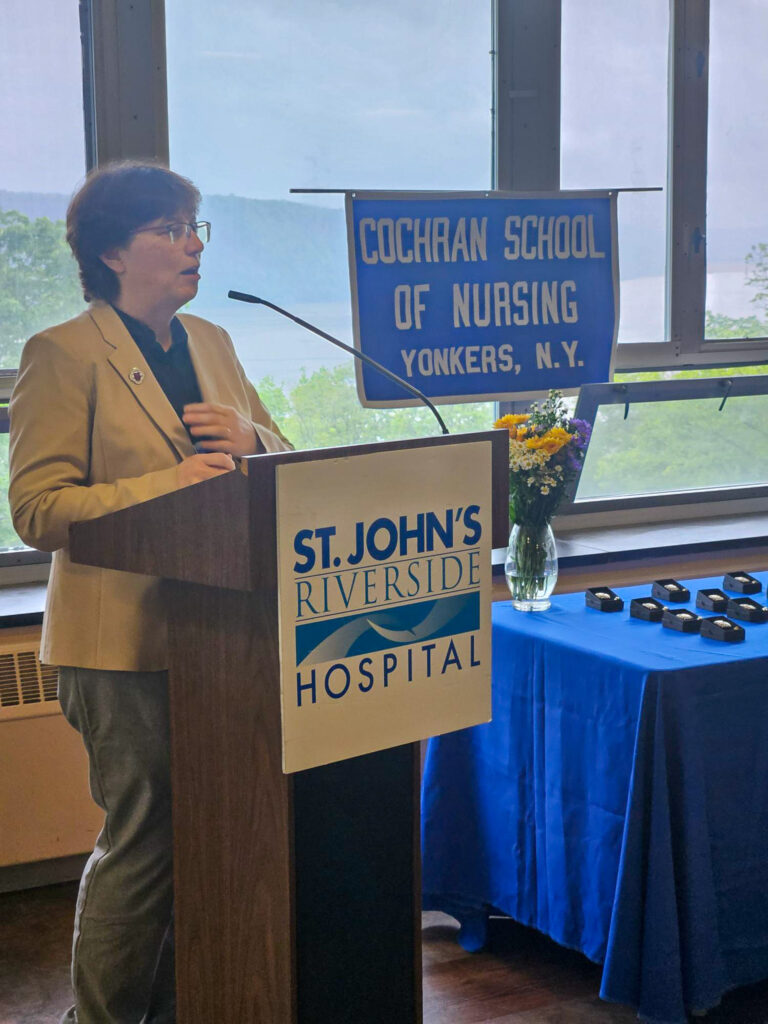
Dr. Sandra Dave, Dean, Cochran Nursing School at St. John’s Riverside Hospital
The Cochran Nursing School at St. John’s Riverside Hospital is working to help more students become nurses with a hospital-based, immersive learning experience. Its fast-paced, two-year program offers unique learning opportunities, according to the school’s dean, Dr. Sandra Dave.
“I think what separates it is being a hospital-based program,” says Dr. Dave. “That means students have access to our clinical facilities and don’t have to fight to get placements in other hospitals.”
She adds that the two-year program is attractive to many potential students.
“A lot of our graduates come from the area we serve. Some are socioeconomically challenged, and because of that, they’re very driven. They want to be out in 2 years and in the workforce, starting to provide for their families. As a result, they get into the workplace more quickly with our two-year program. They gain more clinical skills, more acumen.”
Students who graduate from the two-year program can begin working right away, but will need to complete a bachelor’s degree within ten years due to New York State licensing requirements.
Dr Dave completed her undergraduate nursing degree in England, where she is originally from, and then came to the US to earn her FNP (Family Nurse Practitioner) degree at Pace University. She later completed a doctorate in clinical nursing practice.
In 2022, Dr. Dave became the Dean of Cochran Nursing School and immediately began working to increase enrollment.
“Enrollment across the board for nursing and some of the health sciences is down,” she says. “The school enrollment has ebbed and flowed. I think it was over 300 at its peak, but at the moment, we have a total enrolled body of about 114 to 120. That’s where we’re averaging. So our graduating classes tend to be around 35 to 50 students, depending on attrition and other factors.”
However, each individual class is much smaller. Dr. Dave says they aim for a 1-to-6 faculty-to-student ratio to improve the learning experience.
“We’re trying to reflect that as well in the clinical space,” she says. “So a group of no more than six students will be on the floor at any one time. That means they have a more individualized experience and more 1:1 time with the patient. They get more time with the faculty rather than just being, you know, a number in a group.”
Cochran also offers a simulation lab to help students learn delicate procedures, such as starting an IV.
“It’s a luxury to have a SIM lab, especially in a small institution like Cochran,” Dr. Dave explains. “A SIM lab or simulation lab can be a variety of things to different people, but basically, it’s an excellent, safe space in which nurses can train. We use a human patient simulator, which is a high-fidelity mannequin that breathes and has a pulse. We can relay voice commands through them. They can blink their eyes. They have realistic hair. Realistic skin. You can catheterize them. You can put a vent in or start an IV line.”
She adds that the SIM lab walks students through a wide variety of potential patient scenarios.
“So our first-year students get a low-fidelity respiratory simulation. In our final semester, students who are doing a lot of cardiac and neuro will get maybe a patient who has an arrhythmia or is having a myocardial infarction, and they’ll be taking care of that patient in the SIM lab.”
This experience prepares students for interactions with real patients and helps build confidence.
“This is where they learn the first steps of teamwork,” says Dr. Dave. “You get to see who the leader is in the room, who’s delegating, who’s just standing in a corner, who needs to be coaxed out of their shell a little bit. There’s progression as they go through the curriculum, so you get to see the students develop more. And that translates to what the instructors see on the floor. They get to see that confidence.”
As students train in the lab, Dr. Dave continues to work to increase enrollment and attract new students to Cochran. Scholarships are available, and she continues to seek additional funding from local foundations to make nursing education more accessible.
“We have set up some fantastic scholarships for our students,” says Dr. Dave. “We have at least four students who pretty much get a full ride because of the generosity of some of our donors. We also have donations earmarked for some physical and capital improvements.”
Dr Dave hopes not only to bring more students to the school but also to attract more people to the field of nursing.
“I think people should study nursing and come to Cochran, because it provides such a foundational experience for the rest of your life,” she explains. “You know, if you can look after people, that means you can certainly look after yourself and your own family. You can build on that foundation to take you anywhere that you want to go. If you want to be an ICU nurse, it’s going to prepare you for that. If you want to look after pediatric patients, it will prepare you for that. If you want to be a school nurse, it will prepare you for that. If you want a career that you can really apply your focus to and that has ever-expanding opportunities, nursing is there for you.”
To apply or learn more about nursing programs, please visit the Cochran Nursing School website.