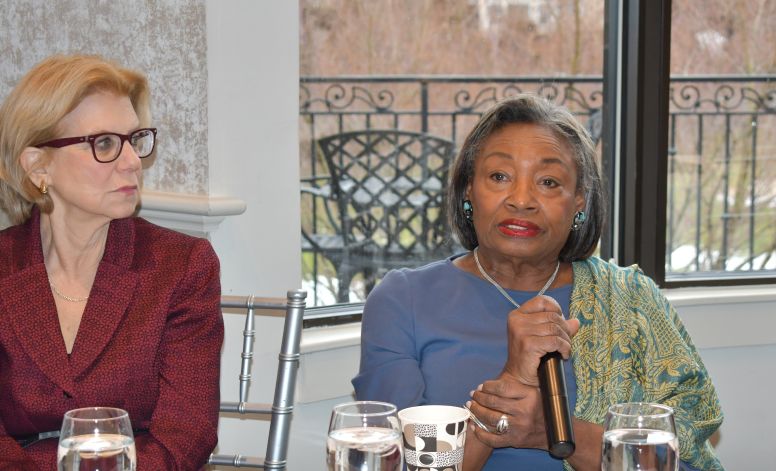
State Senator Shelley Mayer, left, and State Senate Majority Leader Andrea Stewart-Cousins
The Building & Realty Institute (BRI) of the Hudson Valley hosted its annual Legislative Breakfast on March 6 at Mulino’s at Lake Isle, bringing together state lawmakers and housing industry leaders for a conversation about the most pressing housing challenges facing Westchester County and the broader Hudson Valley.
The event also marked the official unveiling of the BRI’s 2026 Legislative Agenda, outlining the organization’s policy priorities for addressing the region’s housing shortage, stabilizing the multifamily housing market, and tackling rising costs affecting both housing providers and residents.
Among the members of the legislative delegation who attended were Senate Majority Leader Andrea Stewart-Cousins, State Senator Shelley Mayer, State Senator James Skoufis, Assemblymember Amy Paulin, Assemblymember Matt Slater, Assemblymember Chris Burdick, Assemblymember Dana Levenberg, and Assemblymember Steve Otis. Westchester County Executive Ken Jenkins also made an appearance at the event.
BRI members—including builders, property owners, landlords, developers, managers, co-op and condo boards, and service providers—had the opportunity to engage directly with lawmakers on policy issues impacting housing affordability, development, and the stability of the region’s existing housing stock.
A key topic of discussion was potential reform of the State Environmental Quality Review Act (SEQRA). Participants noted that the current environmental review process can create significant delays for housing development projects, and legislators expressed optimism that a balanced approach could be reached that protects environmental standards while allowing responsible housing development to move forward more efficiently.
Another issue raised during the discussion was the need to reconvene the temporary commission established to evaluate the impacts of the Housing Stability and Tenant Protection Act of 2019 (HSTPA). Senate Majority Leader Stewart-Cousins indicated she would look into the possibility of convening a temporary commission of stakeholders – as called for in the law itself — to evaluate how the law has affected housing supply, building conditions, and tenants across the state.
Attendees also highlighted the impact of rising energy costs on housing providers and residents. Increasing electricity and utility expenses continue to put pressure on operating budgets for multifamily housing and contribute to broader affordability challenges across the region.
The newly released BRI 2026 Legislative Agenda outlines four key policy priorities: removing barriers to housing development, stabilizing the multifamily housing market, protecting the affordability of nonprofit housing cooperatives, and addressing major cost drivers such as insurance and utilities while promoting opportunities for first-time homeownership.
“The BRI’s Legislative Breakfast provides a backdrop for policymakers and the housing industry to have important discussions about the on-the-ground realities that most affect builders and those who own or operate existing multifamily. These discussions are a real opportunity to exchange ideas and discuss practical solutions,” said Tim Foley, CEO of the BRI. “Housing challenges affect every community in our region, and conversations like this help ensure that lawmakers hear directly from the people working on the front lines of housing. BRI members have spent 80 years building the future of Westchester, and we’re grateful for the ongoing conversation about how we can keep moving forward.”
The BRI represents more than 1,000 members throughout Westchester, Rockland, and Putnam counties and advocates for policies that support housing stability, responsible development, and vibrant communities across the Hudson Valley.