
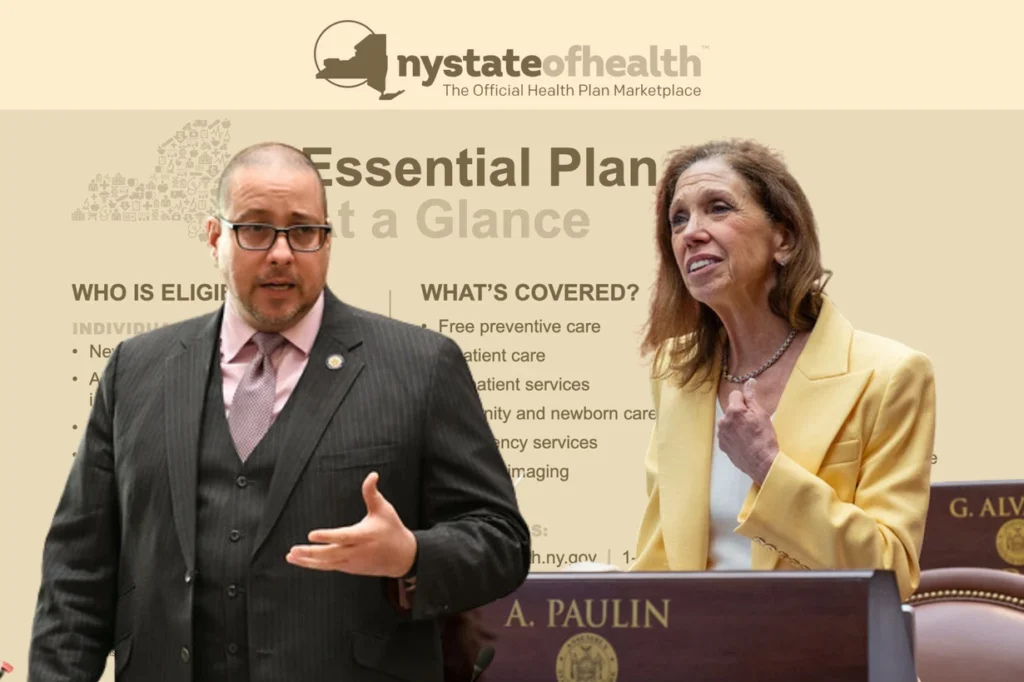
Bills sponsored by Assemblymember Amy Paulin and Senator Gustavo Rivera would use state funding to continue Essential Plan access for moderate income New Yorkers. | Card: NY State of Health; Photos: New York State Assembly Majority; New York Senate Photo | Illustration: Leor Stylar
Nearly half a million New Yorkers on the Essential Plan could lose their coverage this summer
Note: This story originally appeared in New York Focus, a nonprofit news publication investigating power in New York. Sign up for their newsletter here.
State lawmakers are announcing legislation this week to ensure health care coverage for nearly half a million New Yorkers set to lose their insurance in July as a result of federal cuts.
The bills, sponsored by Assemblymember Amy Paulin and Senator Gustavo Rivera, would direct the state to use its own funds to continue Essential Plan access for moderate-income New Yorkers. The flagship program provides free or low-cost healthcare to 1.7 million residents and has been instrumental in helping the state achieve near-universal insurance coverage.
The bills represent the first major proposal from state leaders to protect Essential Plan enrollees from policy changes enacted under the megabill President Donald Trump signed last year. Under those changes, New York lost a chunk of federal funding for the Essential Plan on January 1.
Earlier this month, the state secured federal approval to retool the plan — averting a “worse-case scenario” that could have ended the program entirely. The maneuver preserves coverage for 1.3 million New Yorkers, but an estimated 450,000 to 470,000 enrollees are set to be disenrolled in July.
None of the budget proposals introduced earlier this year by Governor Kathy Hochul, the Assembly, and the Senate address the impending coverage cliff, frustrating health care advocates who have been urging lawmakers to take action for months.
“There’s been a resistance generally, and I get it, to not have state dollars be responsible for the federal debacle, but we’re talking about human beings,” Paulin said of how current budget negotiations have evolved. “We’re trying very hard to work cooperatively to put forward a plan that could save them.”
State health officials are planning to mail notices by early April to New Yorkers losing coverage, directing them to seek out insurance from employers or purchase plans through the state’s exchange. Advocates have noted that few will likely be able to afford the plans, whose monthly premiums rank among the most expensive in the country.
Rivera’s bill would also set up a state-funded premium assistance program to make those plans more affordable, and other measures specifically addressing new restrictions on certain legal immigrants on the plan.
“These are the people who go to work every day and generate billions in economic activity,” Rivera wrote in a press release of the impacted New Yorkers. “This bill will protect basic healthcare access and mitigate the harm of these cruel policy choices.”
Paulin’s bill is expected to be released soon.
The bills do not allocate any specific funds, but Paulin said she hopes the effort “catches fire” and prompts deeper discussion about how much the state is willing to spend. A recent report by the Community Service Society of New York estimated that extending coverage for New Yorkers who will otherwise be kicked off the Essential Plan could cost $2.3 billion a year. The nonprofit has been among several organizations urging state lawmakers to consider various options to avoid imminent coverage loss.
Hochul’s budget proposal, which assumed New York might not get federal approval to tweak the Essential Plan, earmarked $2 billion to insure a subset of enrollees the state is legally mandated to provide health coverage for, regardless of federal support.
Now that the state got federal approval to rework the Essential Plan, the state could redirect that $2 billion to cover New Yorkers getting dropped from the program, said Michael Kinnucan, director of health policy at the left-leaning Fiscal Policy Institute.
“We have the moral obligation to cover this population,” said Kinnucan, who supports legislative efforts to use state funding to continue Essential Plan coverage. “The money is there.”
It’s unclear if legislators and the governor will agree. Paulin noted the governor’s budget proposal put that money aside strictly in the event that the Essential Plan ended. All three budget proposals also call for hefty reimbursement rate increases to health care providers, which would complicate the overall financial picture. Kinnucan is among a group of health care advocates who have criticized lawmakers prioritizing provider rate increases over the coverage cliff.
“The bottom line is there’s been no agreement with the three [budget proposals] of what it is we have to spend,” Paulin said.
The Paulin and Rivera bills represent a significant departure from the legislature’s approach to federal cuts. Last fall, top Democrats declined to return to Albany for a special session to address the imminent impact of federal cuts to Medicaid and other benefits programs — effectively punting the issue to the current budget season.
Earlier this month, both chambers’ budget proposals stopped short of allocating state funds to fully replace the cuts. It’s unclear how much traction the eleventh-hour proposals could get at this stage of negotiations. The state’s fiscal year starts on April 1, but in recent years lawmakers have delivered a final budget weeks or months late.
The measure is likely to encounter strong resistance from Hochul, who has centered her budget proposal this year on “affordability” but has been reluctant to raise taxes on the wealthy. She has insisted the state cannot afford to backfill federal cuts. The governor’s office declined to respond to a list of specific questions, but pointed to recent interviews where Hochul said she is continuing to work with federal officials to figure out a path forward for New Yorkers who are dropped from the Essential Plan.
Essential plan enrollee Chris Sahar, a substitute special needs teacher in Queens, is among those likely to become uninsured in July. Sahar, who also works as a church organist and a musical composer, relies on the plan to manage Hashimoto’s disease, an autoimmune disorder that requires medication and regular checkups.
“The Essential Plan this year has taken away the stress of worrying over high health care costs, and the zero monthly deductible has made it easier for me to put more money into my retirement,” said the 59-year-old. As a substitute teacher, Sahar is not eligible for employer-provided insurance or paid leave unless he is able to consistently increase his shifts.
Like many New Yorkers enrolled in the Essential Plan, Sahar earns too much to qualify for Medicaid but not enough to purchase a plan on the state’s exchange. Sahar currently falls in the tier of users that earn between $31,921 and $39,900 as a single person — or 200 to 250 percent of the federal poverty level — a demographic ineligible for coverage starting in July.
Sahar was previously enrolled in Medicaid for years while his career took a backseat to caregiving for his mother, who was suffering from metastatic breast cancer. “I think the best thing I ever did in my life was take care of my mom in her last years,” he said, noting how the experience also left him “haunted” by how financially devastating a diagnosis could be.
The Essential Plan’s impending coverage cliff is just the first of several seismic changes coming to the state’s healthcare landscape as a result of federal cutbacks. New work rule requirements for Medicaid that kick in next January are projected to result in hundreds of thousands more New Yorkers losing their health coverage over the next year and a half. Similar work rules for food assistance kicked in earlier this month.