
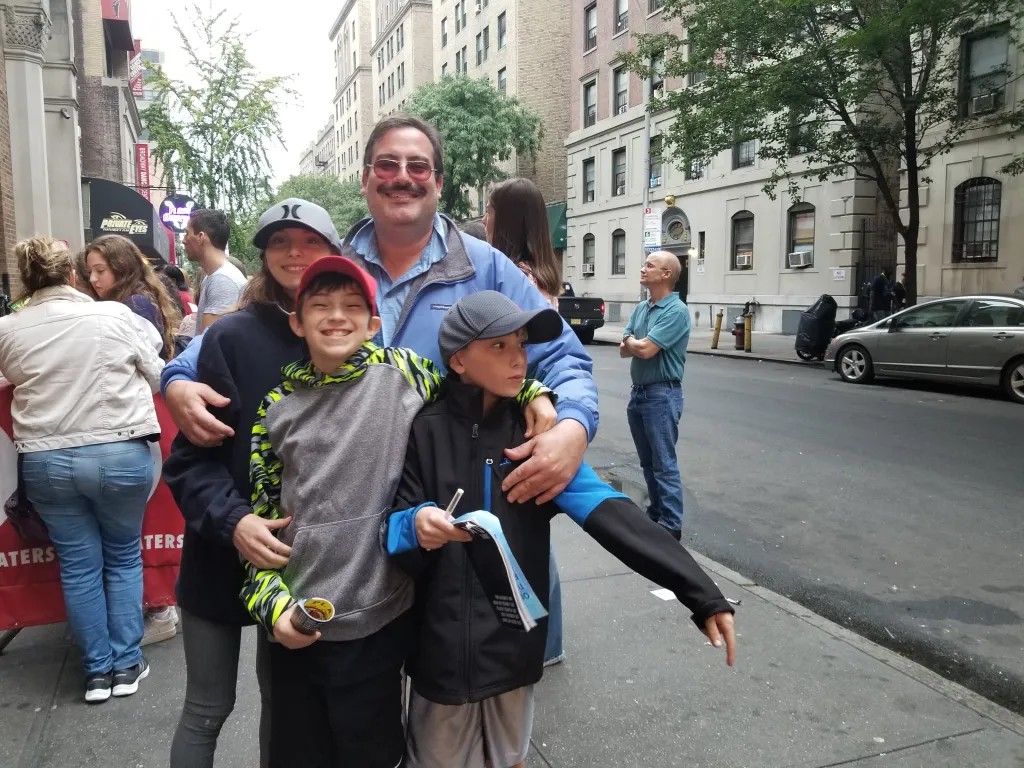
Mark Fishman with family
New York has become increasingly adept at documenting official misconduct. It must become equally adept at correcting the consequences that growing misconduct produces.
The New York Times this week reported that New York City paid more than $117 million through 1,044 police misconduct settlements in 2025. This marks the largest number of settlements since 2019, and contributing to nearly $800 million in total payouts since then, according to a new Legal Aid Society study. Furthermore, New York ranks third nationally in documented wrongful convictions, according to the National Registry of Exonerations.
These are not disconnected statistics. They point to a structural flaw in how the state handles institutional failure, and are living fractured families, and fathers with good intentions fearing prison. For more than 1,600 days, disabled New Rochelle father Marc Fishman has been separated from his children following a conviction tied to a police officer whom the New York State Attorney General later identified as engaging in a pattern of serious misconduct, including more than two dozen documented complaints.Despite that official finding, Fishman’s case was never automatically reviewed.
That gap — between identifying misconduct and correcting its consequences — is what Fishman is now working to change.
In Westchester, two Peekskill officers were suspended following public outcry over a use-of-force incident. Meanwhile, a federal lawsuit challenges alleged constitutional violations within the Office of Children and Family Services. In both instances, accountability mechanisms are reactive — driven by headlines and litigation rather than statutory design.
The same structural gap appears in criminal prosecutions.
When the Attorney General formally designates a law enforcement officer as having engaged in a pattern of serious misconduct, that finding does not trigger automatic review of prosecutions materially dependent on that officer’s testimony or investigation. Cases remain intact unless defendants independently raise the issue — often years later.
Consider Marc Fishman, a disabled New Rochelle father we’ve been reporting on closely, whose conviction was tied to an officer later identified by the state as a repeat misconduct offender. Despite that designation, there was no statutory trigger requiring reassessment of his case.
This is not about undermining law enforcement. It is about institutional coherence. If the state concludes that repeated misconduct occurred, the legal system should require structured review of outcomes built on that conduct.
Albany has the opportunity to address this through Fishman’s proposed Protect New Yorkers Amendment. The legislation would not mandate automatic reversals, and is not “anti-cop,” as Fishman states, rather, it is “pro-public safety.” As an ammendment the excisting Law Enforcement Misconduct Investigative Office (LEMIO), it would narrowly mandate review when the state itself has identified a pattern of serious misconduct.
That is a modest but consequential shift: from symbolic acknowledgment to procedural alignment.
Transparency reforms over the past decade were necessary. But transparency without any consequence leaves the burden on individuals to litigate what the state already knows.
If New York wants to reduce settlement costs, limit wrongful convictions and restore public confidence, it must close the gap between official findings and legal outcomes.
Recognition is not reform. Statutory recalibration is.
Albany can choose whether accountability remains episodic — or becomes structural.