
Report finds high levels of toxic pollution in majority of tested kitchens
As Governor Hochul weighs the Healthy Homes Right to Know Act, legislation that would require warning labels on gas stoves, a new study on a community-led testing project of kitchens released today finds high-levels of health-harming nitrogen dioxide pollution as a result of gas stove usage.
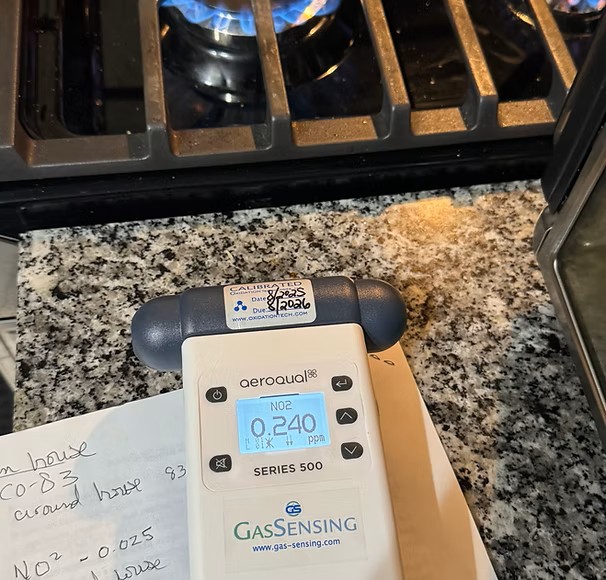
Over the course of several months, trained community volunteers ran 30-minute cooking tests in 135 New York homes, with monitors logging nitrogen dioxide readings every minute in the kitchen and bedrooms nearest to gas stoves. Findings from the testing are below:
- The majority of kitchens had nitrogen dioxide levels above 100 ppb at 15-minute and 30-minute intervals. For reference, the EPA’s outdoor 1-hour health standard is 100 ppb.
- Nitrogen dioxide pollution travelled to other rooms as well, with half of the bedrooms tested having average nitrogen dioxide levels above 100 ppb.
- Nitrogen dioxide levels in tested kitchens rose within 2-4 minutes of gas stove usage and climbed for the duration of the 30-minute test. The median kitchen averaged 116 ppb over its worst 30 minutes.
“The numbers alone seem pretty abstract, but having your home tested, it becomes personal. Scary, even,” said New York Senator Rachel May. “Reading up on the issue, it seems like these numbers in NY are consistent with studies in other places like Maryland. I want people to know about emissions from gas stoves and the possible health harms related to them, so they have a choice about what’s best for their families.”
Gas stoves are known for triggering respiratory illnesses, with children more likely to have asthma if living in homes with gas stoves. A study from this summer found that replacing gas stoves could be as effective as medication in treating asthma, dropping average nitrogen dioxide levels by 70%. Modeled after cigarette warning labels, the Healthy Homes Right to Know Act would help consumers make informed choices that reflect the growing body of evidence pointing to the toxicity of gas stoves.
“This is another important data set that highlights an essential point for families to consider: humans spend a lot of time indoors, and indoor air quality is important for our overall health,” said Charles Moon, MD FAAP, Co-Chair Public Policy & Advocacy Committee, New York State American Academy of Pediatrics. “We must identify sources of poor air quality in our homes and ask ourselves: how can I make my home healthier to live in? It is becoming increasingly clear through research like this that gas stoves are a source of poor indoor air quality that can contribute to poor health outcomes. We must adapt our homes to improve ventilation and transition when possible to non-polluting appliances that do not contribute to these exposures.”
A similar citizen-science project in Illinois found elevated carbon monoxide and nitrogen dioxide levels after 30 minutes of gas stove usage. A 2024 study found that nearly two-thirds of kitchens tested in Washington, D.C. and Maryland had unsafe levels of nitrogen dioxide.
Additional quotes from individuals who had their homes tested can be found below:
“I was glad my kitchen was tested,” said Actress Piper Perabo. “How else would you know this? Knowing the levels of nitrogen dioxide has definitely made me change my behaviour. I open the windows when I cook now. Of course they didn’t test for benzene or carbon monoxide or formaldehyde – the other chemicals gas stoves emit. But I’ll keep my window open whenever I cook.”
“I was unaware of the emissions from gas stoves,” said Actor Aidan Quinn. “I guess most people are. Learning about the levels of nitrogen dioxide which my family was being exposed to all these years was shocking.”