
By Larry Thaul
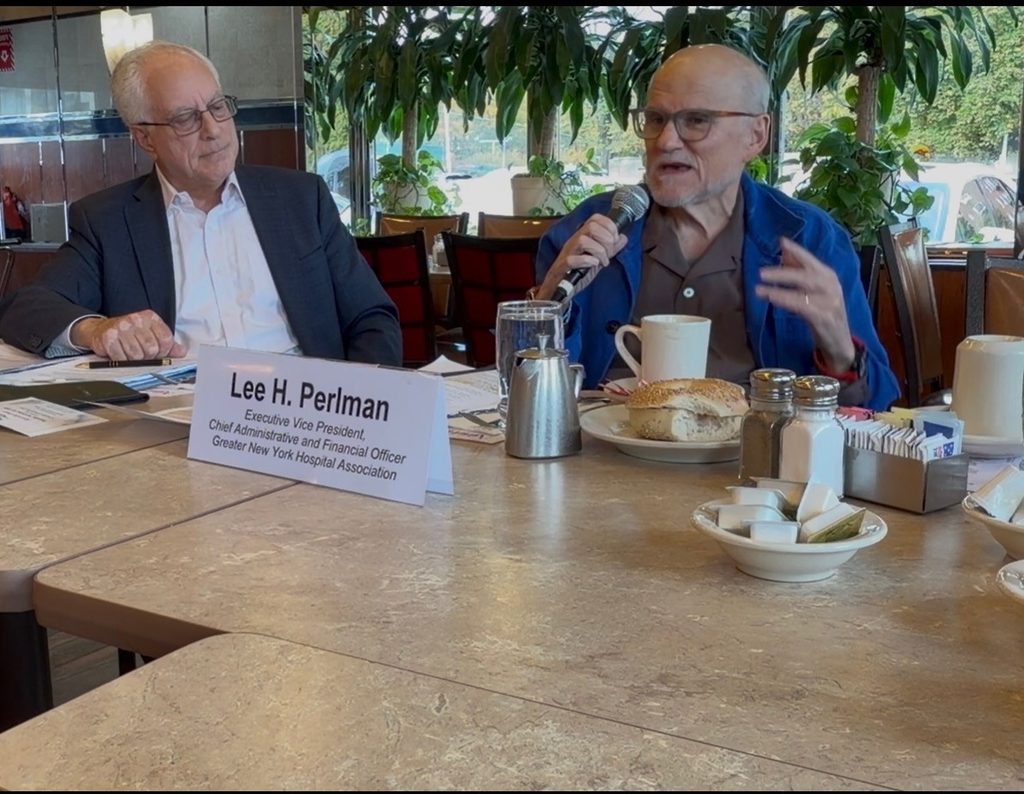
On November 10, The Larchmont/Mamaroneck Local Summit addressed healthcare, a topic affecting everyone. Longtime area resident Lee Perlman, Executive Director and Chief Administrative and Financial Officer of the Greater New York Hospital Association, answered an array of questions concerning access, quality, costs, and delivery of the medical care we receive.
Hospitals as Community Lifelines
Perlman opened by expressing his respect for hospitals, depicting them as egalitarian places that treat all comers, rich and poor. Admiring the compassion and the healing, he noted, “I see miracles happening every day,” and continued that hospitals are not perfect, but they are open round the clock, 365 days a year. That standby capacity costs money to maintain, so that they will be there when needed. He defended hospital consolidation, saying it has enhanced care, preserved smaller hospitals in Westchester, and has given healthcare systems the market power to negotiate with insurers and venders.
Primary Care, New Models of Care, and Drug Costs
Perlman believes the shortage of primary care physicians is temporary. He urges patience. Some area medical schools now offer free tuition due to philanthropic gifts. He feels that these schools should eventually produce more graduates drawn to primary care, since they will be free of medical school debt.
Perlman encouraged the establishment and use of urgent care facilities because they keep people out of emergency rooms where both the waiting time and the cost of treatment are so much greater. An example of alternative access to primary care arethe newly opened offices on the Post Road of One Medical, an Amazon-Montefiore arrangement. He said concierge medicine works as a navigation tool, though it cannot help in an emergency, where the ER treats patients solely by medical priority,
While acknowledging high prescription drug costs, he held that drug companies are not “the evil empire.” They have delivered great health benefits. He recommended that those with chronic diseases use generics and mail order for lower costs.
Coverage, Cuts, and Reforms
Perlman warned that upcoming federal cuts from the “Big Beautiful Bill” threaten Medicaid access, affordability and hospital crowding, and that lost Obamacare subsidies have made insurance unaffordable for some.
He saw healthcare a major issue in the November election and expressed hope that the new Congress can deliver incremental restorations. “Nobody should be without a safety net,”he said, adding that everyone has a stake in the wellness of the poorest because it affects the health of the whole community.
Medicare for all might be the design if the system were reinvented, he mused, but employer-based insurance is too entrenched. He anticipates reform will focus on Medicare expansion for people between 55 and 65. He added that malpractice reform is also needed, because legal costs drive up the cost of care.
Useful Technology
Perlman encouraged residents to use wearables that measure heart rate and other health data which can be shared with their doctor. He also said that AI can help to deliver better health care. It can cut hospital paperwork, compare scans against past cases and large data sets, more accurately read x-rays, and help hospitals and consumers contest insurance denials.
Mental Health, Long-term Care, and Value-based Payment
On mental health, the first step is talking about the crisis. He expects a shortage of psychiatrists and mental health beds to dominate national discussion. He called geriatric medicine and long-term care essential because hospitals depend on safe places to discharge patients; without them ER patients wait for beds. He indicated that hospitals are eager to move toward value-based care, in which payment reflects whole patient outcomes.
Perlman’s message was consistent: value the hospitals that serve everyone, protect access to coverage, and keep pressing for practical improvements that strengthen the community’s health. We also must keep informed and take an active role in our own care.
The Larchmont-Mamaroneck Local Summit is an informal community council that seeks to improve community life by keeping residents informed about major issues of concern. The next meeting, on December 1, will feature County Executive Ken Jenkins on how the recently approved county budget will affect our area. For more information, visit https://www.localsummitlm.org/. To view recorded programs on LMC Media, visit https://lmcmedia.org/series-page/larchmont-mamaroneck-local-summit/.