
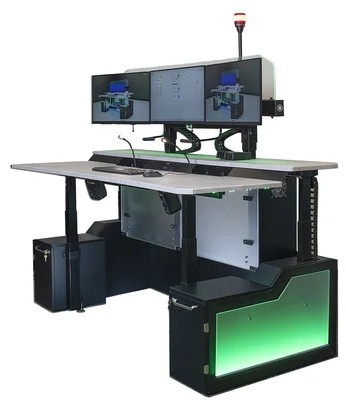
Your control room tech gets audited every year. The desk under it doesn’t. Here’s how to spec furniture that protects 12-hour shifts.
Twelve hours. That’s how long a 911 dispatcher might sit in the same chair before a break that may or may not arrive on schedule. Meanwhile, your facility team probably has a maintenance log for every monitor, every server rack, every UPS battery in the building. Ask them for the last inspection record on the desks those dispatchers sit at, and watch what happens to the conversation.
Control rooms get audited, funded, and upgraded around their technology. The furniture underneath it usually gets bought once and forgotten. That’s a mistake, and it’s an expensive one when you have to replace a full console bank in a building that can’t shut down for a week. Workstation vendors like XYBIX Systems, Inc. exist because enough agencies, hospitals, and utilities got tired of treating desks as an afterthought, and their catalogs reveal how much engineering actually goes into surfaces most people never think about.
What makes a control room desk different from office furniture
A cubicle desk holds a laptop and a coffee mug. A dispatch console holds four to six monitors, a radio stack, phone lines, and the person responsible for routing an entire city’s emergency calls. Those aren’t the same job, and the furniture shouldn’t pretend otherwise.
Three things separate them. Cable management has to survive reconfiguration without a technician crawling under the floor. Sit-to-stand travel has to be smooth enough that someone adjusts mid-call without losing focus. And the surface has to take a beating, because shared consoles get used by three shifts a day, seven days a week, for a decade or more.
If you’re specifying anything for a room that never goes dark, ask the vendor how their desks hold up under continuous multi-shift use. Not “durable.” Ask for the actual testing protocol. The answer tells you whether you’re talking to a furniture company or a control room company.
Does height adjustment actually matter for dispatchers?
Yes, and more than most people buying the furniture expect. The Occupational Safety and Health Administration has long treated workstation design as a core element of workplace safety, and the guidance consistently points toward adjustability over fixed heights. A console built for one body type is a console that fits everyone else badly.
Here’s the scenario that sells sit-to-stand in a control room: you staff a 12-hour overnight shift with three dispatchers of different heights using the same console in rotation. Static desks force at least two of them into a posture they’ll hold for hours. Adjustable desks let each person set the surface once and reset it on the next shift change. Small thing. Compounds over a career.
My recommendation, if you’re picking between a cheaper fixed console and a mid-tier adjustable one: buy the adjustable. You’ll spend more up front and lose far less to reconfiguration requests and replacement cycles later.
The Sight, Reach, and Reset framework
Before you talk to a single vendor, run every candidate console through these three tests using your actual equipment list, not a showroom’s.
- Sight: Sit where a real operator sits and confirm every primary monitor sits within a comfortable viewing arc without neck rotation. Count the ones you have to physically turn your head to read. If it’s more than one, the console geometry is wrong for your room.
- Reach: Place hands on the keyboard and confirm the radio, phone, and mouse all fall inside a forearm sweep. Anything requiring a full lean or a stretch is a console that will produce complaints within a month.
- Reset: Change the desk height from seated to standing and time it. If it takes more than a few seconds, or makes noise loud enough to register over headset audio, operators won’t use the feature. They’ll leave the desk where it is.
I’ve watched agencies spend six figures on consoles and skip all three tests, then discover during the first night shift that the monitor arms don’t clear the radio stack at standing height. That’s not a design flaw you fix with training. That’s a reorder.
Planning around the fact that control rooms never close
Installation is where control room projects live or die. You can’t take a PSAP offline for a week to swap furniture, and you can’t stage a hospital reading room the way you’d stage an office remodel. The room goes dark for a shift at most, sometimes hours.
Which means the vendor’s install and project management process matters as much as the product. Ask these before signing:
- How many installs have you done in a facility that stayed operational during the swap?
- Who’s responsible if a console arrives out of spec for the cable pathway we specified?
- What does your warranty cover, and what does it explicitly not cover?
- Can you produce references from rooms our size, in our industry?
The Centers for Disease Control and Prevention publishes extensive guidance on facility design and occupational environments, and it’s a useful starting point for framing these conversations with your facilities team. Nobody on your side should be guessing about the sequence.
Budgeting for furniture nobody wants to budget for
Capital planning is where the desk argument usually dies. Consoles get classified as furniture, furniture gets cut, and the operators inherit whatever survived the review. If you’re making the case, bring labor data. According to the Bureau of Labor Statistics, the workforce behind public safety and healthcare operations represents a substantial share of total US employment, and replacement costs for trained staff are far higher than most spreadsheet models acknowledge.
Frame the desk as retention infrastructure. If you’re losing dispatchers within their first two years and exit conversations mention the physical workspace, you have a furniture problem disguised as a staffing problem. That reframe usually gets a facilities manager’s attention faster than any ergonomics study.
Where this leaves you
Your monitors have a refresh cycle. Your servers have a maintenance contract. Your desks deserve a spec sheet, a walkthrough, and an honest conversation about who sits in them and for how long. Run them through Sight, Reach, and Reset before you shortlist a vendor, and don’t let the console get buried under a line item labeled “furnishings.”
If you’re planning a control room build or a console replacement this year, what’s the actual hourly cost of a dispatcher who can’t get comfortable at their station? That number usually makes the decision. Now go pull your current console spec and see how many monitors require a head turn.