
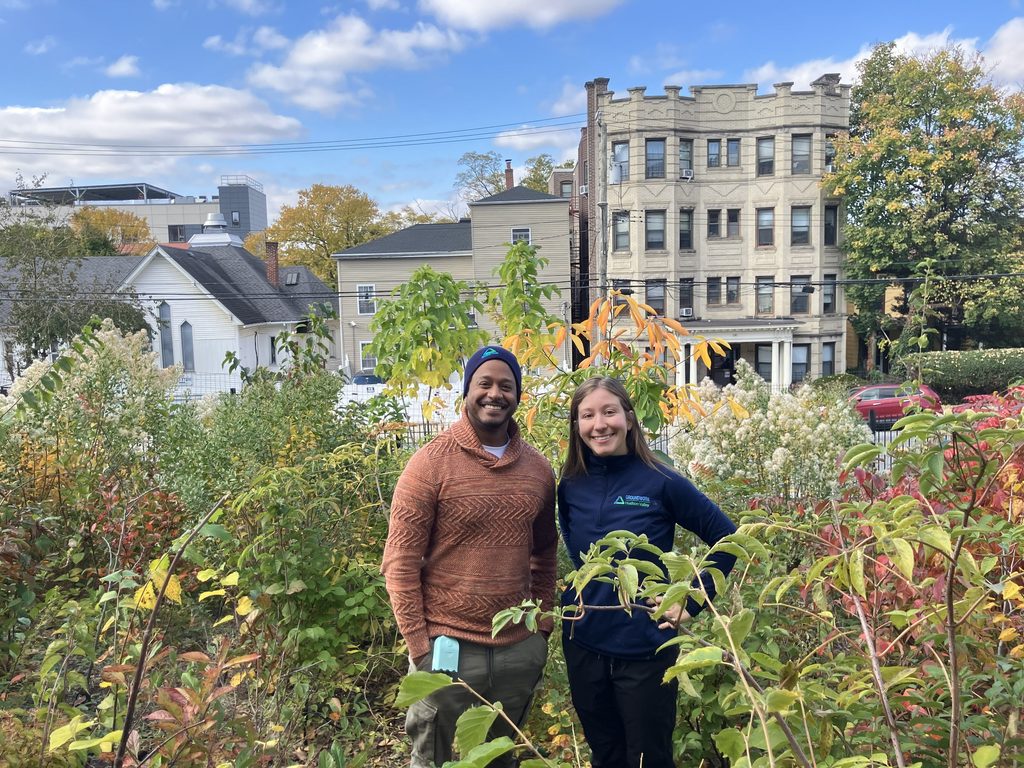
Groundwork Hudson Valley’s Andrew Harris and Christina Weiler stand in the micro forest on the grounds of the Barack Obama School for Social Justice in Yonkers in 2025. Groundwork Hudson Valley, students from the school, local kids, neighbors and Mayor Mike Spano all helped plant the trees and plants
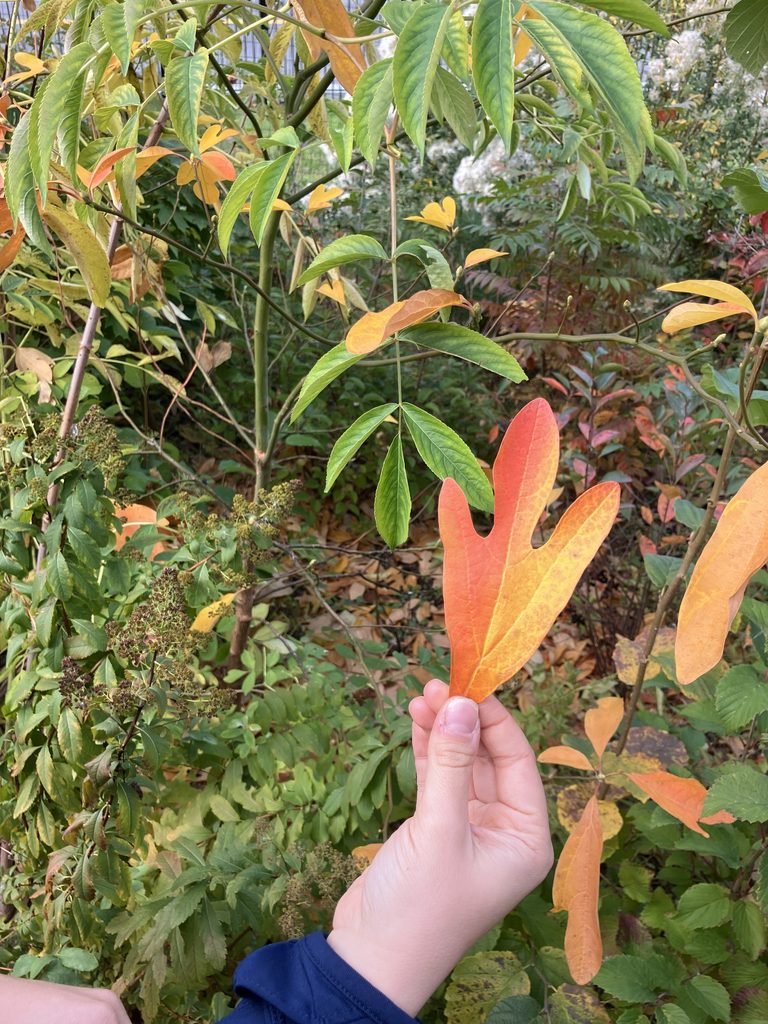
Groundwork Hudson Valley’s Christina Weiler shows how a sassafras plant resembles the foot of a dinosaur, at the Obama School for Social Justice’s micro forest
By Michael Gold
A micro forest grows in Yonkers.
It sits on the western slope of the Barack Obama School for Social Justice on North Broadway, dozens of trees and plants lifting their leaves to the sun and drinking in its energy.
Just 30 feet by 30 feet — 100 square feet in total size, the forest contains a rich variety of native trees, plants and shrubs, including white oak, chestnut oak, birch, alder, paw paw, pine, maple, beech, black cherry, dogwood, elderberry, service berry, ferns, viburnum, chokeberry, blackberry, bayberry, sedge, butterfly milkweed and sassafras. The leaf on the sassafras plant looks like a dinosaur foot, with three toes. Altogether, the forest hosts more than 350 plants and trees.
Christina Weiler and Andrew Harris, of Groundwork Hudson Valley (GWHV) took me on a tour of the forest in late October., when much of it was still green, but starting to change to orange and yellow.
“These are all native species. We’re trying to recreate what that forest would be,” if one were sitting in this place, Weiler said. She’s the community adaptation senior associate for GWHV, an environmental nonprofit organization based in Yonkers, which identified the Obama school as a friendly partner with which to work, and the site as a place where micro forest could thrive.
The patch “has good sun, access to water, and the soil conditions are right,” Weiler said. Also, “it’s a site that’s underutilized by the kids. The school is the perfect partner for us.”
GWHV approached the Yonkers school district and the Obama school to ask about the possibility of planting a micro forest and got approval to go ahead. They then prepared the land for planting by hiring a contractor to excavate and till the soil about two to three feet down.
“You want to remediate the soil,” Weiler said. “The soil was very compacted,” she explained.
Then GWHV used about seven cubic yards of compost and spread it on the ground. The compost contained extra nitrogen, potassium and other ingredients to help the soil.
“We put mulch on top to help put moisture in the soil,” Weiler said.
Thirty of the school’s students, in its ninth grade P-Tech program, planted the vegetation in April 2025. P-Tech program stands for Pathways in Technology Early College High School. The students can follow two academic paths in P-Tech – computers/technology and the environment. GWHV is P-Tech’s environmental studies partner.
The P-Tech students started the planting at about two pm in the afternoon that April day. Then a funny thing happened.
Kids playing basketball, or who were just walking by, stopped what they were doing and joined the P-Tech students in planting. Adults did too.
“About 80 to 100 folks, from kindergarten to high school kids, seniors and neighbors participated in planting the micro forest,” Weiler said.
Yonkers Mayor Mike Spano also showed up and helped plant some trees.
As the forest grows, “kids help to water it two times a week,” said Zack Stelzner, a P-Tech teacher and advisor. “The kids learn maintenance and what it’s doing for our community and environment. It’s going from seedlings to a forest in two years. It’s growing really well,” Stelzner said.
“The plants are competing with each other. That’s how they grow so fast,” Stelzner explained.
“They’re competing for sunlight,” Weiler said, which means the trees and plants are growing as fast as possible to reach the light.
“The forest knows what to do” in terms of growth, she said.
The Obama micro forest will be “a mature forest in 20 years,” Weiler said. “It’s a plant community that loves to grow together in a dense space.”
“She’s a master of micro forests,” said Harris, a community adaptation manager with GWHV, who grew up in Yonkers.
Some of the plants in the patch are already taller than a person. Others reach up to a person’s chest.
“These are just saplings,” said Harris. “Birch shoot up the fastest. The oaks are growing strong and steadily and will shade out the birch. The winterberry will feed birds in the winter. You can turn elderberry into jam,” he said.
“There are at least 20 to 30 canopy trees in the forest. The canopy trees will be 60 to 80 feet tall in 20 years,” Weiler said.
I took a walk in the micro forest with Weiler and Harris. Weiler pulled a leaf off a sassafras plant to show me how it resembled a dinosaur foot, with its three lobes looking like giant toes.
“The plants are mixed in neatly. That allows their roots to connect and share nutrients,” Weiler said. The canopy trees – maples, black cherry and beech – help cover plants that like shade.
I don’t know how, but everything seemed a little quieter as we walked, surrounded by all this vegetation.
“It’s kind of a peaceful place to step into,” Harris said. “Birds are coming. Pollinators are coming in and utilizing the space. You get to just look at nature. There’s a 10 to 15 degree difference in the temperature because of the micro forest, within this area,” he explained.
Milkweed is getting spread through the forest, which can attract monarchs and other butterflies.
The forest also helps absorb the pollution from the school buses that drive down the street and stop by the school. As the trees grow bigger, so does their capacity to pull vehicle exhaust and carbon from the air.
“The magic is in the maintenance,” Weiler said. “For years and years to come, this forest provides an opportunity for community. The kids will water and pull weeds and prune. This is going to grow. Kids will grow their connection to nature. Kids gain skills in urban forestry and planting,” she explained.
“The kids are having an impact on the community where they live,” Harris said. “The planting is paired with education. We take the kids through the process of planting a tree. It’s great to watch teenagers do that work and get excited about it,” Harris said.
GWHV employs about 30 kids each summer in its summer youth jobs program.
“The kids gain skills in urban forestry and planting,” Weiler said.
The organization has completed a lot of other green infrastructure projects in Yonkers. In addition to the micro forest, GWHV planted five trees on the northwestern side of the school – service berry trees and redbud trees, as well as a bioswale at the Obama School and a second bioswale at a local library.
“Groundwork built a bioswale at the Will Library on Central Park Avenue in Yonkers,” Harris said. Bioswales generally contain pebbles, soil and plants, which collect and absorb rain, thus helping to prevent flooding. GWHV also recently planted trees by the Saw Mill River, which is notorious for flooding.
“We planted 26 trees in Yonkers in the last three weeks,” Harris said, “in front of private homes and other buildings, within environmental justice areas.”
I asked him what environmental justice means.
“An environmental justice area is a place vulnerable to climate change,” he said, with greater potential for suffering episodes of extreme heat, flooding and air pollution. GWHV uses maps of Yonkers to locate areas with the most exposure to the effects of our warming world.
“Hotter temperatures are felt most acutely in dense urban environments, where buildings, paved roads, and parking lots absorb and retain heat. Forecasts for Yonkers show by 2050 we’ll have 30 days per year over 92 degrees, a stressful temperature with a potential ‘real feel’ impact well into the 100s,” states GWHV’s website.
“These temperatures pose immediate and long-term health risks including heat exhaustion or heat stroke, strain to internal organs, mental health difficulties, adverse birth outcomes and more. Air pollution is worse in the heat. Economic productivity plummets, electricity grids are pushed to their limits, and hospital capacity becomes strained,” the GWHV website states.
GWHV has planted two other micro forests in Yonkers, one this past April at the Cross Hill Academy, a grades three to eight school, on Bolmer Avenue, and Montessori 31, a magnet school serving pre-K through grade six, on Ravenswood Road, which was planted in May.
“We welcome schools to let us plant micro forests, trees, and green infrastructure,” Weiler said.
If you’re interested in working with Groundwork Hudson Valley, contact them at 914-375-2151, or christina@groundworkhv.org.
Michael Gold is a columnist for The Yonkers Times. His work has been published in The New York Daily News, The Albany Times-Union, the Adirondack Daily Enterprise, The Hartford Courant and other newspapers.