
Every medical practice has the same problem at 5:01 p.m. The phones keep ringing, the front desk has gone home and patient calls roll to voicemail. An AI receptionist can answer those calls, but in healthcare it also has to handle protected health information safely.
This review ranks six platforms against the criteria that decide whether a deployment actually works. Every vendor claim comes from that vendor’s own published material. Where a vendor doesn’t publish something, whether pricing, a certification or a named integration, we say so rather than filling the gap.
Key Takeaways
- A “HIPAA compliant” badge is not a BAA. Get a signed Business Associate Agreement before any patient call reaches the system.
- Only one vendor here publishes a full price list. The rest require a sales call before you can model a monthly bill.
- EHR integration depth matters more than voice quality. Check which systems are named and whether bookings write back in real time.
- Match the platform to your size. A solo practice and a multi-site health system need different products.
How We Ranked These
Five criteria, weighted toward what makes deployments fail rather than what demos well:
| Criterion | Why it decides the outcome |
| HIPAA posture | Will the vendor sign a BAA, and does it publish a certification such as SOC 2, HITRUST or ISO 27001? |
| Integration depth | Which EHRs or calendars are named, and do bookings write back in real time? |
| Escalation and safety | What happens on an emergency call, a loop or an outage? |
| Pricing transparency | Can you model your monthly cost before a sales call? |
| Fit | Solo practice, specialty group or health system |
Quick Comparison
| Platform | Best for | Compliance stated | Integrations named |
| Central AI | Small and growing practices wanting 24/7 coverage and a built-in CRM | Request the BAA and security documents | Cal.com, Calendly, Google Calendar; CRMs via Zapier |
| Luma Health | Epic health systems | ISO 27001, SOC 2, HITRUST | Epic, Oracle Health, MEDITECH, eClinicalWorks, athenahealth, NextGen, Greenway |
| MedReception.ai | Solo and small practices | HIPAA, SOC 2 | 15+ including athenahealth, eClinicalWorks, Elation, ModMed, Tebra |
| OmniMD | All-in-one practice operations | HIPAA, SOC 2 Type II | Athena live-integrated; FHIR and HL7 APIs |
| Zocdoc Zo | Practices already on Zocdoc | HIPAA, SOC 2 | “Leading EHRs”, unnamed |
| Assort Health | Specialty groups | None stated | 15+ platforms, Athena deepest |
The Six Platforms, Ranked
1. Central AI: Best for Small and Growing Practices
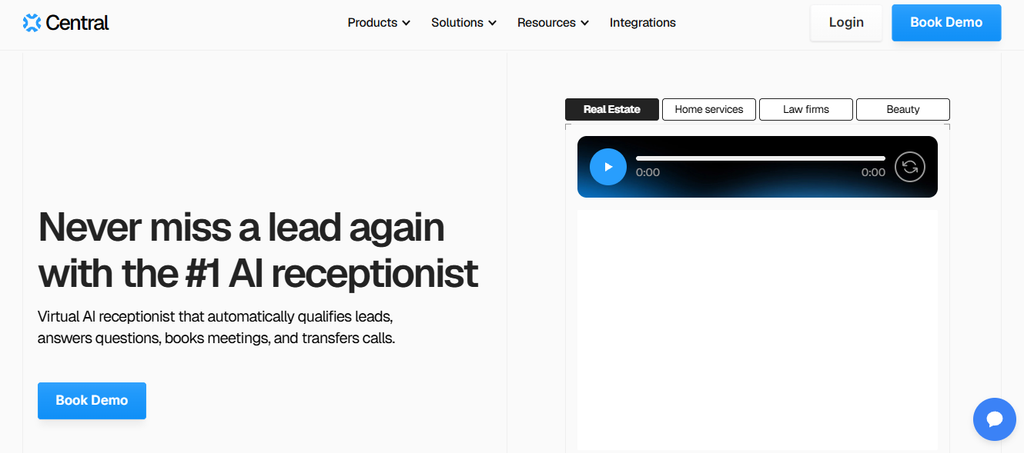
Central AI answers inbound calls around the clock, books appointments during the call and transfers to a person when needed.
Key features: live booking into Cal.com, Calendly or Google Calendar, automatic capture of caller names and numbers, a summary after every call and support for 30+ languages. A built-in CRM, scheduler and docs tool come free with every plan.
Compliance: ask for the BAA and current security documentation before routing patient calls.
Pricing: quoted by call volume, with a 10-day free trial.
Limitations: no EHR integrations are named, CRM syncing runs through Zapier for now and live receptionist backup costs extra.
2. Luma Health: Best for Epic Health Systems
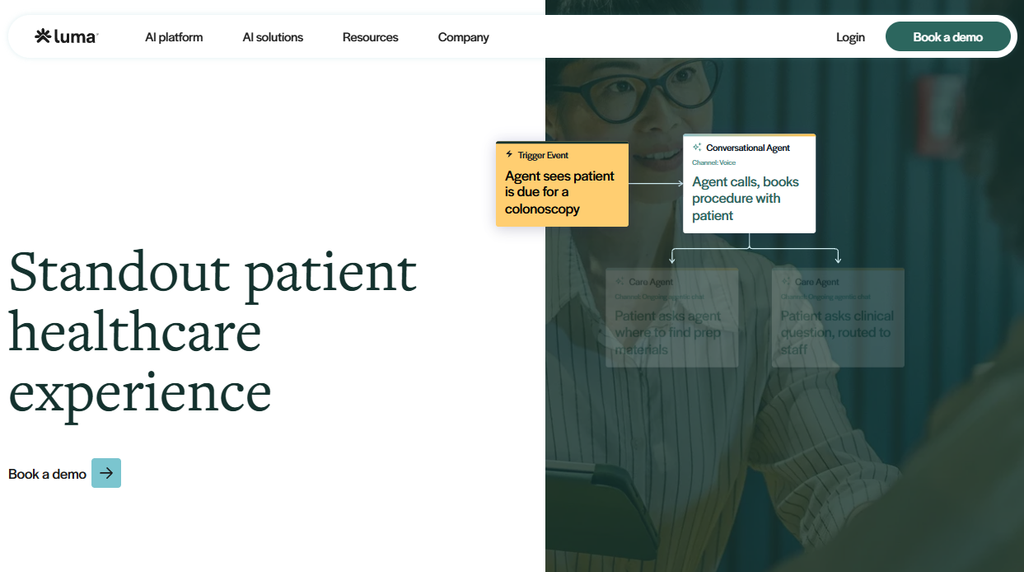
Luma Health is the enterprise option, serving more than 1,000 healthcare organizations with a conversational agent for after-hours calls, cancellations and appointment requests.
Key features: the broadest named EHR list here, including Epic, Oracle Health and MEDITECH, plus two-way AI translation.
Compliance: ISO 27001, SOC 2 and HITRUST, the strongest set in this review.
Pricing: not published.
Limitations: built for health systems, so smaller practices should expect enterprise implementation timelines.
3. MedReception.ai: Best for Solo and Small Practices
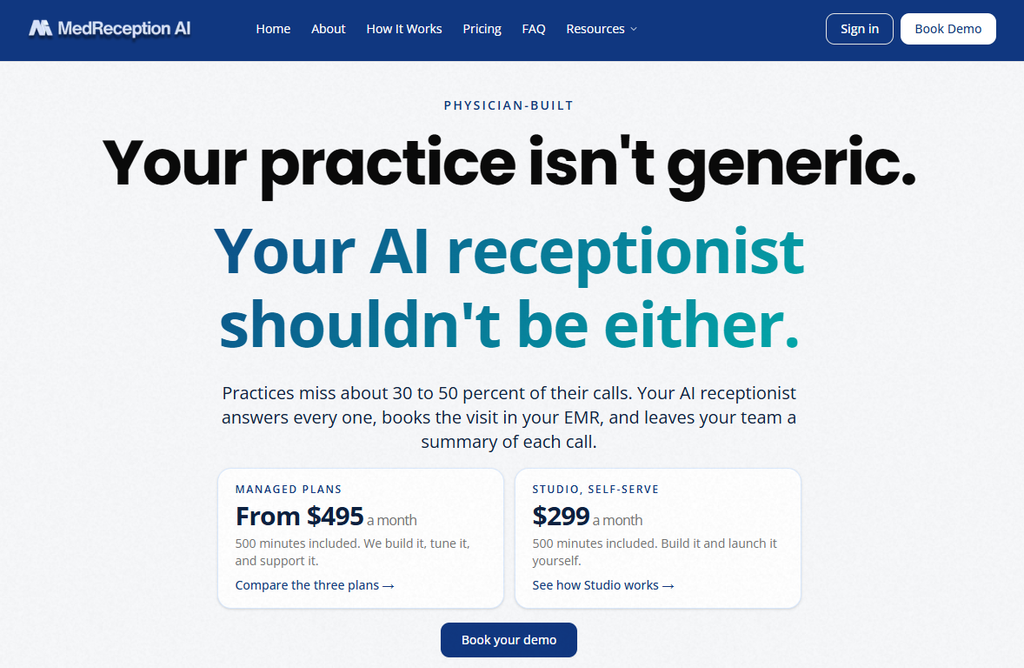
MedReception.ai is the only platform here that publishes a complete price list, and it is built mainly for solo and single-group practices.
Key features: routing by provider, location, language and insurance, voicemail summaries, after-hours coverage and 15+ named EMRs.
Compliance: HIPAA and SOC 2.
Pricing: plans run from $299 to $1,495 a month, with per-minute overage.
Limitations: minute allowances are modest, so busy multi-provider clinics may hit overage quickly.
4. OmniMD: Best for All-in-One Practice Operations
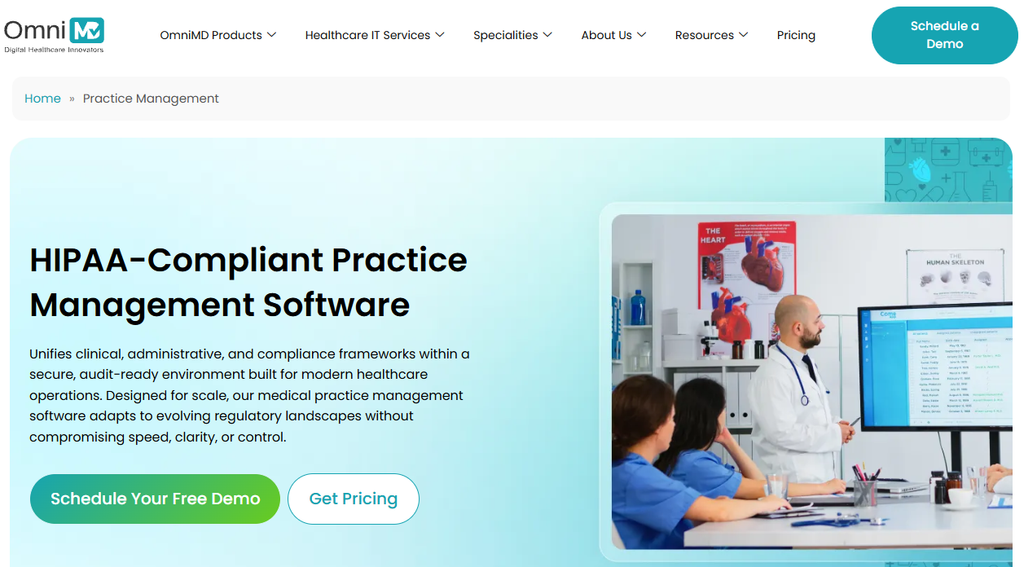
OmniMD ties the phone line to intake, eligibility checks and billing on one patient record.
Key features: real-time insurance eligibility verification, copay collection, post-visit follow-up and call transcription with AI summaries.
Compliance: HIPAA and SOC 2 Type II.
Pricing: not published.
Limitations: Athena is the only EHR named as live-integrated, so confirm what API integration means for other systems.
5. Zocdoc Zo: Best for Practices Already on Zocdoc
Zo is the least disruptive choice for practices already taking bookings through Zocdoc.
Key features: unlimited concurrent calls 24/7, EHR booking, insurance collection, custom scheduling rules and call summaries for staff.
Compliance: HIPAA and SOC 2.
Pricing: not published.
Limitations: specific EHRs aren’t named, and it deepens reliance on a patient-acquisition marketplace.
6. Assort Health: Best for Specialty Groups
Assort Health has gone deepest on specialty care, with training across 23+ specialties including orthopedics, dermatology and gastroenterology.
Key features: specialty-aware scheduling and integration with 15+ platforms, with Athena the deepest.
Compliance: no certification is stated on its site.
Pricing: not published.
Limitations: raise compliance in writing before any pilot, since nothing is published to check against.
Five Questions to Ask Before You Sign
Feature lists won’t separate these platforms. These questions will.
- Will you sign a BAA, and do your subcontractors that process call audio sign one too? HHS guidance requires a business associate to have a BAA with any subcontractor before disclosing PHI.
- Can you show real-time booking into our EHR or calendar, in a sandbox? Writing a booking live removes work; queueing a request just moves it.
- What happens when a patient describes chest pain at 2 a.m.? If the answer is “it takes a message,” that is a clinical risk.
- What is the all-in monthly cost at our real call volume? Include telephony, integrations and human backup.
- Can we export transcripts and configuration if we leave? Ask before you sign.
Start with a two-week pilot on overflow or after-hours calls, the ones currently going unanswered. The downside is capped and the data is real. Treat the rollout as a leadership decision rather than an IT ticket. Keep people in the loop as you scale, too. Even speakers who champion the technology stress that all AI makes mistakes, so it should not replace professional judgment where the stakes are high.
The Bottom Line
There is no single winner, so pick by fit. Health systems on Epic should look hardest at Luma Health, specialty groups at Assort Health and cost-focused solo practices at MedReception.ai. Small and growing practices that want round-the-clock answering, live booking and a CRM in one place should start with the platform ranked first.
Whichever you choose, get the BAA signed before the first patient call.
Frequently Asked Questions
Is an AI receptionist HIPAA compliant?
Only if the vendor is contractually bound to protect PHI. A signed BAA comes first, and a published certification such as SOC 2 or HITRUST is a useful second check.
How much does an AI medical receptionist cost?
Of the six here, only MedReception.ai publishes full pricing, from $299 to $1,495 a month. The others quote by volume or size, so ask for an all-in figure based on your real call logs.
Can an AI receptionist book directly into our EHR?
Some can. Check which systems each vendor names and test real-time write-back during a pilot.
What happens if the AI can’t help a caller?
It should transfer to a person or take a callback after a set number of attempts. Confirm the threshold and who answers those transfers.
Will AI replace our front desk?
Not in practice. Most practices start with unanswered and after-hours calls, which adds coverage rather than removing staff.