
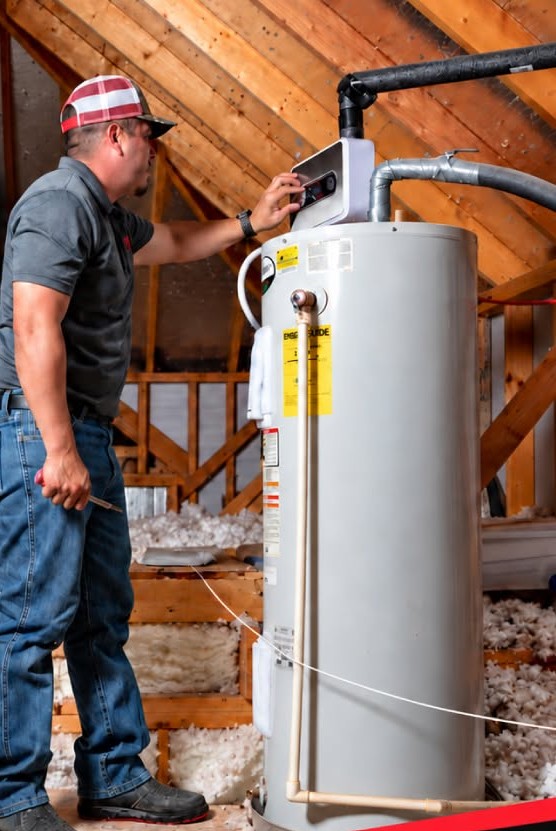
Cold snaps break water heaters for three boring reasons. Here is how to spot each one before you end up with a cold shower at 6 a.m.
Your shower runs cold at 6 a.m. on the coldest morning of the year, and you spend the next hour in slippers reading the side of a tank you’ve never looked at before. I’ve had that morning twice. Both times the heater hadn’t actually died. It just couldn’t keep up, which is a different problem with a much cheaper fix.
Cold weather doesn’t break water heaters so much as it exposes them. The tank, the burner, the supply line, and the vent all get tested at the same time, and the weakest part fails first. Most failures happen at one of four points, and you can rule out three of them yourself before anyone comes through the door. If you do end up calling a plumbing company, knowing which of those four points is suspect will save you money on diagnosis and time on the phone.
Here’s what’s inside this guide: a simple ladder for finding the failure, a table that matches symptoms to causes, and straight talk on what you should never touch yourself.
The four places a cold snap gets in
Every water heater failure I’ve watched up close came down to one of these. Work down the list in order. The cheap checks come first for a reason.
- Incoming water temperature. Groundwater gets colder in winter, so the heater has to lift the water further to reach your set point. A tank that’s already aging can look fine in July and run out of hot water in January.
- The pilot or ignition. A downdraft, a clogged intake, or a vent issue can knock out the flame. On newer units this shows up as a blinking error code on the control board.
- The tank itself. Sediment settles over years and insulates the bottom of the tank from the burner. The metal underneath overheats, and eventually it cracks. A leak from the tank body is the end of the road, no debate.
- Exposed pipe and supply line. The pipe carrying water into the heater can freeze in an unheated crawlspace, garage, or attic. This is the one that does real property damage if you ignore it.
Notice which of those four gets the least attention from homeowners. It’s the sediment. Nobody thinks about it because nobody can see it, and it’s the slow killer of every tank out there.
Cold shower, cold water, or no water at all?
The exact symptom narrows the suspect down fast, and your ears help too. A rumbling, popping sound from the tank is sediment, full stop. Here’s how the common complaints line up.
| What you notice | Most likely cause | What to do |
| Hot water runs out faster than usual | Sediment buildup or a failing lower element | Flush the tank, then test the element |
| No hot water, unit is silent | Pilot out or ignition fault | Check the error code, try a relight per the manual |
| Water on the floor around the base | Tank leak or a loose fitting | Shut the water off, then call |
| Popping or banging during heating | Hard water sediment | Flush and consider a softener |
| No water anywhere in the house | Frozen supply line | Do not force it, get help |
My pick if you only do one thing this fall: flush the tank. Every year, without exception. It’s the highest return chore in the house, and it costs you a garden hose and an afternoon.
Hard water is quietly aging your tank
You can’t feel sediment happening. What you can feel is the drop in capacity, which most people misread as the heater getting old. It is getting old, sure, but faster than it needs to.
The U.S. Geological Survey maintains water resource data on hardness across the country, and large parts of Texas sit firmly in the hard to very hard range. That means more mineral content settling at the bottom of every tank in the neighborhood. Install a softener and the heater lasts longer, the fixtures stop spotting, and the soap actually lathers. Skip it and you’re replacing a tank years before you planned to.
Worth noting: a flush won’t remove hardened scale that’s already cemented to the tank floor. If your heater is past the middle of its expected life and you’ve never flushed it, the flush can sometimes expose a weak spot. Ask yourself whether you want to find that leak on your schedule or on a Saturday in January. I’d rather know.
Should you call someone or handle it yourself?
Some of this is yours. Some of it isn’t, and the line isn’t about skill, it’s about risk. Here’s how I’d draw it.
Do it yourself: check the breaker, read the error code off the control panel, relight a pilot following the label on the unit, drain and flush the tank, and inspect the pipe insulation in the crawlspace. All of it is safe with the power off and the water supply closed.
Call a professional: anything involving the gas line, the venting, a tank that’s leaking from the body, or a frozen line you can’t find. Gas and venting are serious business and a botched job isn’t worth the savings. A leaking tank isn’t fixable, period. No coupon exists for that.
Before you dial anyone, do two boring things. Grab a photo of the data plate on the tank so you can read off the model and serial number, and write down what you actually observed instead of what you assume. Small, established businesses respond well to a customer who has their details straight, and the Small Business Administration regularly points out that those firms live or die on repeat customers. That works in your favor: a shop with its name on the truck has every reason to get it right the first time.
Why a pre-winter check beats an emergency call
Emergency calls in a cold snap are expensive and slow. Everyone’s heater fails on the same thirty degree morning, and you’re at the back of a very long line. The phone rings nonstop at those shops, and the guys on call are running from one flooded garage to the next.
Schedule the inspection in October. You’ll pay a fraction of the emergency rate, the technician takes his time, and you find out about a weak thermostat or a corroding tank before it becomes a wet ceiling. The Department of Energy keeps energy efficiency resources for homeowners that are worth a look, including the case for replacing a tired unit with a more efficient model before it fails on its own terms. If your heater is near the end of its range, planning the swap is much cheaper than reacting to it.
And check the age. An old tank doesn’t fail politely. It fails at the least convenient moment and takes your weekend with it.
Your two minute winter prep list
Insulate the exposed pipes in the crawlspace and garage. Set the thermostat to 120 degrees and leave it there. Flush the tank once a year, same month every year so you don’t forget. Note the serial number and install date in your phone. Test the pressure relief valve by lifting it and letting it snap back. If you’re in a hard water area, budget for a softener. Stand in the basement or garage during a heat cycle and listen for rumbling.
That’s the whole list, and you can knock it out before the first freeze. The National Institute of Standards and Technology sets the standards behind the plumbing fixtures and valves in your home, which is a fancy way of saying the parts are tested so the failures mostly come down to installation, maintenance, and water quality.
None of this is glamorous. That’s the point. The cold shower at 6 a.m. is the price of skipping an hour in October. Would you rather spend an afternoon with a garden hose now, or a morning on hold with a dispatcher when the temperature drops into the twenties? The hose wins every time.