
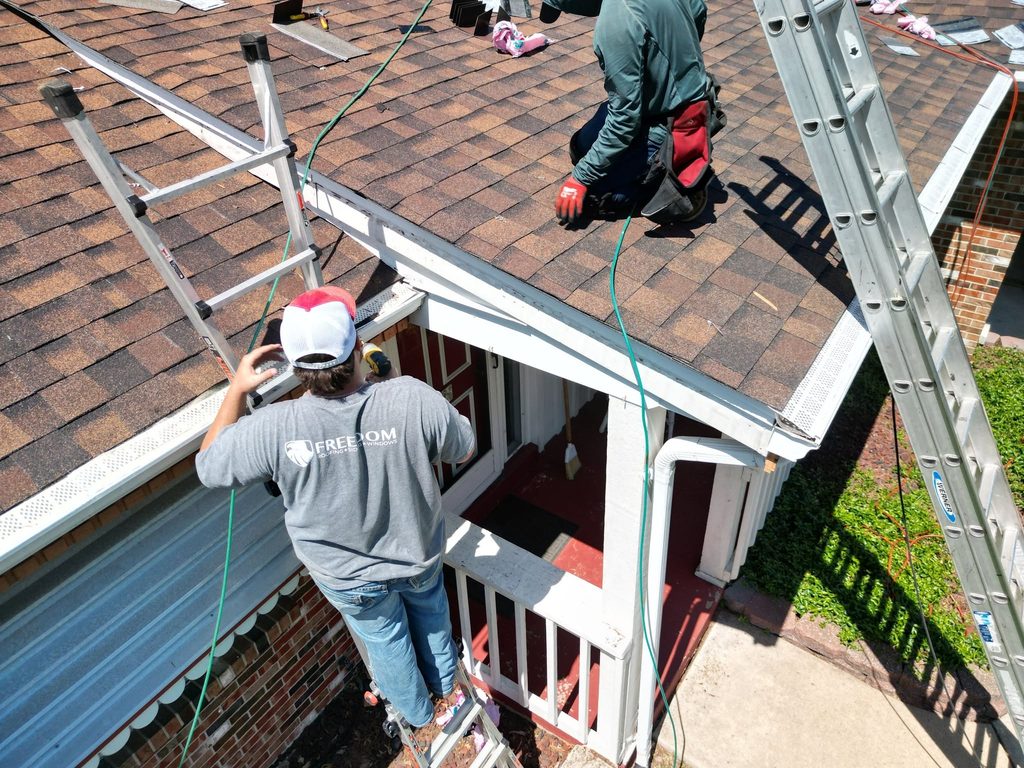
Learn how to spot storm damage on your roof, what insurance adjusters look for, and when to call a pro in Wentzville.
Two days after a hail event, most homeowners are standing in the yard squinting at shingles and guessing. That guess costs money. If you know what you’re looking at before anyone climbs a ladder, you control the conversation with your insurer, your contractor, and your neighbor who swears his guy is cheaper.
My rule after years of watching storm claims get accepted and rejected: the roof tells you what happened if you know where to look. You don’t need to get on top of it. You need to read the signs from the ground, the gutters, and the attic, then match what you find to the direction the storm came from.
This guide walks you through that check, section by section, so that when you do need storm damage repair in Wentzville, MO, you already know which slopes took the hit and roughly what kind of work you’re describing. That puts you ahead of the person who just says “something looks wrong up there.”
What Counts as Storm Damage, Exactly?
Storm damage isn’t one thing. It’s four things wearing the same jacket: wind, hail, water, and debris. Each one leaves a different fingerprint, and confusing them is how homeowners end up arguing with an adjuster about a stain that was actually there before the storm.
Wind damage usually shows up as lifted or creased shingles, missing tabs, and granules collecting in the gutter valleys. Hail leaves soft dents on metal, cracked shingle mats, and bruising that looks fine from six feet away and terrible from one. Water damage is the sneaky one.
It shows up inside the house, weeks later, as a brown ring on the ceiling under a slope that looked perfect from the driveway. Debris damage is trees and limbs, obvious, but often accompanied by punctures you won’t see until someone lifts the shingle above the impact point.
The National Weather Service classifies hail by size for a reason: a quarter-sized stone and a baseball-sized stone do entirely different things to asphalt. Worth knowing before you describe the storm to anyone.
The Three-Pass Walkaround I Use on Every Roof
Here’s the framework I’d hand to any homeowner. Three passes, ten minutes each, no ladder required.
Pass one: from the street
Walk the perimeter and look at the roof edge-on. Shingles should form a straight, unbroken line. If you see a wave, a dip, or a shingle sticking up like a loose tooth, that slope is compromised. Look at the ridge cap too, since ridge shingles fail first in high wind. Note the direction the damage faces. Storms in this part of Missouri usually have a clear prevailing direction, so damage concentrated on the west or southwest slope tells you when and how it happened.
Pass two: gutters and downspouts
Scoop a handful of granule sediment out of a gutter valley and feel it. Sand-like granules are normal aging. Grit that’s thicker, darker, and concentrated in one area points to shingle damage right above that spot. Check for dents on the metal too. Softball-sized hail will leave visible dimples on aluminum gutter runs, and those dimples are some of the easiest evidence to document for a claim.
Pass three: attic and interior
Take a flashlight into the attic and look at the deck underside, especially around chimneys, vents, and valleys. Fresh water stains, streaks, and daylight through the sheathing are all things you can photograph. Then walk the interior ceiling line of every room under a slope that touches the outside. Anything you photograph should include something for scale, a ruler, a coin, your hand.
The pass I’d skip if I were only doing one: attic. Most storm claims that go sideways do so because the interior evidence was never captured.
When Should You Actually Call Someone?
Call when the damage is above your shoulder. If you see lifted shingles, granules across a whole slope, dented gutters, or water stains in the attic, that’s the moment. Not when the ceiling sags. Not after the next rain. The window between “detected” and “active leak” is short, and every day you wait, the decking sits under wet shingles slowly going soft.
Call immediately if the roof surface is visibly porous, if water is actively coming into the house, or if a limb is resting on the plane. And call before you climb up. Ladder falls are the reason professional inspections exist, and a homeowner with a phone camera can document plenty without risking a trip to the ER.
One more thing: call before you sign anything from the person knocking on your door. Reputable contractors don’t need a signed agreement on the front porch. Take photos, take their card, take a day to think.
Reading the Insurance Side of the Equation
Here’s where most people lose money. Storm damage claims get paid on documented evidence, not adjectives. Your job as a homeowner is to hand the adjuster a file, not a story.
- Date and time of the storm, plus the street address of the property.
- Photographs of the damage with something for scale and a clear location tag.
- The weather report or hail report from that date, which the National Weather Service publishes publicly.
- Photos of the interior stains alongside an interior shot of the same floor to prove location.
- Any receipts for temporary repairs like tarps or patches.
The Federal Emergency Management Agency publishes guidance on documenting storm damage and filing claims, and it’s worth a read before you call your carrier, because the standard of evidence doesn’t change just because a storm was local.
Adjusters aren’t adversaries. They’re working from a checklist, and your job is to help them check boxes. Show them the dented gutter and the granule sediment and the attic stain from the same slope, and the claim writes itself.
What a Good Repair Looks Like After the Fact
The claim gets paid, the crew shows up, and the roof is back. The part nobody warns you about is what to watch for during the repair itself. A proper storm repair replaces like with like. If the damaged shingles were architectural asphalt, the new ones should match, not approximate. The underlayment under any removed section should be inspected, and if it’s torn, replaced. Flashing around vents and chimneys should be pulled and reinstalled, never patched over.
Ask for the work to be photographed before and after. Any contractor who resists that is telling you something. According to the National Association of Home Builders, shingle warranties are often voided by improper install, which means the shoddy shortcut today becomes your problem three winters from now. Worth the extra conversation.
The repair should also come with a written scope: which slopes were replaced, which weren’t, what was done to the flashing, and what to watch for over the next six months. Don’t accept a verbal “you’re good to go.” Roofs are quietly expensive to get wrong twice.
The One Thing Worth Remembering
You don’t need to be a roofer to read a roof. You need to walk it three times, document what you see, and know when to stop. The paperwork is the job. The photos are the evidence. The repair is the recovery.
So before you pick up the phone after the next storm rolls through, do your three passes. What did you find that you didn’t expect?