
Albania is a candidate for European Union membership, holds elections and has a written criminal code that prohibits the conduct at the centre of most claims brought by its nationals. For a decision maker, that is the starting point, and it is an unfavourable one for the applicant.
It is also why these cases turn almost entirely on country evidence. The applicant is rarely disputing what the law says. The dispute is about what the law does.
The two recurring claim types
Blood feud. Claims based on the customary code of retribution require the tribunal to decide several things at once: whether a feud exists, whether it is still active, whether the reconciliation mechanisms that are supposed to end it have been attempted, and whether the state can protect a person who is in one. Each of those is a factual question with a documented answer, and the answer differs by region and by family. General statements that feuds persist are not enough; general statements that the practice has declined are not enough either.
Trafficking and re-trafficking risk. Claims brought by women and by young men who were trafficked out of the country depend on what happens on return. Whether reintegration support exists in practice, whether the original network retains reach, and whether the person’s family or community will receive them are the determinative facts, not the existence of an anti-trafficking statute.
What a decision maker actually has to resolve
Three questions come up in almost every Albanian file.
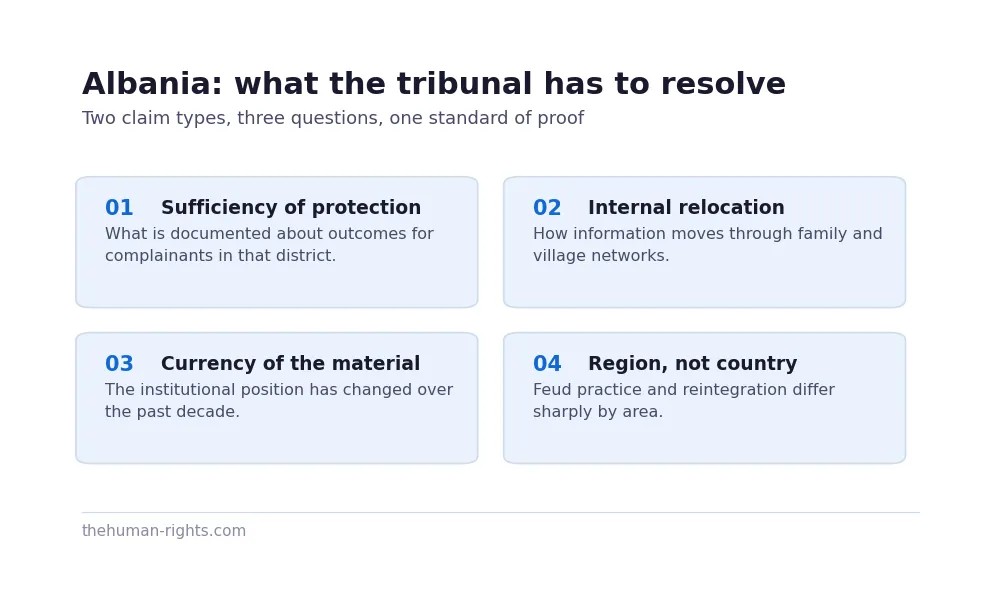
Sufficiency of protection. Not whether the police exist, but whether this police force, in this district, investigates this kind of complaint, and what has been documented about outcomes for complainants who pursue it.
Internal relocation. Albania is small, its population is concentrated, and family and village networks mean that identification across distance is often realistic. Whether relocation defeats the risk in a given case is a question about how information moves in that specific context, and it is answerable with evidence.
Currency. Country guidance and published reporting age quickly, and Albania’s institutional position has changed materially over the past decade. Material that described the position accurately five years ago may be wrong now, in either direction. A tribunal is entitled to know which it is.
What good evidence looks like
A useful report is specific. It addresses the applicant’s region, not the country as a whole. It distinguishes between what is documented, what can reasonably be inferred and what the available material does not establish. It cites sources a court can check, and it says plainly where the record is thin.
A report that overstates risk is worse than no report. Once a tribunal concludes that one proposition in a document is not supported, it reads everything else in that document with the same scepticism, and the rest of the file suffers.
Practical note
If the country material in a file describes Albania generally but not the district, the institution and the profile in question, the gap will not close with more of the same material. That is the point at which a specialist is worth instructing.
Representatives who want to see the standard before committing can ask for a CV and an anonymised sample report. Current country evidence on Albania is prepared by people who work to that standard, and the written work is the fairest way to judge it.
These claims are not decided on sympathy or on the strength of the account alone. They are decided on whether the evidence answers the questions the court has to resolve.