
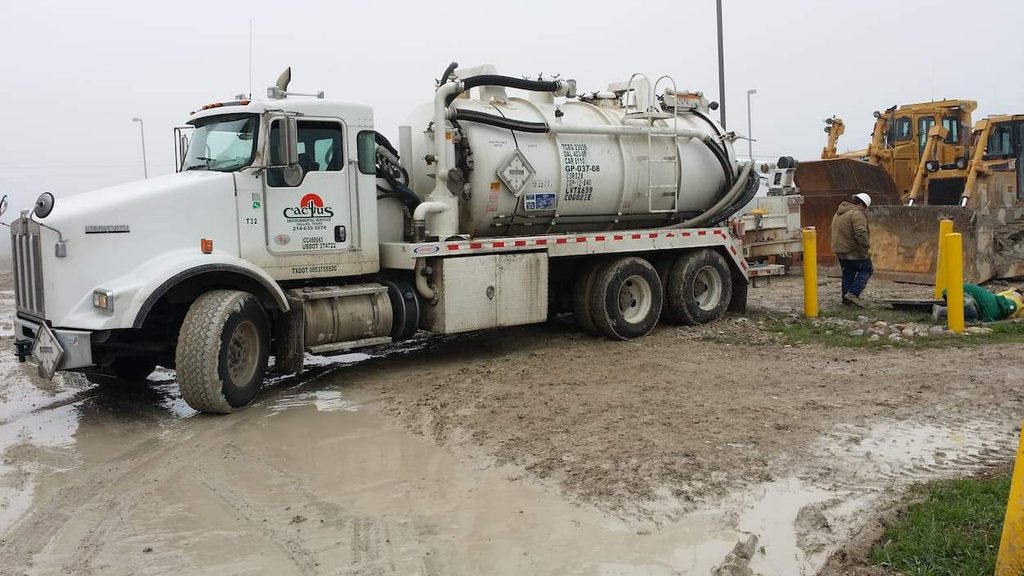
Facility managers share one blind spot when hiring vacuum truck services. Here’s the PACT Framework that fixes it before a spill becomes a shutdown.
At 3 a.m. on a Tuesday, a cracked manifold at a manufacturing facility outside Fort Worth released a pressurized mix of caustic slurry and grit into a secondary containment trench. The plant manager had two phone numbers on her desk. The first number rolled to voicemail. The second connected to a live dispatcher who had a combination wet/dry vacuum truck on site within 90 minutes. That gap, one call answered and one not, is the entire story of why vendor selection matters before an emergency happens, not during it.
Most plant and facility managers think about vacuum truck services the wrong way. They treat it as a commodity purchase, comparing day rates and truck counts, when the real differentiators are response time, regulatory competency, and equipment range. Here’s how to think through it properly.
A Market Expanding Faster Than Most Facilities Realize
The demand for industrial vacuum truck services is not flat. According to a 2025 ResearchAndMarkets report published via Globe Newswire, the United States vacuum truck market is expected to reach $946.4 million by 2033, up from $563.99 million in 2024, driven by aging infrastructure, emergency response needs, and strict environmental compliance requirements.
That growth matters to you as a buyer. More demand means more providers entering the market, which is great on paper. But it also means more unqualified operators hanging out a shingle. A bigger market creates more options and more noise. Your job is cutting through it.
Industrial cleaning applications accounted for a 38.83% share of the vacuum truck market in 2024, according to Mordor Intelligence , which tells you the industrial segment is not a niche add-on. It’s the core use case. That’s exactly why the vendors serving it range from highly specialized environmental contractors to general haulers who bought a vacuum unit last spring. Those two categories perform very differently when your containment system is overwhelmed at midnight.
What the Regulatory Environment Is Actually Asking of You
Federal hazardous waste law does not forgive improvisation. Over 11 reporting cycles between 2001 and 2021, the quantity of RCRA hazardous waste generated in the U.S. ranged from 21.9 to 30.7 million tons, according to EPA’s Report on the Environment. That volume has to go somewhere, and the chain of custody from your facility to final disposal is your legal responsibility, not your contractor’s.
This means your vendor’s compliance record is not a background detail. It’s a core qualification. A contractor who cuts corners on waste manifests or skips proper labeling on transport becomes your liability the moment their truck leaves your gate. Ask for documented proof of current permits, RCRA training records, and disposal facility relationships before any conversation about pricing.
As of September 2024, there were 1,340 National Priorities List Superfund sites in the United States, per the American Society of Civil Engineers’ 2025 Report Card for Hazardous Waste Infrastructure. Many of those sites trace back to decades of improper industrial waste handling. The regulatory framework you’re operating under today is a direct response to that history, and enforcement is not loosening.
The PACT Framework for Evaluating Vendors
After working through what actually separates reliable contractors from risky ones, four criteria emerge consistently. Call it the PACT Framework. It’s not complicated, but most plant managers don’t use it because they’re usually making the call in a reactive mode.
Provider credentials. Verify active federal and state permits, EPA identification numbers, and any industry certifications specific to your waste stream. A vendor handling petroleum sludge needs different credentials than one handling non-hazardous grit.
Application scope. Your facility probably generates more than one waste type. A contractor with a single truck type can handle simple jobs. A contractor with a mixed fleet of dry vac units, wet vac units, and combination trucks can handle everything on one call. Scope matters most when you have an unscheduled emergency, not a routine cleaning cycle.
Compliance history. Ask directly: any EPA violations in the past five years? Any OSHA citations related to hazardous material transport? A good vendor answers that question without hesitation and has documentation ready. A bad vendor changes the subject.
Turnaround capability. “24/7 service” appears on almost every contractor’s website. What it means in practice varies enormously. Ask specifically: what is their guaranteed response time for emergency calls? Do they dispatch from a local yard or route from a regional hub two states away? For companies seeking vacuum truck services in Dallas, proximity to a local, fully equipped operations base is not a luxury. It’s the difference between a containment situation and a reportable release.
The 3 A.M. Test
Here’s a useful mental exercise: imagine your worst-case scenario happens tonight. A tank seal fails, a pipe connection gives way, and you have liquid sludge moving toward a storm drain. You have maybe 20 minutes before it becomes an environmental incident.
Pull out the contract you signed with your current vacuum truck vendor. Now answer these questions honestly. Does their emergency contact actually connect to a dispatcher, or to an answering service that takes a message? Do they have a combination unit that can handle wet material available tonight, or is their emergency response limited to dry vac only? Is the operator who shows up trained in confined space protocols, or just licensed to drive the truck?
If you can’t answer those questions with confidence, you don’t actually have an emergency vendor. You have a vendor for the easy jobs.
A Practical Vendor Evaluation Table
| Evaluation Criterion | Minimum Acceptable Standard | Strong Indicator |
| Regulatory permits | Current EPA ID, state-specific transport permit | Documented RCRA training records, third-party audits on file |
| Fleet variety | At least wet and dry vac capability | Mixed fleet including combination units, frac tanks, hose trailers |
| Emergency response time | On-site within 4 hours | Local yard within region, dispatched within 2 hours or less |
| Waste handling range | Hazardous and non-hazardous classification | Documented experience across sludge, particulates, and liquid waste streams |
| Confined space capability | OSHA confined space entry certified staff | On-call rescue-trained technicians available 24/7 |
Questions Worth Asking Before You Sign
Run through this short list with any vendor before committing to a contract or a spot job:
- What is your dispatcher’s direct line, and is it staffed overnight?
- Which disposal facilities do you use, and can you provide current permits for each?
- What is your operator-to-truck ratio, and how do you staff surge periods?
- Have you worked with our specific waste classification before? Can you provide references?
- What’s your process for generating and handing off waste manifests?
A vendor who stumbles on any of these questions in a sales call will stumble harder when the situation is real and urgent. You want clarity, not hesitation.
The Vendor Who Picks Up at 3 A.M. Wins
Choosing an industrial vacuum truck contractor is not a procurement task you hand to the lowest bidder. It’s a risk management decision. The PACT Framework gives you a structured way to compare vendors on criteria that actually predict performance under pressure, not just price. Build your short list before you need it. Verify credentials when there’s no urgency. And run the 3 A.M. test on whoever makes the final cut.
The facility manager who answered her second call right understood something worth remembering: a vendor relationship built on compliance, capability, and local presence is worth considerably more than one built on a good rate sheet.