
By Mary Hoar
According to residents, Lincoln Park’s main issue in 1936 was the nuisance created by “hoodlums from the Bronx.” Homeowners claimed not only did they destroy property, the interlopers interfered with Lincoln Park’s peace and quiet. Tibbets Club members wanted to get an injunction to restrain New York City from allowing the Aqueduct to be used as a hikers’ highway to Yonkers.
Not happy with aspersions Slater and Yonkers people were casting on their women, Bronx Magistrate Bernard Mogilesky proclaimed, “Our girls have been brought up not to have anything to do with young men from Yonkers!”[9]
The publicity and letters to The Herald Stateman reflected support for both sides, attracting the attention of people around the country.
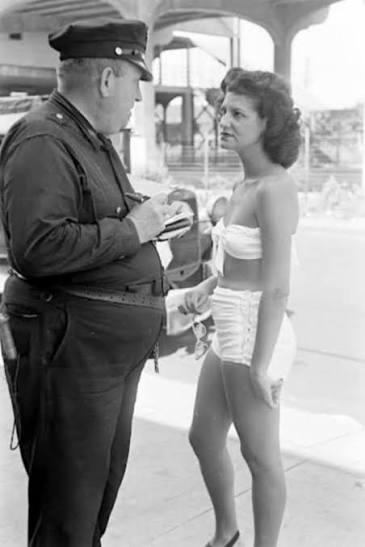
June 21st, 1936, a couple wearing shorts stepped out of a taxi on McLean Avenue near Yonkers police officers… and asked to be arrested! The New York Daily News reporters Rose O’Gorman and William Matthias specifically came to Yonkers to test the legality of Slater’s law.
Represented by attorney Paul Bleakley, the case against the reporters was presented to County Judge Nolan in November; Nolan upheld the Anti-Shorts Law in his January 1937 decision. The case went before the Court of Appeals in Albany a few months later because the case revolved around a constitutional issue, alleged infringement of personal rights guaranteed by the American Constitution; the reporters skipped right to New York’s highest court! The Court of Appeals tossed out Yonkers’ shorts ban! Chief Judge Crane wrote the ordinance was “vague and meaningless… No man or woman is obliged to wear ordinary street attire. Our constitution still leaves some opportunity for people to be foolish if they so desire.”
Slater turned to Yonkers Corporation Counsel to help draft a new Anti-Shorts law. This version forbade anyone of any age from wearing shorts, halters, bathing suits or “any costume or clothing which indecently exposes or reveals any part of the wearer’s person” on Yonkers’ streets. The Council approved the new version by a vote of 10 to 2. Alderman Salvatore Cerone voted against it because Slater “put Yonkers through enough ridicule because of his shorts ordinance;” Alderman Sy Barker voted no because he wanted the ordinance “confined to the source of the trouble– Slater’s own ward,” not the entire city.
Assistant Corporation Counsel Rossenwasser deemed the new legislation was free of the objections the Court of Appeals had to the old law; the new law was valid. Even so, Mayor Loehr considered the document for several days; before signing his name, he stated any child under seven was incapable of committing a crime, so would “escape the wrath of Alderman Slater and law enforcement authorities.” The mayor added a second loophole, the presumption a child between seven and twelve was incapable of crime. Marathon runners and other athletes also were exempt. Unfortunately, there were no other loopholes.
Two days later, Police Chief Quirk announced the new law would be enforced… but instructed his men not to make test case arrests. The decision if clothing was modest or not would be left to the police officers. Chief Quirk also reminded the officers they had other responsibilities, saying, “We’ve got to protect the rest of the city, too!” Most officers did not want to be censors or decide whether clothing was indecent. It was not why they joined the Yonkers Police Department.
When the time came to witness the new parade of women coming to the park, Slater left town. It was rumored the alderman fled from the “shocking displays of feminine limbs found in the usual Sunday throng of hikers in shorts and halters.” Instead, Slater went to the beach where he was exposed to a more shocking display of the human body; no one thought twice about legs and backs they saw!
One bright young woman gave this advice to her sisters in shorts: since the law department said marathon runners were exempt and could “sprint in their briefs,” she advised everyone to start running if they saw an officer… “evidence” they were running in a marathon!
Yonkers native Major Francis Clune was stationed in Asia; he reported every Chinese newspaper carried the story of our shorts ban!
In 1939, Alderman Slater ran for Supervisor and lost to Patrick Meehan. A. O. Hudson flew a pair of blue and white striped shorts under an American flag on the flagpole at his 930 McLean Avenue Real Estate Office. Why? Slater put a bus stop in front of a house Hudson built on Kimball Avenue; no bus line ran on Kimball at the time.
By 1940, our controversy was done. City Councilman Edith Welty confirmed, although the law still was on the books, she believed Yonkers was “fed up with its annual campaigns against shorts for female hikers.” She doubted local officials would enforce the ban, saying police officers would not pay attention to what female hikers were wearing. Perhaps giving weight to the accusation his shorts ban was purely political, Slater stopped advocating for the ban. The law in Yonkers died a natural death, perhaps because Slater was out of office… but it still is on our books.
In 1942, Mayor Barnes said he was going to lift the ban, a tidbit that made front page news in Honolulu. He saw “nothing indecent in shorts,’ adding wearing them aided the war effort by conserving material. He planned to introduce it to the Common Council. I can find no evidence it happened!
The Yonkers shorts issue remained dead until 1966, when officials from our Boy Scout Troops defended our boys wearing shorts!
Seems the Boy Scouts Association of Great Britain wanted to do away with Scouts wearing “childish” shorts and substitute long pants year round. Deemed “quite unsuitable for the British climate,” they claimed the shorts thy looked like they were left over from “the Boar War which ended in 1902.”
Yonkers Scout Leaders agreed with Otto Ferraro, Chair of the Hudson River District Scouts, when he said, “Wearing short pants in the summer is a pretty good idea.”[10]
[1] “Scanty Garb Of Aqueduct Hikers Decried By Modest Alderman,” April 26, 1933. p. 1, The Herald Statesman.
[2] “Drive on Hikers’ Nudism Opens; Alderman Orders 5 Summoned”, June 17, 1935, p. 1 The Herald Statesman.
[3]“Slater Launches War On Nudists: Five Summoned,” June 17, 1935, p. 2, The Herald Statesman.
[4] Ibid.
[5] “Slater Gets Setback In Three Pleas,” June 19, 1935, p. 1, The Herald Statesman,
[6] Ibid.
[7] “The New Censorship,” July 3, 1935, p. 6, The Herald Statesman.
[8] Ibid.
[9] “Yonkers Romeos ‘Not Wanted’ “, p 4, March 9, 1936, The Herald Statesman.
[10] Carleton, Hilda, “Shorts Answer: Yonkers Scouts Say Yes,” June 10, 1966, p. 9, The Herald Statesman.