
NFPA compliance rarely fails because a property owner didn’t know the rules. It fails in the gap between knowing the rule and proving you followed it — the missing log entry, the guard who wasn’t actually certified, the patrol that happened but was never timestamped. That gap is where fire marshals issue stop-work orders and insurers deny claims.
The Fast Fire Watch Company was built around closing that specific gap. Every deployment of fire watch guards pairs a trained officer with a documentation system designed to survive an audit, not just a walkthrough — which matters more than most property managers realize until the inspector is already standing in the lobby.
1. Assigning Only Certified Personnel
NFPA fire watch provisions assume the person on patrol actually understands what they’re looking at. An untrained guard walking a route is a body, not a compensating measure.
All guards deployed by the company receive OSHA training, while those assigned to specialized jurisdictions receive regional credentials—such as New York City’s FDNY F-01 Fire Guard certification where required. This is important since NFPA standards refer to “qualified personnel,” not just “personnel.”
2. Matching Patrol Duration to the Standard
Not every fire watch runs the same length, and this is where a lot of DIY compliance efforts fall apart. Hot work triggers one duration; torch-applied roofing triggers another; impaired suppression systems run until the system is restored, not until someone gets bored.
| Trigger | Governing Standard | Minimum Post-Work Watch |
| General hot work (welding, cutting, grinding) | NFPA 51B / NFPA 241 | 1 hour |
| Torch-applied roofing | NFPA 241, Section 10.3.9 | 2 hours |
| Impaired sprinkler or alarm system | NFPA 1 (Fire Code) | Until system restored or AHJ lifts watch |
| Buildings over 40 ft, combustible construction | NFPA 241 | Continuous during nonworking hours |
The Permit Authorizing Individual can extend hot work monitoring up to three additional hours if conditions warrant it, which is a detail a lot of general security firms simply don’t track.
3. Documenting Every Round in Real Time
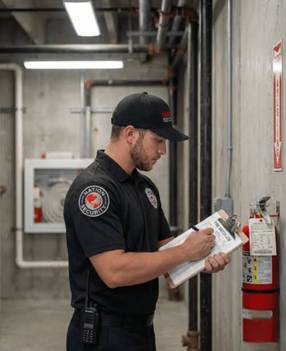
NFPA fire watching is not just someone standing in a hall. Guards from The Fast Fire Watch Company provide GPS-verified images of their patrol rounds, and this is something that the fire marshal or insurance company cannot just assume to be true.
- Route and interval logged automatically, not written from memory afterward
- Timestamped photos at each checkpoint
- A compliance packet delivered at the end of the engagement
That last piece is worth dwelling on. According to OSHA’s fire watch guidance, the burden of proof in a citation dispute sits with the employer — a verbal assurance that patrols happened carries far less weight than a dated log.
4. Bridging the Response Time Gap
A lot of NFPA violations happen not because a property refuses to comply, but because compliance takes hours to arrange while the fire marshal’s deadline is measured in days. Fast Fire Watch Guards reach most sites in under three hours nationwide, which keeps a building operating instead of sitting under a stop-work order while a guard gets sourced.
That speed matters more than ever. OSHA’s penalty structure imposes severe maximum fines—reaching up to $16,550 for a single serious violation and $165,514 for willful or repeated violations—hence the expense of a non-covered period for impairment didn’t go down at all.
5. Coordination with the Local Fire Marshal
Every jurisdiction interprets NFPA fire watch guard requirements slightly differently, and the AHJ has final say on what satisfies the code locally. Guards get briefed on the specific Local Fire Department’s documentation expectations before their first round, not after a failed inspection flags the gap.
6. Covering the Standards Overlap Correctly
Construction sites frequently trigger NFPA 241, NFPA 51B, and OSHA’s 29 CFR 1926.352 simultaneously. When standards overlap, the more stringent requirement applies — and getting that wrong is a common, avoidable way properties end up cited twice for one gap in coverage.
Fire Watch Compliance FAQs
How long does a fire watch have to stay after hot work ends?
At minimum one hour under NFPA 51B and NFPA 241, extending to two hours for torch-applied roofing and up to three additional hours at the Permit Authorizing Individual’s discretion.
Can a building keep operating during a sprinkler impairment?
Yes, assuming that a compliant fire watch monitor remains stationed within the affected system continuously until the system is either fixed or the order is rescinded by the AHJ.
Who decides if a fire watch log is acceptable?
The Authority Having Jurisdiction (AHJ), usually the fire marshal’s office, although insurance auditors are likely to look at the same information independently.
Is NFPA 241 applicable for renovations?
It applies to construction, alteration, and demolition alike — a gut renovation carries the same fire watch triggers as a ground-up build.
What happens if a fire watch guard isn’t properly certified?
The watch may not satisfy the AHJ’s requirement at all, exposing the property to citations even though a guard was physically on site.
Compliance isn’t really about memorizing which NFPA section applies to which scenario. It’s about having a system that produces the right proof, at the right time, without you having to think about it during an emergency. That’s the part most properties get wrong, and the part worth fixing before the fire marshal’s next visit — not during it.