
In-house agencies have become an important part of enterprise marketing. They help organizations produce campaigns, creative assets, videos, presentations, digital content, brand materials, and sales enablement resources without outsourcing every project to an external provider.
Because internal agencies work inside the business, they often have a stronger understanding of the company’s brand, products, customers, internal processes, and strategic priorities. They can collaborate closely with stakeholders and respond more quickly when business requirements change.
However, bringing creative services in-house does not automatically make them efficient.
Internal agencies often serve many departments, regions, brands, and business units. Requests arrive from product marketing, sales, corporate communications, human resources, regional teams, and senior leadership. Each stakeholder has different priorities, deadlines, and expectations.
As demand grows, the agency must manage more projects without losing control of quality, costs, capacity, approvals, or delivery timelines.
Without a structured operating model, project managers spend too much time chasing updates and resolving conflicts. Creative teams receive incomplete briefs, work through unnecessary revisions, and struggle with shifting priorities. Leaders lack reliable information about workload, costs, productivity, and business impact.
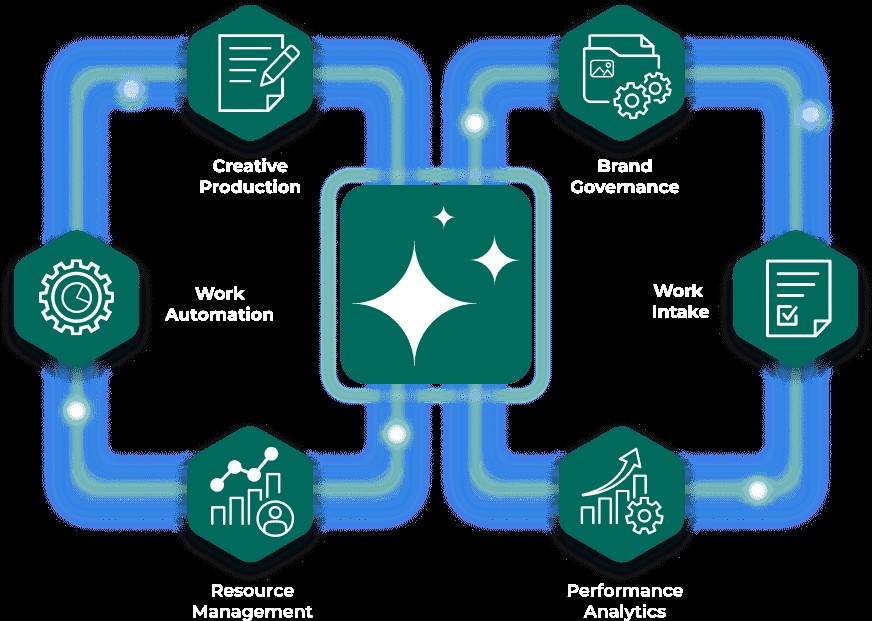
A scalable in-house agency needs connected processes for project intake, prioritization, workflow management, collaboration, resource planning, approvals, digital assets, financial control, and reporting.
The objective is not simply to complete more tasks. It is to help the agency focus on valuable work, deliver it efficiently, and support increasing revenue and income through faster, better-coordinated marketing execution.
Why Managing an In-House Agency Becomes Difficult
An internal agency may operate inside one organization, but it still serves many clients.
A product team may need a launch campaign. A sales department may request presentations, proposals, and customer materials. Regional marketers may require localized versions of global assets. Human resources may need recruitment content, while corporate communications may request executive materials with short deadlines.
Each request competes for the same creative and operational resources.
Unlike an external agency, an internal team may find it difficult to reject work. Stakeholders may assume that internal resources are always available, even when the agency is already managing a full workload.
This creates a constant conflict between demand and capacity.
Complexity also increases when the agency relies on disconnected tools.
Requests may arrive through email, chat messages, spreadsheets, meetings, or informal conversations. Tasks may be tracked in one system, creative assets stored in another, and budgets maintained in separate spreadsheets.
Feedback may be spread across document comments, email threads, meetings, and annotated files.
Employees must reconstruct project context manually.
Managers cannot easily see the full pipeline of work. Requesters do not know when their projects will begin. Executives lack reliable information about costs, capacity, utilization, and delivery performance.
These problems become more serious as the agency expands across regions, brands, and service areas.
The Operational Cost of Fragmented Work
Many internal agency inefficiencies seem minor when viewed separately.
A project manager sends a reminder to a reviewer.
A designer asks which brief is current.
A stakeholder requests a status update.
A regional marketer waits for localization approval.
A finance partner asks for revised cost information.
Each activity may take only a few minutes. Across hundreds of projects, however, the total administrative burden becomes significant.
Fragmented processes reduce the amount of time available for strategic, creative, and customer-focused work.
They also create inconsistent outcomes because successful delivery depends heavily on individual follow-up.
A missed reminder can delay an approval.
An outdated file can create another revision cycle.
An incomplete spreadsheet can lead to poor resource decisions.
A project submitted outside the standard process may interrupt higher-priority work.
These inefficiencies rarely appear as one clear cost in financial reports. Instead, they appear through slower delivery, increased labor costs, employee frustration, duplicated work, and missed deadlines.
Commercial performance may also be affected.
When campaigns, launch materials, and sales content are delivered late, the business may miss opportunities to reach buyers, support active deals, or respond to market changes.
Improving agency operations can therefore create both operational and financial value.
Standardizing Project Requests
Many project problems begin before production starts.
Requests often arrive without clear objectives, complete briefs, realistic timelines, defined budgets, or confirmed approval requirements. A stakeholder may ask for a campaign, video, presentation, or design asset without explaining the intended audience or desired business outcome.
The agency may begin work based on assumptions.
This usually creates avoidable revisions later.
Creative teams may produce work that does not meet expectations because those expectations were never documented. Legal, compliance, or brand requirements may appear after production has started. Deliverables may expand without changes to the deadline or resource plan.
A standardized intake process ensures that each request contains enough information for evaluation.
This may include the business objective, audience, required deliverables, channels, budget, desired deadline, regional needs, approval stakeholders, and strategic priority.
A clear intake process creates a reliable starting point for scoping and planning.
It also improves accountability.
Requesters understand what information they must provide, while the agency has a documented basis for its timing, cost, and priority decisions.
Standardization does not mean that every project must follow the same workflow.
A major global campaign should not be managed like a small update to an approved asset. The purpose of intake is to gather enough information to select the right process and make a realistic commitment.
Prioritizing Work Based on Business Value
Most in-house agencies receive more requests than they can complete immediately.
Demand management is therefore one of the most important parts of the operating model.
The agency needs a clear way to evaluate work according to strategic importance, customer impact, commercial value, urgency, complexity, risk, and available capacity.
Without a transparent system, projects may be prioritized according to influence rather than business value.
Senior stakeholders may push urgent requests forward while less visible but commercially important projects remain delayed.
Urgency must also be assessed carefully.
A request may have a short deadline because the stakeholder submitted it late. Treating every late request as the highest priority encourages poor planning and disrupts work that has already been approved.
True urgency may involve a regulatory change, a major customer opportunity, or an unexpected business event.
A transparent prioritization model helps leaders distinguish between these situations.
It also allows the agency to explain why a project must be rescheduled, reduced in scope, or assigned externally.
Requesters may not always agree with the decision, but they are more likely to accept it when the process is clear and based on consistent criteria.
Creating Repeatable Creative Workflows
Creative work requires flexibility, but flexibility does not mean every project needs a completely different process.
Most internal agency projects follow recognizable stages.
A request is submitted, evaluated, prioritized, scoped, assigned, produced, reviewed, approved, delivered, and archived.
The specific tasks vary by project type, but the broader lifecycle is often similar.
Repeatable workflows provide structure around these stages.
Project managers know when a request is ready for production. Creative employees understand what information is available. Reviewers know when their input is required, and requesters can follow progress without asking for repeated updates.
Workflow templates make this approach easier to scale.
The agency may create separate templates for campaign development, video production, presentations, social content, localization, sales enablement, and brand review.
Each template can include standard tasks, dependencies, responsibilities, estimated timelines, required information, and approval stages.
This reduces project setup time and creates more predictable delivery.
It also improves operational reporting.
When similar projects follow similar processes, managers can compare performance and identify recurring bottlenecks. They may discover that briefs are frequently incomplete, legal review begins too late, or a production stage regularly takes longer than expected.
The agency can then improve the process using evidence rather than assumptions.
Centralizing In-House Agency Operations
Managing projects, resources, briefs, feedback, approvals, budgets, and assets through separate tools creates unnecessary friction.
Employees move between applications to locate information. Project records become inconsistent. Comments are separated from creative files, and leadership reports require manual consolidation.
A connected environment provides a clearer operational view.
When evaluating solutions, many organizations choose an enterprise platform such as Screendragon’s in-house agency solution to centralize demand, projects, workflows, resources, collaboration, approvals, financial information, and reporting.
Centralization does not mean that every user should see every detail.
Requesters may need access to project status, delivery dates, and final assets. Creative teams need briefs, tasks, files, and feedback. Managers need information about workloads, risks, and capacity. Executives need a higher-level view of costs, output, efficiency, and business impact.
A shared environment can provide each group with an appropriate view while keeping the underlying information connected.
This reduces manual status reporting and preserves project knowledge.
It also gives the agency a more reliable source of data for planning, performance management, and continuous improvement.
Improving Collaboration With Internal Clients
The relationship between an in-house agency and its internal clients can become difficult when expectations are unclear.
Requesters may view the agency as an unlimited production resource. Creative teams may feel that stakeholders submit weak briefs, unrealistic deadlines, or excessive revision requests.
Both sides may believe the other is responsible for delays.
Better collaboration starts with clear responsibilities.
Requesters should understand what information they need to provide, when their feedback is required, and how scope changes affect timing or cost.
The agency should provide realistic delivery dates, transparent status information, and clear explanations when priorities change.
Centralized project discussions also preserve context.
Instead of feedback being spread across meetings, email threads, chat messages, and annotated documents, comments remain connected to the relevant project or asset.
Team members can see what was requested, what changed, and why a decision was made.
This is especially important when multiple stakeholders review the same work.
Without a shared process, one person may approve an asset while another requests major changes. The creative team then receives conflicting direction and may need to repeat completed work.
A structured review process helps consolidate feedback and clarifies who has final decision authority.
Reducing Review and Approval Delays
Approvals are among the most common causes of delay in creative operations.
Marketing materials may require review from the requester, brand managers, legal teams, product specialists, compliance departments, regional leaders, and executives.
When approvals happen through email, the process becomes difficult to control.
Reviewers may comment on different versions. Feedback may be duplicated or contradictory. The agency may not know whether silence means approval or whether the project is still waiting for attention.
A structured approval workflow defines who must review the work, in what order, and by what deadline.
Some approvals can take place in parallel. Others must happen sequentially because one decision affects the next stage.
The workflow should reflect the level of risk.
A minor update to an approved template may require a simple review. A public campaign containing regulated claims may require a more detailed process.
Automated reminders and escalation rules reduce the need for project managers to chase reviewers manually.
Version history also provides accountability.
The organization can see which asset was reviewed, what comments were submitted, who approved it, and when the decision occurred.
This supports faster delivery while strengthening governance and compliance.
Improving Resource Visibility
People are usually the in-house agency’s most important and limited resource.
Managers need to know who is available, what skills each person has, how much work is already assigned, and where future demand may exceed capacity.
Without this visibility, assignments are often based on incomplete information.
The same reliable employees may receive too many urgent projects. Specialist roles such as motion designers, video editors, or copywriters may become bottlenecks. Other team members may remain underused because their availability or capabilities are not visible.
Resource planning connects project demand with actual capacity.
Managers can view active assignments, planned projects, expected effort, deadlines, and utilization across the team.
They can identify resource conflicts before delivery dates are affected.
This information also improves conversations with stakeholders.
Instead of simply saying that the agency is busy, leaders can explain which skills are constrained, what work is already committed, and when capacity is likely to become available.
Longer-term forecasting becomes more reliable as well.
Agency leaders can determine whether future demand requires hiring, training, freelancers, external agencies, process improvements, or changes in priority.
Resource visibility should support employee wellbeing as well as productivity.
Creative teams cannot operate at maximum utilization indefinitely. Strong work requires time for research, thinking, collaboration, quality control, and professional development.
Controlling Scope Changes and Revisions
Creative projects often change after production begins.
New stakeholders may join the review process. Messaging may shift. Deliverables may expand, or a project initially described as a simple update may become a larger campaign.
Some change is unavoidable.
The problem occurs when scope grows without adjustments to the deadline, budget, or resource plan.
A structured change process allows the agency to evaluate the impact before accepting new requirements.
The project manager can document what changed, why it changed, what additional work is required, and how the change will affect delivery.
This creates accountability without removing necessary flexibility.
Revision data also provides useful operational insight.
If certain project types repeatedly require more revision cycles than expected, the agency can investigate the cause.
The problem may be weak intake, unclear decision authority, too many reviewers, poor alignment at the start, or changing stakeholder expectations.
Reducing avoidable revisions improves productivity and protects creative capacity.
It also creates a more predictable experience for internal clients.
Understanding Internal Agency Costs
Even when an in-house agency does not charge departments directly, it still needs visibility into the cost of its work.
Leadership may want to compare internal production with external alternatives. Agency managers need to understand budgets, vendor expenses, freelance costs, and the amount of employee effort required for different services.
Without reliable financial information, demonstrating value becomes difficult.
The agency may appear expensive because leadership sees total headcount costs without understanding project volume, external savings, speed improvements, or strategic impact.
Time and cost data provide a more complete view.
Managers can compare estimated and actual effort, identify projects with excessive revisions, and understand which services consume the most resources.
This does not mean that every creative decision should be based on cost alone.
Some strategically important projects require greater investment because they support major business goals. Financial visibility should improve decision-making rather than encourage the cheapest possible output.
Cost information can also support sourcing decisions.
The agency may determine that certain high-volume capabilities are more effective internally, while specialist or temporary needs are better handled by external partners.
Connecting Digital Assets to Agency Workflows
In-house agencies create large volumes of digital content.
These assets may include videos, images, presentations, campaign templates, product materials, event collateral, brand resources, and sales content.
If final assets remain inside project folders or personal drives, the wider organization may struggle to find and reuse them.
Teams may request new work even when suitable content already exists.
They may also use outdated, unapproved, expired, or incorrectly licensed assets.
Connecting project workflows with digital asset management helps prevent these problems.
Once an asset is approved, it can move into a controlled library with the correct metadata, ownership, permissions, usage rights, and expiration date.
Employees can search for approved content before submitting a new request.
This reduces duplicate production and allows the agency to focus on projects that genuinely require new creative work.
Asset usage information can also guide future investment.
Agency leaders can see which materials are reused, which formats provide the greatest value, and where content gaps remain.
Effective digital asset management extends the value of previous creative investment while strengthening brand governance.
Using Automation to Reduce Administrative Work
Project managers and creative employees often spend significant time on repetitive coordination.
They assign tasks, send reminders, update project statuses, move work between stages, prepare reports, and follow up on missing information.
These activities are necessary, but many do not require human judgment.
Workflow automation can handle them consistently.
Tasks can be assigned when a request is approved. Reviewers can be notified when files are ready. Overdue approvals can be escalated, and completed assets can be transferred into the correct library.
Automation reduces dependence on individual follow-up.
It also creates a more predictable experience for requesters and employees.
Artificial intelligence can support less structured work.
It may summarize a brief, classify a request, identify missing details, consolidate feedback, or flag a project that appears likely to miss its deadline.
The strongest use cases typically begin with frequent, low-risk activities.
More advanced automation can be introduced after the agency has established clear workflows, reliable data, suitable governance, and user trust.
The objective is not to remove people from creative operations. It is to reduce administration so they can focus on strategy, collaboration, creative quality, and business impact.
Turning Operational Data Into Useful Reporting
In-house agencies generate substantial amounts of operational information.
This may include request volume, project duration, approval time, revision levels, resource utilization, costs, stakeholder satisfaction, and asset reuse.
Raw data does not automatically demonstrate value.
Leaders need reporting that explains what the agency delivers, how efficiently it operates, and where improvement is required.
Different audiences need different levels of detail.
Project managers require information about deadlines, workloads, and bottlenecks. Agency leaders need insight into demand, capacity, service performance, and costs. Executives need a concise view of strategic alignment and business impact.
Reporting should go beyond counting completed projects.
A high project volume may look positive, but it could consist mainly of low-value production work. A lower volume may reflect larger, more complex campaigns with greater commercial importance.
Measures should therefore consider quality, speed, efficiency, cost, strategic value, and stakeholder outcomes.
Reliable reporting also helps identify recurring operational issues.
If projects regularly exceed estimates, the cause may be poor intake, uncontrolled scope, excessive revisions, limited capacity, or unrealistic planning assumptions.
Agency leaders can improve the operating model using this evidence.
Establishing Governance Without Slowing Delivery
Governance protects brand consistency, financial control, compliance, and accountability.
However, governance should not create the same process for every project.
Low-risk work should not require the same level of review as a regulated campaign or major product launch.
A practical model applies controls according to project value, content type, region, and risk.
This allows routine work to move quickly while ensuring that sensitive projects receive appropriate oversight.
Permissions are also important.
External freelancers may need access to specific files without seeing confidential internal information. Regional teams may need approved assets without being able to modify master versions.
Clear access controls support collaboration while reducing unnecessary risk.
Audit trails provide additional accountability.
The organization can see who submitted a request, who changed the scope, who reviewed the work, and who approved the final version.
Effective governance creates clarity rather than bureaucracy.
When people understand the process and their responsibilities, work can move faster with fewer disputes.
Scaling the In-House Agency Model
An agency that depends on individual knowledge and manual coordination becomes harder to manage as demand grows.
Scalability requires standardized intake, repeatable workflows, connected information, resource visibility, automation, and reliable reporting.
It also requires a clear service model.
Stakeholders should understand what services the agency offers, how requests are evaluated, how long different types of projects usually take, and what responsibilities remain with the requester.
Service-level expectations improve planning and reduce conflict.
They should be based on real delivery data and available capacity rather than arbitrary promises.
Reusable templates also support scale.
The agency can standardize briefs, project plans, approval routes, reports, and asset metadata while preserving flexibility for different markets and campaign types.
Scaling does not mean accepting unlimited demand.
It means creating an operating model that can support growing business requirements without creating the same increase in administrative effort.
In some cases, the agency may need to reduce low-value work, provide self-service templates, or assign specialist projects to approved external partners.
Reliable operational data helps leaders make these decisions.
Measuring Business Impact
The value of an in-house agency should be measured through both operational and commercial outcomes.
Operational measures may include shorter delivery cycles, faster approvals, lower revision rates, improved resource utilization, reduced external costs, and greater asset reuse.
Commercial impact may include faster campaign launches, stronger sales support, improved customer experiences, and closer alignment with strategic priorities.
These improvements can contribute to increasing revenue and income.
A campaign that launches sooner can begin generating demand earlier. Sales materials delivered on time can support active opportunities. Reusing approved assets can reduce production costs while maintaining quality.
Some benefits are less direct.
Internal teams may possess deeper organizational knowledge, stronger stakeholder relationships, and a better understanding of brand standards than external providers.
Employee experience matters as well.
A well-managed agency gives creative professionals clearer priorities, stronger briefs, realistic workloads, and fewer administrative distractions. This can improve retention, quality, and long-term capability.
A balanced measurement framework should therefore consider efficiency, quality, cost, stakeholder satisfaction, employee experience, and commercial impact.
Building a Stronger Internal Agency Operating Model
In-house agencies can create substantial value by combining creative expertise with deep organizational knowledge. However, that value depends on the operating model supporting the team.
Manual intake, disconnected systems, poor resource visibility, unclear approvals, and limited reporting make consistent delivery difficult at enterprise scale.
A stronger model connects demand, projects, people, budgets, assets, decisions, and performance information.
Standardized intake improves planning. Repeatable workflows reduce uncertainty. Shared collaboration preserves project context. Resource management supports realistic commitments, while automation reduces repetitive administration.
Structured approvals and governance protect quality without creating unnecessary delays. Reporting gives agency leaders the evidence required to improve operations and demonstrate value.
The objective is not simply to produce more creative work.
It is to help the agency focus on strategically important projects, deliver them efficiently, and create measurable value for the wider organization.
When these capabilities work together, an in-house agency can improve operational efficiency, strengthen collaboration, scale its services, and support long-term business success without allowing complexity to grow unchecked.